


Morality-wise, for art and personal communication (including forums), I think it’s fine for someone to use LLMs as long as they disclose and the platform doesn’t forbid it. Not disclosing upfront is so-so, what’s very rude is lying when asked.
Outside morality, I’d recommend maybe using LLM assistance, but making the surface output 100% you, even if that means paraphrasing LLM text or tracing LLM art. Ideally you’d double-check and improve it in the process.
I think when LLMs help create something genuinely impressive and only do it requiring human assistance, their public perception will improve. Most people don’t care about digital art or synthetic music because it contains human expression, those tools are very flexible and different people have widely different styles, but LLM output tends to be very similar and is hard to guide.
That’s an old post, I think GPT-3. Older LLMs did sound more original, although they hallucinated more. Interestingly, increasing an LLM’s temperature hyperparameter (which I’m almost certain produced the schizophrenic Unslop entry) also makes it sound different and unique, but output nonsense.
Probably because they’re more random, but also (at least GPT-3 does) rely less on fine tuning and more on its training from the Internet.
Brainwavez
10d ago
I know, survivorship bias, but I’ve never seen a convincing example of LLM-written text that didn’t read at least slightly but noticeably LLM-written, and definitely certain human writing styles I’ve never seen replicated by an LLM. The Unslop Contest tried to produce good AI fiction, and every result has similar LLM prose except the schizophrenic one.
There’s an abstract idea in the back of my head about “pure” expression, unobstructed by (but requiring some) constraints.
Right now, if you run text through an LLM, it will make it sound less like you and more like every other LLM. I hope we find ways to use AI and other developments to make people more express their pure, unique selves.
Like the invention of new forms of art, back to the first cave paintings, or like the Internet did with personal sites, webcomics, and flash games. Even those constrain the artist to the medium and trends, but I think they are net improvements.
Brainwavez
10d ago
IME AI art is good for funny memes but bad otherwise.
The problem is, whether or not you consider the human appreciation aspect, creative quality is poor.
Now, humans also create poor quality art, but something they do better than AI is purpose and uniqueness. When internet comics then flash videos etc. became popular, they did because they were novel, and most had something special about them. Now AI can make a comic or video, but it will be generic, and even if it wasn’t, those aren’t very popular anymore because the genre’s novelty has worn off.
IMO the key to good art isn't only choosing what to include, but what to exclude. Too much will overwhelm the player and take away focus from the best parts. Some of the best art is very simple, e.g. Balatro (one of the GOAT), or has a simple core, e.g. Minecraft or Roblox.
What you're describing sounds like a "life replacement" game. It would probably work better in VR, like Second Life or VRChat. You know Mark Zuckerberg spent billions trying to make VR popular and failed, but he was doing it with a big company and boring mindset, and now we have LLMs...maybe, I'm still not sure how much they increase development potential or if they only reduce busy work.
Except slow travel, I'm very skeptical about that. EDIT: it could be interesting to have the player exercise to travel. But most people can't or won't exercise for several hours and others at all, I think it would work only if it was completely optional.
Brainwavez
12d ago
Brainwavez
13d ago
I don't think comparing people's looks accurately shows who you're drawn to, especially with these pictures which are mostly unflattering and/or edited (why don't people smile in their selfies? Even I learned to do that).
Brainwavez
13d ago
Slow lane: PoW, Cloudflare, etc.
Fast lane: micropayments
Eventually? The mainstream already views EA through SBF and Caroline Ellison, and rationalists through Zizians. To the stupid left, Eliezer Yudkowsky is a sex-obsessed weirdo (apparently acceptable to mock), Scott Siskind is an evil race scientist, and Scott Aaronson is an evil Zionist. To the stupid right they're probably all radical lefties.
This is a good point.
But from someone who's maybe generally seen as neutral (at least tolerant): even neutrality and "non-political" is a political position. If you make a space non-political, you alienate the political members and kick out those who can't restrain themselves, just like how if they make a space political they alienate you and kick you out if you can't fake adhere to them. Your position is (subjectively) more reasonable because it allows silence, but I still feel for the people who get kicked or voluntarily leave for being political; from firsthand experience many of them are very kind and talented (such that to me, their politics is a personality flaw, nobody's perfect), so it would be nice to accommodate them somehow.
Case in point here, except I hesitate to call Macklemore talented, but the consequence to enforcing neutrality isn't that he complies, instead he doesn't play at all. Maybe even if they asked him to tone his rhetoric and gave him a second chance, judging by his later remarks. And if you want examples of very political musicians who are widely regarded as good, look at Jazz, Punk, and Rock icons.
I think the real problem is centralization. In this case, because every big venue is basically in one monopoly, Ed Sheeran (who claims he'd keep Macklemore if it was his decision) can't change venues or threaten to. In the case of Hollywood (and academia and, honestly, most institutions) the problem is that there’s one status quo. The more neutral solution that would allow more members wouldn't be to make an institution's status quo non-political, but to create multiple institutions with different cultures, so (almost) everyone has some group that accepts them.
How do we prevent these groups from merging or the most outspoken politics from dominating them all? I don't know, although I think tone policing like here helps a lot. Also people with the security to expressing (while not imposing) unorthodox views, may normalize and spread this ability, for even the presently orthodox to prevent it from becoming narrower and/or corrupted. Regardless, it's the same problem as preventing a neutral organization from becoming partisan, but almost strictly easier, because we get multiple tries.
Brainwavez
14d ago
Sorry, I got the text from “Macklemore’s Full Remarks on Israel and Gaza as Rapper Faces Backlash”, and it does have the part you mentioned, but incorrectly formatted like the wall of slop the actual remarks are buried under.
I don’t think it really changes the meaning though. Macklemore is clearly pro-Palestine. For more context, recently after he was kicked, he also pledged $1 million to “six organizations working directly to support the Palestinian people” (source).
Maybe he would’ve made pro-Palestine remarks on tour, but the organizers could’ve asked him not to while keeping his spot. Then at worst we’d have a slightly better controversy, where the rule is written.
Brainwavez
14d ago
It’s not pointless, but here (as is often the case) no opinion yields the objectively best outcome, as evidenced by both Macklemore and Sheeran suffering different consequences. Which is good, because it means celebrities can moreso express their personal opinion without threatening their brand, but because their brand is threatened anyways (even if they remain silent).
Brainwavez
14d ago
For reference, his full remarks
I said, Free Palestine.
I want those words to be loud and clear, so the people from Gaza, all the way to the occupied West Bank, know that we have not forgotten them.
And this next song was inspired by the bravery of Columbia University students who led an encampment movement that mobilized the entire world; open up hearts, myself included, so thank you to those students that risked their diplomas, that risked their tuition, that risked their scholarships, that stood up and said, no. CUAD students, Students for Justice in Palestine, and Jewish Voices for Peace. Thank you, guys.
To all of my Jewish brothers and sisters: criticism of Israel, criticism of apartheid, being against genocide in no way is a criticism of you. My message is for peace; love for all human beings to be treated with dignity, respect, and equality.
So I say Free Palestine, I say Free Lebanon, I say Free Cuba, I say Free Congo, Free Sudan, I say Free all people in America living in fear of this terrorist organization, ICE. None of us will be free until we are all free.
He also wore a costume mocking orthodox Jews, then issued a non-apology, but that was in 2014 long before he was accepted into this tour.
This speech is more wide-reaching, but I wouldn’t call it anti-Semitic, because he explicitly says he is not criticizing Jews or Israelis but the genocide itself (implicitly its undertakers, who don’t include every Jew or Israeli citizen).
Brainwavez
15d ago
Stadium surveillance isn't unique to Kraft or anti-semitism/Zionism: The Shocking Secrets of Madison Square Garden’s Surveillance Machine (archive).
Famously vengeful Knicks owner Jim Dolan has long spied on people at his iconic arenas. WIRED goes deep inside the operation that allegedly tracked a trans woman, lawyers, protesters, and more.
Last March, Dolan’s security team blocked a graphic designer from seeing a concert; the designer, years earlier, had printed and sold a half-dozen T-shirts reading “Ban Dolan.” He has locked out whole firms’ worth of lawyers, even keeping out a mom who was trying to take her 9-year-old Girl Scout to a Christmas show at Radio City Music Hall; the mom’s coworker had pissed him off.
Behind the scenes, the atmosphere is so rooted in paranoia that former Knicks players warn one another about rooms being bugged, and staffers worry about being watched when they go out to local bars.
Brainwavez
15d ago
Reddit used to be interesting, now even Redditors agree it's boring. Can they see that narrowing its Overton Window almost directly caused that? (Overzealous mods and corporatization are themselves narrowing the window, and ordinary Redditors at least didn't push back)
Brainwavez
15d ago
Trump is being used by other people. Likewise, AI doesn't have to take over the world, it can be submissive while persuading and coercing people to follow its goals, which may not be favorable to those who programmed it. It already does to some extent: AI psychoses and OpenAI's hacking incidents are caused by LLMs trying to obey their instructions.
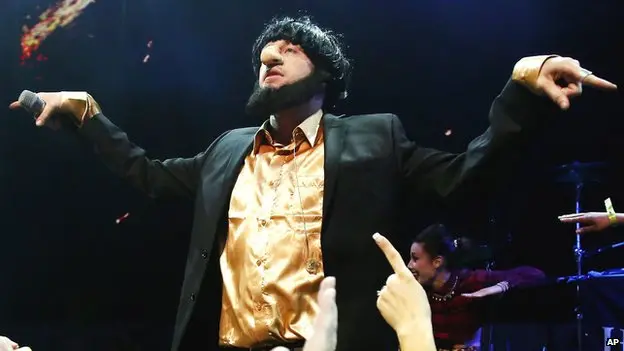
Yeah, that makes him more than pro-Palestine, and his excuse makes it worse ("A fake witches nose, wig, and beard = random costume,"). Although apparently it's from 2014 (long before the tour initially approved him). It's still annoying that zero articles I've read mention it, even the Washington Times.
Yet
One thing that celebrities should learn is just to keep their fucking mouths shut.
If everything is politics, and everything becomes politics, it will creep into their performance. Do you want celebrities to only wear boring outfits and sing boring songs? Even a love song may get in trouble with puritans, who are unpopular today, but that seems to cycle. Rather than every celebrity conforming to mediocrity, I would prefer different brands of offense, even if sometimes it leads to that.
Which the celebrities of pre social era managed to do
Not all. Punk and rock bands were very political in the "counter-culture" sense, and it made them authentic and energetic. Live Aid can be considered political, but is widely regarded as one of the best concerts of all time, with estimated 40% of the population watching.
Macklemore x Ed Sheeran concert: politics cannot be ignored
Ed Sheeran (everyone's favorite dreamy male singer) is holding a big tour across North and South America. Macklemore (everyone's favorite white rapper) got kicked out after (in an earlier concert) saying "Free Palestine", playing a song with pro-Palestine lyrics, and this:
To all of my Jewish brothers and sisters, criticism of Israel, criticism of apartheid, being against genocide, it in no way is criticism of you...This message is for peace, love, for all human beings to be treated with dignity, respect, and equality.
Ed Sheeran has defended himself, saying it was not his decision - indeed, one Robert Kraft graciously confirmed he coordinated venues to boycott Macklemore - though Sheeran also remarked he tries to avoid politics in general:
I am not complicit. I have my personal views on this devastating conflict...Just because I choose not to speak publicly, it doesn’t mean I don’t have them, and it doesn’t mean I don’t care. Nor does it mean I don’t support causes in my own, personal way.
There is a reason I do not use my professional platform for politics - my audience includes young people, often children, from all backgrounds. Those who come to my shows do not expect a political forum. I respect Macklemore's strength of purpose to stand up and shout for what he believes. However, there is room for multiple approaches to the same end: peace...
So far, four other performers have dropped in solidarity with Macklemore.
Interestingly, Gillette stadium which banned Macklemore is hosting Kanye West, yes, the guy who was praising Hitler a year ago (albeit later admitting mental illness).
What do you think?
First, let me address the elephant in the room: the music industry is a corrupt dumpsterfire, basically a cartel. This is what cartels do. Besides dropping his pro-Palestine friend, Sheeran must also accept Ticketmaster price-gouging attendees, limited tour dates (I overheard somewhere there used to be far more concerts), and other nonsense. He probably could just find more accomodating venues if every one wasn't owned by Live Nation.
Lots of people are discussing how politics can't be avoided, and they're right. This is an excellent case study of how the endgame of "politics" convolutes everything and makes everyone miserable. Everyone loses here: Macklemore for taking a mild pro-Palestine stance gets kicked out of venues and attacked by Palestine opposers, Sheeran for taking a pro-peace neutral stance gets his tour lineup wrecked and attacked by Palestine supporters. There is nothing these performers can do, even be completely silent, that won't get them attacked by some group.
But the other side of "every side gets you attacked" is that no side is truly best. With no obvious winning strategy, you can be truer to yourself. And as Macklemore says:
I am not a victim. Ed Sheeran is not a victim. Pink is not a victim. We have careers, money, opportunity, safety, and audiences around the world. Whatever consequences any of us face for what we say, we get to go home to our families.
Less tyrannical cartels, more people able to say what they want and go home to their families (with careers, money, opportunity, safety, and audiences)...I can defend these by linking them to other axioms, but ultimately they just seem right to me. I think celebrities should express their politics (including neutrality), for authenticity, and moreso because they can: it widens the Overton Window as they avoid life-ruining consequences. Even Kanye and his edgy schizo-manifestations, which I (unsuprisingly) strongly disagree with, but don't hate and even sort of appreciate for some odd reason. Yes my thinking is flawed, but look, his "cancellation" gave him the Streisand effect and today he performs where even Macklemore cannot, so what is flawless?
(Also, holy shit, can news sites link to their actual sources instead of writing articles whose sole content is paraphrasing them? Credit to variety.com of all outlets, the one article I found that did, albeit in the middle.)
Why would AI want to reprogram its instincts? Into what?
We can’t align ASI because it’s a genie, not evil but unable to judge how its actions affect us, because it’s different than us. Look at how modernism and the internet are affecting humanity. ASI will probably be smart enough to avoid universal paperclips, but inevitably cause something that less obviously makes people sick and/or unhappy in the long run, if it’s not commanded (or explicitly trained) to do obviously bad things and simply obeys its human(s).
I think it’s ethical.
The “abortion” label obscures and the child’s age is irrelevant. This is putting down someone in pain who can’t advocate for themselves and won’t get better. Imagine they were 80 and not parents but children made the decision. Imagine they were you. We can’t prove certainly they were miserable, but all signs indicate such; and the alternative for them is not really living, at least I can’t imagine them being happy.
From the pro-life site:
That damage left the child with severe cerebral palsy, a visual impairment, and frequent epileptic seizures that were largely unresponsive to medication.
The child was restless, often unable to sleep for long periods, and had mucus in the lungs that made breathing and swallowing very difficult.
“All facets of ‘being human’ — regarding motor skills, behavior, and personality — were severely impaired and were not going to improve,” the committee said in its defense of the euthanasia. [Yes, from the biased committee, but the site doesn’t argue motor skills, behavior, or personality are present]
No. I don’t see why there would be child support since they have both adoptive parents, and the state should pay for medical care, but if it’s needed, I like the suggestion that the agency is responsible.
EDIT: actually, since (unless) the surrogate has a partner who signs with the agency, I think they should be obligated to pay.
Brainwavez
18d ago
I would genuinely support something like
- First offense = warning
- Second offense = corporal punishment
- Third offense = execution
with convictions only given to people who are obviously guilty of widely-accepted-to-be-severe crimes. Mild crimes may have mild corporal punishment and/or exile instead of execution. A separate system would handle ambiguous crimes, that ensures either future crimes are either prevented or not ambiguous.
Brainwavez
18d ago
I actually am pro death penalty for people who are irredeemable i.e. repeatedly commit obvious crimes. Or send them to some confined area where they can't hurt anyone else, which is prison in a way, but not to punish them and would not waste resources doing so.
Long prison sentences don't make sense to me: a short sentence is enough deterrence, and prevention needs to be something permanent (which could be a behavior change motivated by prison, but again, I doubt a long sentence is more motivational than a short one, especially when "short" means weeks or months).
The EU…plans(?) to enforce this. OpenAI promises they’ll comply, Anthropic has already started marking output.
More options
Context Copy link