

RandomRanger
Just build nuclear plants!
No bio...
User ID: 317
RandomRanger
Just build nuclear plants!
3yr ago
Entertainment? So they're integral to directing and writing the biggest hits in cinema, writing the best selling novels, making computer games? The biggest twitch streamers and youtubers are black?
The places blacks do well are in highly centralized domains like music, acting or sports, not making any kind of sophisticated content.
RandomRanger
Just build nuclear plants!
3yr ago
No, this is not what his model suggests at all.
You're splitting hairs. There are three possible outcomes. Technological development and energy use keep going up and we become an interstellar civilization. They stagnate and we get stuck somewhere below where we are now. Or we are wiped out. He clearly dismisses 1 and 3. Therefore he agrees with 2. It's as simple as that.
France's electrical power system is currently about to be nationalised because it has taken on so much debt
So what? Companies take on excessive debt and are restructured from time to time. French electricity prices are low, France exports electricity every year on net. They undertook various manipulations of prices, forcing EDF to sell at artificially low prices to competitors or other countries, forcing them to buy at higher market prices, imposing price caps in 2022 to protect consumers...
EDF was profitable literally every year but 2022: https://www.statista.com/statistics/279640/consolidated-net-income-of-edf/
And yes, there was corrosion and power outages at reactors because they are old and need replacing (which France simply hasn't done because they too have been drinking the renewables cool aid). You crow at one year of unprofitability but sneer at 15 years of profits?
The most concise summation of Greer's position on nuclear I can find is the following paragraph, from the article "Too little, too late."
Right, we're agreed here, this is what he thinks. He does not provide even a single citation or anything at all to back up his point. This guy thinks he knows more about nuclear energy than the actual scientists who write papers about it (with statistics and everything) and doesn't deign to provide any evidence! He's clearly read none of the literature about the reverse learning by doing that plagues US nuclear energy. He doesn't understand the importance of interest rates, regulation, political risks in prices. Even then it's still profitable: https://www.bloomberg.com/news/articles/2017-07-14/why-nuclear-power-once-cash-cow-now-has-tin-cup-quicktake-q-a#xj4y7vzkg
This article alone torpedoes Greer's entire ideology, it explains how cheap gas has been outcompeting otherwise profitable nuclear energy, even in one of the most hostile environments for nuclear energy, the US. It also helps shed light on the complexities he doesn't understand, how there's a role for subsidizing long-term energy sources that temporarily aren't profitable for when gas prices rise.
Just step back and think about what Greer is saying. Nuclear power plants (all of them, in every country) are commercially unprofitable, not just at some times based on volatile oil prices, macroeconomic conditions or political interference but always and forever! Do you realize how insane this sounds? All these investors just line up to get zero returns? Of course nuclear power is, has and will be profitable, despite the best efforts of a very well organized sabotage campaign.
Take EROEI into account and demonstrate that the nuclear power plant can produce enough energy to be economically viable - and remember to take the various invisible subsidies petroleum supplies into account as well.
This is a meaningless and impossible demand. How am I supposed to know what the 'invisible subsidy' of petroleum is? Even Greer admitted that it just comes down to prices at the end of the day. The price of nuclear energy is low. That's why people spend billions building these plants and operating them. I have already linked papers that show that nuclear is as cheap as fossil fuels if the plants are built correctly at $2000, as in Korea.
You're accusing him of combining ignorance and arrogance while you look at a vanishingly small section of his work
He's a crank that projects his own ignorance on nuclear 'fanboys', making snide remarks about them and refuses to provide any factual substantiation at all for his claims. There's no need to look at his 'work', which is free from any basis in fact or scholarly convention.
RandomRanger
Just build nuclear plants!
3yr ago
This is emphatically not what he has said or predicted, apart from the "never going to space" part. The wavy line heading down is modern western industrial civilisation - eventually it will die and another civilisation will take its place, with its own birth, growth, peak and decline.
But if we're not heading to space, then we must be stuck with pre-industrial tech, right? Notwithstanding individual civilizations rising and falling, we'd be stuck at pre-industrial technology forever, in his model.
Nuclear power makes a lot of sense for some contexts (does a great job powering military submarines) but I have not seen a single example of nuclear power being used or able to support the kind of energy demands required of a modern industrial society.
If you're correct, why hasn't a single nation on Earth produced the kind of nuclear power grid you're talking about?
France? Their grid primarily runs off nuclear power. French electricity is quite cheap by European standards and remember that they export a fair bit, so their prices are pushed up: https://www.statista.com/statistics/263492/electricity-prices-in-selected-countries/
it was a long series of financial disasters suffered by utilities that got suckered into the nuclear hoopla
The financial disasters were manufactured by the US government that sabotaged nuclear industry, deliberately raising costs. After 1978, the US had plants redesigned while they were being constructed, introduced all kinds of regulatory nonsense, having workers strip out parts and replace them... South Korea has been producing cheap nuclear plants in the last decade. China is doing it. India is doing it. It's not hard, it's just that an increasing number of countries are allergic to doing these things correctly. Nuclear energy is like high speed rail. It is completely possible and perfectly practical if you do it right (France, Japan, China). It is very expensive if you do it wrong (UK, California). It's not 'a few years today' it's being done, it has been done 40 years ago by the French.
Take the Washington Power Company. Did it fail in the 1960s? The early 1970s? No, it failed in the early 1980s just after the US decided to start wrecking the nuclear industry. Greer doesn't explain why the cost of US nuclear power plants suddenly spikes after 1978, why construction times ballooned 5-10 years then specifically (and why this EROEI issue apparently doesn't apply to South Korea, China or India). The laws of physics apply across the entire universe. The woes of nuclear energy are based in human stupidity, not physics.
Yes, nuclear energy needs subsidies. But not for the reasons Greer would have us believe but because it's a big long-term investment that pays off slowly, over decades. Once the plant is built, it can run for fifty years or more at very low fuel costs and very high capacity factor. There's an obvious role for government in subsidizing long-term investments like education, sanitation and so on. Nuclear power is similar. Markets don't like investments that governments might regulate into oblivion or suddenly cancel midway through construction, either.
The reason I don't like Greer is because he doesn't provide a single shred of evidence to back up his arguments and prove causal links. I've spent 10 minutes looking for a more detailed analysis from him about nuclear power than a few unreferenced paragraphs. It isn't there. I've linked papers and statistics that actually discuss in a quantitative and rigorous way what the costs of nuclear energy actually are. Since we know they differ from plant to plant, country to country, we can discuss why this might be based upon reason and logic. Greer just tells a story that has no relation to reality. Compare Greer with this book review: https://rootsofprogress.org/devanney-on-the-nuclear-flop. There are numbers! Figures! Graphs! Actual analysis based upon data, as opposed to dogma. Greer is a good writer and is good at telling a story but that story is not true! He combines ignorance with arrogance in a very unattractive way.
RandomRanger
Just build nuclear plants!
3yr ago
Market forces might seek cheap foreign labour but market forces do not always dominate. Markets want no minimum wage, child labour, slave labour, drug legalization, total freedom to hire and fire, free trade, world peace, unlimited working hours, no unionization, no social welfare for the unemployed...
It's ideology and society that decides what is and isn't permissible, where sliders should be set regardless of economic advantage or disadvantage. The Italians could tell business leaders to grow up, they're not going to lower the minimum wage to zero and let employers give workers amphetamines, that's just not a serious proposal worthy of consideration... They could do the same with regard to immigration.
RandomRanger
Just build nuclear plants!
3yr ago
I did read that. But I think it's silly to go to huge such huge efforts to reduce risk in nuclear energy while we pump out enormous amounts of air pollution with coal. Tens of thousands die every year in the US alone, millions worldwide... and people are worried about potential risks from freak events? We should worry about large, real, experienced dangers rather than small, unreal, conjecture-based dangers.
I see Fukushima and raise dam failures - those actually kill people in huge numbers. One dam failure in China made Fukushima look like a joke - 11 million homeless, 171,000 dead. Yet nobody scrambles to prevent dams being built, blanket-bans them by law.
As for the worst case scenarios... there's excessive hysteria about radiation. The methodology is dubious at best, linear no-limit threshold models are just a guessing game of extrapolating from real danger to effects that can't even be observed. It's unscientific and defies reason - should we build giant shades to blot out the sun (a major source of radiation)? If there's no safe threshold for nuclear-derived radiation, why should there be a safe threshold for UV (which again kills orders of magnitude more than nuclear energy ever has every single year). The cost of a major nuclear disaster is a social construct, people feeling like they ought to evacuate, be stressed or expensively clean up despite the effects being small. There's zero existential risk as well.
RandomRanger
Just build nuclear plants!
3yr ago
Say there are people who profit from riots, in this case DEI professionals. They might not riot themselves but they might encourage others to riot. Perhaps some of them have power as thought leaders or community leaders. Perhaps people who are thought leaders or community leaders think they might get bought off with sinecures if they can produce some big riots.
Your average rioter doesn't necessarily want a DEI job, I'm talking about people with megaphones who don't throw any stones but might intensify their rhetoric depending on the situation. If they thought they'd be liquidated by the security forces as in China, they'd probably not show up at all.
RandomRanger
Just build nuclear plants!
3yr ago
The major contractors and subcontractors (CB&I, S&W, Westinghouse, etc) have all gone bankrupt and the people who built our original fleet never properly transferred their knowledge to the next generation of workers.
IMO, they were forced into bankruptcy. After Three Mile Island, the regulators simply refused to allow any new nuclear plants to be constructed. See the wikipedia list of US nuclear plants: https://en.wikipedia.org/wiki/List_of_commercial_nuclear_reactors#United_States
There's about five US nuclear plants started every year, up until 1978. Then there's a little excitement at Three Mile Island in 1979, where nobody is hurt. No nuclear plants begin construction until 2013.
How would Ford survive if the US government decreed that they could not produce any new cars for 30 years, they could only go on with cars in production in 1979? What use is there in having skills for nuclear power plant design and construction if they're de facto illegal to use for 30 years? And that doesn't include the insane forced cost overruns regulation imposed, requiring nuclear plants cope with physically impossible engineering failures, amongst other abuses:
Another example was the acceptance in 1972 of the Double-Ended-Guillotine-Break of the primary loop piping as a credible failure. In this scenario, a section of the piping instantaneously disappears. Steel cannot fail in this manner. As usual Ted Rockwell put it best, “We can’t simulate instantaneous double ended breaks because things don’t break that way.” Designing to handle this impossible casualty imposed very severe requirements on pipe whip restraints, spray shields, sizing of Emergency Core Cooling Systems, emergency diesel start up times, etc., requirements so severe that it pushed the designers into using developmental, unrobust technology. A far more reliable approach is Leak Before Break by which the designer ensures that a stable crack will penetrate the piping before larger scale failure.
Regulation was the assassin, gun and bullet while Westinghouse was the corpse on the floor.
RandomRanger
Just build nuclear plants!
3yr ago
Very few of the people who burned the city down got cushy DEI jobs, which mostly went to college educated women
There's division of labour in ideological groups. College educated women can legitimize and sanction things that they don't actually do themselves, or they can draft policies that make it easier to burn cities down.
RandomRanger
Just build nuclear plants!
3yr ago
Just make sure not to call for cognitive diversity either. It won't save you, even if you look diverse: https://nypost.com/2017/11/17/apples-diversity-chief-lasts-just-six-months/
RandomRanger
Just build nuclear plants!
3yr ago
The rapid organizational movement toward addressing inequalities was initially exciting for DEI professionals. But in just a couple of years, that excitement wavered as growth rapidly fell apart.
"The honeymoon is over," Cecil Howard, a DEI consultant and former chief diversity officer at the University of South Florida, told ABC News.
"Right after George Floyd's killing, everybody who didn't have a diversity office quickly created a diversity office," he added. "A few years later, they started realizing, 'We checked the box and things are a little quieter now.'"
This might be teaching the wrong lesson, if the rule is 'unrest will be rewarded with jobs, lack of unrest will be punished by the withdrawal of jobs'. Groups respond to incentives after all.
Also, if positions grew 168% but then fell 33%, they're still doing pretty well.
RandomRanger
Just build nuclear plants!
3yr ago
I just want to keep my money, why is that so much to ask? My investments do better than any fund manager and so what if I did worse, it's my money. Is there any confidence the money will really be there when we retire, that the baby boomers won't take it all, or the government won't tax/inflate it away? In crypto, there's a saying 'not your keys, not your coins' which should go double for wealth hidden opaquely that can't be withdrawn by law. And $30 billion is charged every year in superannuation fees.
True on the Indian doctor front, I understand that there's a lot of cheating, degree mill universities, fake credentials. Presumably that's why we have these rules and checks, though the UK is more desperate for doctors.
RandomRanger
Just build nuclear plants!
3yr ago
Well, Britain has been in decline for the last century... I think we could learn a great deal by watching what they've done, what they do and committing to the opposite. They deliberately crushed Birmingham for instance - 'too much development in this rich industrial region, stop!' https://unherd.com/2020/09/the-plot-against-mercia/
And apparently NHS maternity incompetence costs twice as much as NHS maternities themselves: https://www.thetimes.co.uk/article/maternity-payouts-twice-cost-of-care-times-health-commission-svdhsjhqk
The Chinese politburo has a fair few with a basis in science and engineering, I made a post about it a while ago which was contested. Xi at least has an engineering background, other Politburo members have tiny wikipedia pages. https://www.themotte.org/post/238/what-if-your-entire-worldview-was/44213?context=8#context
RandomRanger
Just build nuclear plants!
3yr ago
I can just not eat the junk right? I'm not making promises, but you can trust me when I say that I keep my weight within a mostly respectable range while having a rather degenerate diet.
This is genuinely hard in America! HFCS is in a lot of things. There are comparisons of products in the UK to US products, the American version is full of all kinds of weird stuff: https://foodbabe.com/food-in-america-compared-to-the-u-k-why-is-it-so-different/
There are stories of Americans moving to Europe and losing weight without effort, plus the reverse.
I think nobody should idolize or denigrate countries excessively. America isn't the worst country in the world but it's probably not the best either. There are different kinds of 'best' and worst too, tradeoffs between wealth and health and affordability, quality of life, crime, sane politics and so on. As much as I like Australia, there are all kinds of things wrong with it too. Nuclear power is illegal for instance and we're busily wrecking our energy market with renewable aspirations. The same quality of planning that fumbles all our defence procurement is also wishing for (but not building) enormous amounts of solar, wind and cables to link them all up.
RandomRanger
Just build nuclear plants!
3yr ago
When Trump (supposedly the elected head of the government) wanted to change nuclear policy
What's this in reference too? The shift to develop tactical nukes? I thought they did obey him there: https://www.politico.com/news/2022/01/12/biden-trump-nuclear-weapons-526976
This link seems to imply more tactical nukes were fielded. Broadly, I take your point about Trump being defied and outmanoeuvred, especially in foreign policy.
The people eat great food.
This is a bit much. America has a huge obesity problem because they stick all these chemicals in their food. While obesity is a better problem to have than malnutrition as in India, it's still a problem.
Australia is like a better version of California. American brands like Starbucks can't compete with our domestic, high-quality artisanal quality coffee. Our food doesn't have nearly as many chemicals in it and people aren't quite so fat. There's no weird tipping culture. Our medical system is better than the NHS (we poach a bunch of British doctors) and more cost-efficient than the US. We have good beaches. There aren't any open-air drug markets and barely any visible homeless (this was a big shock when I was in San Francisco). Public transport is used for transporting the public (even people who wear suits), as opposed to being a moneypit full of undesirables. Very low crime generally. Plus we have resource rents to subsidize the rest of our economy because our population/land value ratio is very generous. Our national debt is half that of the US and we had a surplus this year. Taxes are roughly equivalent to the US, well below European standards.
On the down side, there's a cancerous compulsory superannuation scheme that siphons off 9% (and rising) of worker income so big finance can squander it and charge fees on it. You can manage your own superannuation if you fill out a metric tonne of paperwork. Our technology sector isn't as advanced as the US, though we do pretty well in quantum computing and materials science. Wages are somewhat lower than the US, though property is fairly expensive (likely due to how desirable this country is). People don't work as hard as in the US either, so it's somewhat balanced. No guns and a mildly more authoritarian government. It gets quite hot in summer but we can afford air conditioning.
Broadly speaking, I'd put Australia just ahead of the US or UK, having been to all three.
RandomRanger
Just build nuclear plants!
3yr ago
It's good at sparking ideas, indeed.
RandomRanger
Just build nuclear plants!
3yr ago
Good post, agree. I hope people will realize we've been doing things wrong when it becomes more obvious, as economies fail and wars are lost. Like they said about the Soviet Union, 'it was forever, until it was no more'. If not, death is also an automatic stabilizer, the future will belong to those who do things correctly.
RandomRanger
Just build nuclear plants!
3yr ago
I am honestly surprised that you have read his work at all if those are the conclusions you drew from it. His articles about Trump were some of his most popular and he wrote an entire book on the subject
I only read a couple of his articles, the ones where he talks about net returns from energy and explains his ideology and predictions. It reads to me more like he's anti-elite than pro-Trump.
He did not predict permanent stagnation at all - and in fact he even points out that the ragged curve of decline will include periods of recovery and prosperity as society is forced to reduce energy expenditures.
I meant permanent stagnation in the end - he said we'd never be going to space. A wavy line heading down, then stagnation.
Show me the functioning nuclear power plant that generates energy in a sustainably profitable way (this includes taking waste handling into account)
Firstly, waste is not even a small problem. There's so little of it that it can just be put in boxes, taken to a warehouse in a desert and left there, perhaps with some guards. It's only the very stupid people in the US government who insist on ridiculous nonsense like spending billions inspecting the geology of Cheyenne mountain to establish whether any waste will leak out over 10,000 years (unironically having legal cases about whether 10,000 years was too short a time span), promising to build a permanent waste dump and then not doing it for decades. In the US today, waste is just stored in boxes next to the nuclear plants because there's so little. In a smarter world, it'd be taken to breeder reactors to be used for fuel, yet nobody bothered to develop that technology because uranium is too cheap.
Anyway, the functioning power plants that generate energy in a sustainably profitable way! See link, see the chart of nuclear power plant construction costs by country: https://rootsofprogress.org/devanney-on-the-nuclear-flop
The nuclear power plants that South Korea has just built for example, cost about $2000 per kilowatt (USD 2010) in capacity. That is to say they'll then produce energy basically for free, because contra Greer, uranium is very cheap because of its insane energy density. 80% of the cost of nuclear energy is building the reactor, nobody even bothered developing breeders because there's no shortage of uranium.
Nuclear power plants in the US were cheap and profitable to produce, then Three Mile Island happened (a massive nothingburger where nobody was hurt, compared to the hundreds of thousands who die from air pollution annually) and the US decided 'let's make it really hard to build nuclear power plants, let's make it take 5-10 years longer, let's refuse to give a single permission for about 30 years so we choke our nuclear industry to death'. See the graph here: https://www.researchgate.net/figure/Overnight-Construction-Cost-and-Construction-Duration-of-US-Nuclear-Reactors-Color_fig6_292964046
Also, consider this graph: https://www.researchgate.net/figure/Historical-Cost-Experience-Curve-of-Coal-Power-compared-with-Cost-Experience-Curves-of_fig12_292964046
Nuclear power is roughly comparable to coal power in the cost of plants (slightly more expensive), when it's not grossly mismanaged. But the cost of a nuclear plant contributes much more to the cost of the electricity than with coal. Coal needs trainloads of fuel after all. Nuclear power is cheap as long as the reactors don't cost 3x more than they should because govt regulators invent insane nonsense to pump up those costs:
Another example was the acceptance in 1972 of the Double-Ended-Guillotine-Break of the primary loop piping as a credible failure. In this scenario, a section of the piping instantaneously disappears. Steel cannot fail in this manner. As usual Ted Rockwell put it best, “We can’t simulate instantaneous double ended breaks because things don’t break that way.” Designing to handle this impossible casualty imposed very severe requirements on pipe whip restraints, spray shields, sizing of Emergency Core Cooling Systems, emergency diesel start up times, etc., requirements so severe that it pushed the designers into using developmental, unrobust technology. A far more reliable approach is Leak Before Break by which the designer ensures that a stable crack will penetrate the piping before larger scale failure.
A forklift at the Idaho National Engineering Laboratory moved a small spent fuel cask from the storage pool to the hot cell. The cask had not been properly drained and some pool water was dribbled onto the blacktop along the way. Despite the fact that some characters had taken a midnight swim in such a pool in the days when I used to visit there and were none the worse for it, storage pool water is defined as a hazardous contaminant. It was deemed necessary therefore to dig up the entire path of the forklift, creating a trench two feet wide by a half mile long that was dubbed Toomer’s Creek, after the unfortunate worker whose job it was to ensure that the cask was fully drained. The Bannock Paving Company was hired to repave the entire road. Bannock used slag from the local phosphate plants as aggregate in the blacktop, which had proved to be highly satisfactory in many of the roads in the Pocatello, Idaho area. After the job was complete, it was learned that the aggregate was naturally high in thorium, and was more radioactive that the material that had been dug up, marked with the dreaded radiation symbol, and hauled away for expensive, long-term burial.
This is the kind of nonsense that the US government inflicts on the nuclear industry, along with refusing to grant permits for any new plants after Three Mile Island for decades. Meanwhile in Korea they waited ages before shooting themselves in the foot with the renewables meme and built a fair few cheap nuclear plants.
Decommissioning isn't a major problem either. It's because of an irrational phobia of radiation that people even raise this as a problem. A few thousand tonnes of mildly radioactive steel, who cares? That's about 200 truck loads, peanuts in the grand scheme of things. We could put it in another warehouse in a desert. Civilizations produce waste, the planet is big, mining anything creates huge amounts of toxic, often radioactive, waste. We know how to deal with waste.
Furthermore, the onus is on Greer to explain why nuclear power is inherently unprofitable, (and not merely unprofitable but incapable of sustaining technological civilization) he doesn't even provide a single statistic, just cites a first-in-its-class cargo ship. Revolutionary, innovative tech is often uneconomical.
Oh, and remember that if you are trying to make a proposal for a future plant you can't just instantly vaporise the existing US government and replace them with a squad of enlightened technocrats - if you want to get rid of that regulation you have to explain how you're going to do that from within the confines of the current political system, and all the graft and corruption that entails.
I can't vaporize the US government but some combination of the PLA and the American people can and will. It's not competitive to have leaders who pursue bad economic/energy policy. The power of competition automatically rewards the wise and punishes the stupid. People are going to realize that renewables don't work, that we can't just build tens of thousands of kilometres more transmission cables, produce more copper than we've produced in the whole of human history in 30 years... People will go back to tech that actually works, coal, gas, oil and nuclear. We can do some more unconventional exploration and unleash the power of the market, end the sabotage campaign. In my country, nuclear power plants are actually illegal! The idiots in government will change their tune very quickly if they face a lynch mob and efficient, energy-rich foreign war machines.
RandomRanger
Just build nuclear plants!
3yr ago
When I saw that, I took a closer look at how it performed in assorted test, and saw it comprehensively failed the AP English Language and Composition and AP English Language and Literature tests. Which makes sense to me, because a lot of those tests involve more generalized and flexible reasoning than the sorts of formalized mathematical logic examples it might plausibly be trained to imitate.
Come on, most of the UK parliament can't even give the probability of two coins both coming up heads: https://www.bbc.com/news/uk-19801666
Most people can't even imitate intelligence, by your logic.
GPT-4 has vastly superhuman knowledge, superhuman language knowledge, superhuman speed. Its reasoning skills are well above most of humanity. Most people can't program at all, let alone in all the languages, know how to use so much software like it can. These niggling flaws in AP English and Composition probably have more to do with the arcane and arbitrary scoring mechanism in those tests. It can write just fine. Its prose is not amazing and tends to be rather cliche and predictable, yet that has a lot to do with the RLHF.
RandomRanger
Just build nuclear plants!
3yr ago
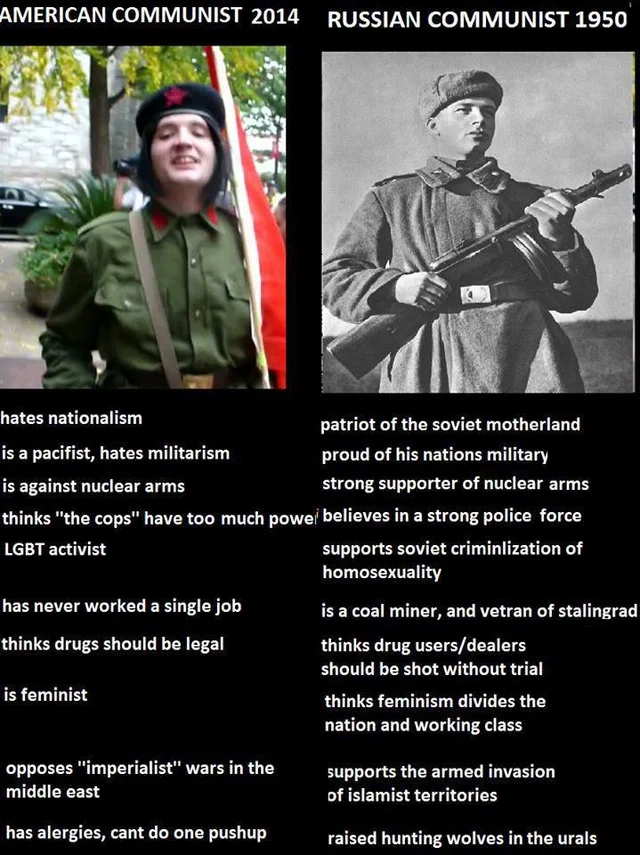
Why can't strong men uphold the status quo? See pic related. Notwithstanding spelling errors or stereotypes, surely it paints a picture of a tough, patriotic, disciplined, brave man (a strong man). In contrast we have a lazy, timid, pacifist (a weak man). Now these are just archetypes, yet there are surely people who more or less match them. I'm willing to bet the Romans who made Rome great were more like the former, Caesar, Marius and so on, leading from the front, risking all for glory and victory. The Romans who made Rome weak were probably more like the latter - the Empire somehow stopped being able to field huge armies, they had to pay for foreigners to fight for them.
There could well be a status quo that revolves around strength, a status quo that rewards bravery and great deeds. Strong men would fit fine in that.
 RandomRanger
Just build nuclear plants!
3yr ago
The barbarians didn't bring disaster to themselves, it was great being a Frank or a Goth or a Vandal, as opposed to being a Roman. Likewise, you did not want to be a Gaul when Julius Caesar was running around.
Stalin is mixed. On the one hand his economic management and wartime leadership leave much to be desired. But on the other hand, he did win and Russia became a superpower. Could Gorbachev have built such a powerful war machine from the mess that Stalin inherited? Or would he have disintegrated the Union and let Germany eat it for breakfast?
RandomRanger
Just build nuclear plants!
3yr ago
Your post here isn't just counter to what JMG actually believes but I believe it contains a misreading that he was complaining about having to clear up back in 2011, specifically the idea that the collapse will be sudden or immediately noticeable, like a sharp fall off a cliff which leaves us back in the 19th century forever (though I freely admit I may be misinterpreting you here).
I agree with you about what he predicts I think, it's just that it's hard to summarize a quasi-ideology in a single sentence. A lot is riding on the 'eventually' in my sentence. I did read a couple of posts from him where he says 'no the collapse won't be sharp but a steady decline, perhaps accelerating at some points under various competitive pressures'. Also, is he not on the left? I thought the whole 'archdruid' thing and a fairly anti-capitalist tint shone through his work, along with the ecological emphasis. Maybe left-right isn't so clear with these unusual ideologies. Also, since when was he pro-Trump? I never saw anything like that.
More importantly, the collapse that JMG has been writing about for the last two decades isn't some far-off "eventually" - it is happening now, right outside our windows.
This is just bad management of resources and bad politics. If the US decided to criminalize drug dealing as opposed to leaving these festering open-air drug markets... If the US and most of the West wasn't 'investing' in inefficient renewables as opposed to nuclear energy... If the US and West generally didn't decide to send our manufacturing base overseas to China...
Look at the actual predictions he made from the 2011 link:
The notion that America can drill its way out of crisis would be funny if the situation was not so serious; despite dizzyingly huge government subsidies and the best oil exploration and extraction technology on Earth, US oil production has been in decline since 1972.
That being the case, the question is simply when to place the first wave of catabolism in America – the point at which crises bring a temporary end to business as usual, access to real wealth becomes a much more challenging thing for a large fraction of the population, and significant amounts of the national infrastructure are abandoned or stripped for salvage. It’s not a difficult question to answer, either.
The date in question is 1974.
neither we nor Britain nor any other of our close allies has a big new petroleum reserve just waiting to be tapped, after all.
And then we had the fracking boom! US oil production reached a record high in 2019, contra Greer. Likewise with global oil production. COVID hit and then we had the war in Ukraine which have thrown things out of whack, yet these crises don't stem from energy problems, they stem from human stupidity in geopolitics and biomedical research. The West's leaders have been working around the clock to sabotage the fossil fuel industry, shut down pipelines like Keystone, ban exploration, shut down power plants, impose punitive taxes, engage in lawfare against coal mines.
On that note, you've also missed one of the other central points of his hypothesis - that another civilisation will eventually be born on the other side of the dark ages we're headed towards.
I said that civilization would collapse down to 19th century standards, I got the sense that he predicted permanent stagnation. Did he not deride all alternate energy sources, including nuclear, as cope? What is left to build back on if there's no fossil fuels, nuclear or anything? Hydro alone seems rather limited. You can definitely maintain civilizations with 19th century tech, use charcoal and so on. Yet technological civilizations like ours need more power IMO.
Anyway, my primary disagreement with him is that we are not short of energy. There's plenty of uranium and thorium if only we bother to use 50-year old, simple technologies like breeder reactors, if only we get rid of all the red tape that slows down construction. The state-sponsored sabotage of nuclear energy is staggering - see https://rootsofprogress.org/devanney-on-the-nuclear-flop
Likewise, sulphate aerosols could reverse climate change in a matter of years, if only we chose to deploy them.
Nuclear energy is actually cheaper than coal for electricity in technical terms, it's just that we choose to make it more expensive. More broadly, all the time we're finding new efficiencies, new sources of power, new ways to accelerate development. Fracking is just one example. Peak oil was supposed to come in 1974, 2006, then 2011, it still hasn't come and it won't mean anything more than 'peak whale oil' ever did when it does come, since we'll be onto gas, nuclear fission and fusion, or solar if it ever becomes economically viable. That is, provided our leaders are wise enough to do their jobs correctly, as opposed to flailing around like children. That's what was going on with Rome and Byzantium, their energy sources were stable but their leadership became incompetent.
RandomRanger
Just build nuclear plants!
3yr ago
Well, disaster is really contingent on external forces and on how resilient the system is. Rome didn't face many strong external threats until the great migrations of the 5th century because they'd already destroyed Carthage, Pontus, Macedonia, Gaul and only had to deal with Parthia. Plus Constantinople is incredibly defensible.
Under Brezhnev, the USSR was stable. Brezhnev didn't hesitate to use force either, he was definitely a strong man: send dissidents to mental institutions, send tanks into Czechoslovakia. The economic problems with the Soviet Union under Brezhnev and afterwards were definitely solvable with some judiciously executed reforms, as we see from China. Reducing the military budget below 15% of GDP would've been a good start!
All I'm saying is 'Strong men cause a range of outcomes, weak men cause hard times', which is pretty intuitive. I don't even have anything to say about cycles, just that, contra OP, strong men aren't necessarily bad but weak men are.
RandomRanger
Just build nuclear plants!
3yr ago
Strong men create hard times. It's what one can observe quite clearly anywhere with an abundance of them.
What, the Rome of 200 BC was less functional than the Rome of 300 AD? When Rome was run by really tough, martially inclined men like Scipio Africanus, Marius, Sulla, Pompey and Julius Caesar, they had more than their fair share of wars and civil wars. But they pulled on through! Rome reached the peak of its power, destroyed its peers, grew faster than ever before. They routinely thrashed barbarian migrations - they were the ones 'migrating' into Gaul and elsewhere.
In contrast, the later Roman Empire was run by weak men who totally lacked the Cannae spirit of 'ban weeping, field new armies, fight on to victory' and they got obliterated. They resorted to paying tribute to barbarians, hiring barbarians to do their fighting for them and hiding behind the (admittedly strong) walls of Constantinople. They were passive, reactive not proactive.
Hard times come after weak men take control. Take Russia - was Gorbachev a strong man? No, he was weak. He wasn't in control of the transformation he tried to undertake. Thus the disaster of the 1990s and disintegration of the USSR (which blows anything Putin's done out of the water). Likewise with Nicholas II for that matter. If Nicholas were a strong man, Stalin would've been executed, not given tiny prison sentences. The guy was a revolutionary, a rioter who organized deadly prison breaks and violent bank robberies!
Now, this is not to say that strong men only bring good things. Hitler and Napoleon were about as far on the 'strong' axis as you can get. Things did not go so well for France and Germany under their rule. Yet there's a wider range of outcomes you can get under strong men than weak men. You can have great success as well as great failure. Under weak men, all you get is decline and eventually disaster.
IQ is like strength. It measures performance.
Race is more like nationality, it's about measuring what team you're on.
Say aliens with 1000 IQ showed up tomorrow and harmed our interests by scooping up all the world's forests for their zoo or whatever. It makes no sense to support them just because they're high IQ. For that matter, it makes no sense for Englishmen to support fellow Englishmen who sell them out to foreign interests or exploit public resources for personal gain.
Intelligence is not an unalloyed good in all contexts - just consider our longstanding concerns about AI! The most important thing is what team one is on, capabilities are secondary. If someone is high IQ but uses that intellect to market addictive drugs or perpetrate financial scams, they're worse than their anti-social low IQ peers who tend to be less destructive.
Race, religion, culture, nationality, language are the surest ways of defining what team people are on, in that order. These factors last longer than political ideologies. See the conflicts between communist Russia and China, Vietnam and Cambodia.
Now some will say that different races can work in harmony under a single state. I agree. They can work in harmony, for a time. Yet there's nearly always someone on top, nearly always tension and an eventual break-up. Multiculturalism as we know it today has only really been tried since the 1960s. The Austrian empire ruled over diverse nationalities for centuries (and not nearly as diverse as we're talking about today), yet it still collapsed back into its constituent parts.
We grossly underestimate the importance of unity. What happens when there's a major, serious crisis on the scale of the world wars? Someone will lose, some countries will be put under incredible strain by defeat and recrimination. Multi-national states disintegrate, national states survive. Just imagine if your country suffered 1/10th as much as North Korea. Fifty years of harsh Japanese occupation, then a devastating failed war where every single urban centre was incinerated by the USAF such that people were living in holes in the ground. Then forty years of Stalinist dictatorship, a famine as your superpower ally disintegrated along with your trade, near total isolation from world markets (remember that North Korea is mountainous, cold and lacks much fertile land or oil), blatant hostility from another superpower (Axis of Evil speech)... and despite all that they still have thermonuclear weapons, ballistic missiles plus a huge army! If North Korea had been multi-ethnic, it would've fallen apart like Iraq and Syria. IQ is also a factor, Koreans are pretty smart.
Anyway, diversity isn't strength, unity is strength. Trading unity for brainpower makes the state fragile and more prone to internal conflicts. Everyone should be on the same team, especially when chips are down. This very story proves that the UK is not united, there are open divisions even in peacetime. Consider the RAF stories of whites being rejected, general diversity aspirations throughout the workforce. This is a bad sign!
More options
Context Copy link