
 SneedNibba
1mo ago
The goal for Iran is to establish that attacking them is a mistake which will cost the ruling party their majority.
This doesn't strike me as plausible. The GOP establishment doesn't care in the slightest about losing the midterms, and, even before the war, it seemed to be actively trying to throw them. They could've passed any number of bills, including voter ID, that would've motivated supporters and demoralized opponents, but instead they passed a left-leaning housing bill and blocked Trump from making recess appointments.
The neocons who convinced Trump to engage in this war are thrilled with the outcome. They plan to blame the midterms on immigration enforcement and see if they can get an amnesty on top of everything else.
While it was psychologically important for Trump to negotiate a better deal with Iran than Obama's deal, he will not sacrifice his presidency on the alter of keeping Iran from having nukes. The plan was clearly to bomb Iran, hopefully get a regime change, or at least shock and awe them enough that they will agree to terms which Trump can easily sell as a victory.
By contrast, Trump needs the war to continue until he gets out something which he can sell as a victory or he dies, whatever happens first.
I think it's pretty clear that he was talked into the war on that pretense, and then, up until the MoU, it seemed very clear that he was intent on getting out of it. I defended him quite a bit on that point; he'd made a bad decision and trusted people he shouldn't have, but he seemed appropriately upset with Israel and wanted to withdraw.
After Israel sabotaged the MoU, though, he doesn't seem to be trying anymore. As far as I can tell, he's just endlessly repeating the "Iran's weeks away from a nuke" line that AIPAC's been peddling since decades before I was born. The gasoline deal indicated that he does personally care about the midterms, but I think the neoconservative entryists are running the asylum at this point, and the beliefs of Trump himself don't appear to have any bearing on the Iran war's execution at all. Given what the Biden admin was like, I don't think the Dems would be any different, especially seeing as the odds of a competitive Republican candidate ever emerging again shrink by the day.
As the saying goes, congressional Republicans are openly pro-Israel and not-so-secretly gay, congressional Democrats are openly gay and not-so-secretly pro-Israel.
SneedNibba
1mo ago
I believe there is a good chance they will escalate and cause Trump and Republicans political embarrassment soon.
I'm genuinely confused about why the Iranians (apparently) care about the midterms. Didn't we just get through four years of the Democrats letting Israel do whatever it pleased? Congressional dems have already shown that they have no intention of doing anything that might put a stop to the war, and see it as someone they don't like taking a hit to do something they wanted done anyways.
The Russians, in contrast, seem to understand now that the political establishment is pretty thoroughly neoconservative regardless of the sentiments of the American people, which is why they're willing to take cash to do something that helps the political fortunes of an administration that hasn't been very friendly with them.
I do think that either country could achieve a lot by pointing out that Lindsay Graham openly mocked Trump to the press while selling him on this war, presenting him as gullible and dismissing the voices of his supporters. Reminding him that the neoconservatives he's taking hits for despite him might make him less inclined to do as they say.
SneedNibba
1mo ago
Well, a natural monopoly can abuse its position to an extent, but there are limits. Whenever I want something that wouldn't show up on a 'curated' set of Google results, I default to Yandex. Whenever I want something too complicated for nu-Google to locate, I throw it at a bunch of LLMs (smart ones, not Gemini-flash-2.5-nano-q4 or whatever Google pipes in where its search results should be) and hope that one of the runs gets lucky. When I just want to find a website and I'm too lazy to type '.com', Brave Search is good enough, or Bing if I'm testing something on Edge for webdev reasons, and it doesn't track me.
This leaves Google in a very awkward middle ground where it doesn't do anything very well - it gave up giving good results for political reasons and it gave up giving fast results because the CEO thought he was smarter than he is.
SneedNibba
1mo ago
But today, I can just ask frontier AI what a size of a given component for a particular year was and it'll just do that, and that's not something Google ever really did.
Yeah, that's the other side of that board room meeting. After Google became a curator instead of a search engine, it was a lot more vulnerable to losing users to alternatives, even if other search engines fundamentally couldn't compete due to lack of user data. There are some use-cases where AI is naturally better than a search engine (Google can't compete there, and adding an AI summary doesn't help) and some where a search engine is ideal due to latency, and Google's addition of an LLM popup obscuring the results is counterproductive there.
But a non-technical CEO could say "LLMs are chewing us up! We need to compete by putting one in our search engine!" and, if the technical lads aren't bold enough to speak up, that's what ends up happening.
Re: Latency, it's the single most important thing. My professor went on for half an hour about it, there were internal studies showing users freak the fuck out if Google doesn't present results within K milliseconds. I don't recall the number, but yes, it is very, very important.
SneedNibba
1mo ago
It feels like agency. Openness is more the intrinsic difficulty of doing your own thing on the internet. The average agency of an internet user is a different thing.
I think this is the fundamental misconception I was targeting. You cannot expect a meaningful number of people to have the "agency" to seek out something they never even hear about. They have lives and obligations, and that doesn't make them "sheeple".
It's the obligation (and it's lots of fun) of everyone who got to enjoy the free internet to find a way to make it accessible to the next wave of young lads who don't see anything for them on Netflix and Reddit. It'll take some doing, but it always has.
SneedNibba
1mo ago
See, this is what I mean. It's a secret, hidden website that even I, someone generally in the right milieu, never heard of. Imagine if this were a Fedi server, and the two enclaves could cross-pollinate. Imagine if it could even cross pollinate with adjacent techie-ish communities that were also edgy-ish, like the less average-TLC-viewer parts of KiwiFarms. There's a common set of people who hate censorship and like technology but never really interact with each other across these platforms.
This is what the Reddit-4chan-Facebook-Tumblr ecosystem of 2015 was like. The kind-of-matching parts of different communities could talk to each other, and people could organically discover new interests. You'd see a guy on /r/SSC with good posts, check his history, find him in /r/CringeAnarchy, and thus find a new source of funny content.
SneedNibba
1mo ago
I have the opposite impression. Search engines are popular because they're fast and comprehensive, and AI summaries don't add anything to that. You get a cheap LLM that's too stupid to make any new conclusions summarizing what you'd have been shown instantly if it weren't there, but now need to wait five seconds for.
Having taken a grad-level cloud class, I think I know what went down there. The smart guys who built the system knew that customers care about latency first, but some tech-inept exec saw that LLMs' big problem was hallucination, and concluded that tacking it onto their search results and making it cite them would give them the best LLM ever. The smart guys, because of the post-2014 culture of never being "brilliant but acerbic", didn't speak up, so we get an annoying AI assistant nobody wanted on every results page. Naturally, we can't turn it off except with a custom Ublock filter.
SneedNibba
1mo ago
Yeah, I think a layer on top of the existing internet is much more promising than a parallel internet, at least in terms of what needs to be built first.
SneedNibba
1mo ago
I think they ought to federate, or something similar. If one of those forums goes down, how would users stay in touch? As users age, likewise, they need to be replaced with new blood. Reddit ate a lot of the old forum culture, and then Discord ate a lot of Reddit's younger userbase.
I do think "give me $X and I'll add an advert for your thread" is a good business model for sites locked out of Google ads. It's been done successfully many times.
SneedNibba
1mo ago
Last Summer, Youtube tried to declare war on adblockers. They were completely routed - tons of false positive claims, and every new "please turn off Ublock" filter was met with an immediate patch. Huge embarrassment for Google that left the whole internet laughing at them, and they've since given up completely.
SneedNibba
1mo ago
I suspect the open Internet is permanently dead.
I see a lot of demoralized people saying this, but I don't think it's at all true. The people that created the free internet still exist, the will is still there, and the institutions that censored it are falling apart. We just need to be motivated and agentic, cheering each other on instead of commiserating on how doomed everything is. I expect quite a lot of effort has been expended to create that narrative, but it's false.
The main impediment in the future will not be censorship it will be an avalanche of AI bots.
I don't think this holds, either. AI is an arms race. If a lobby can use Claude to spam your site with shilling posts, you can jailbreak Claude (or use GLM-5.3) to write a script training a lightweight filter, or use Jev to filter posts one by one at vastly lower cost than your opponent is exerting. There are positive and negative technological trends, and focusing on only the negatives is an unagentic way to view the world - you have the tools to win! For every ML censor, there's an EoT attack on a series of analogous open models that'll generalize. For every Flock camera, there's an adversarial license plate. For every debanking, there's a jailbroken LLM willing to help you put a Tor site up and an XMR account ready to conduct off-the-record business.
Really, the tech fight has gone vastly more favorably than I could possibly have expected in 2020. Getting people out of their funk and onboarding them into the tools and strategies they need is the only real bottleneck. We need optimism like we had when 8ch came online; people singing Mr. Blue Sky with the site admins, making funny OC, and laughing at the futility of censorship efforts against them.
Edit: Realized I double-replied. There's useful info in both unique replies, so I'll leave it up.
SneedNibba
1mo ago
This has been my experience also, and it's funny, because it's directly the opposite of OP's.... I no longer have any place where I can talk about anodyne, nonpolitical topics.
To the contrary, I think this is the big problem. There will always be a GigaHitlerBuckbreakingForum for people who want to talk about hard right wing politics (though every imaginable measure will be taken to make it unmentionable on the mainstream internet and impossible to discover through search engines). Political censorship takes the form of walling off the internet 'normalfags' use from anything the regime considers impermissible.
My proposal is something that lets you discuss anodyne things more easily, adding on filters that hide bots and spammers and maybe a shared compilation of means of avoiding getting flagged as a bot by the site itself. Ublock Origin demonstrated that a handful of motivated nerds can reliably pummel the 'elite human capital' of a site like Google looking to block specific user-types, and Reddit's team is much less capable than Google's.
More generally, as a fellow VPN user, I think your IP is the problem. If you want to be anon, either get a dedicated IP from Torguard or create an account in a coffee shop somewhere and then use that account, which is associated with a clean IP address. If they ask for (or even allow) phone verification, set one up through textverified. Some sites, like Twitter, shadowban by default, and require a few months of on again off again posting before you become visible, which is information they never tell you. I really should compile all this info somewhere, it's been immensely useful to me.
SneedNibba
1mo ago
I don't think anything like that can work for anything worth doing. Culturally, people are spread out enough that you're at a major disadvantage even if you magically get buy-in from every sympathetic person in your city. Practically, fears of infiltration, real and otherwise, would quash it.
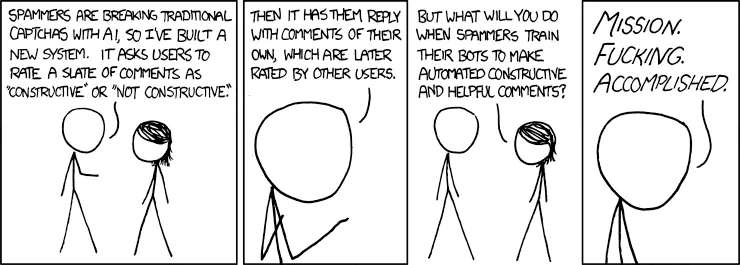
I don't think bots are the primary issue, I think it's ultimately going to be pretty easy to filter them through automated means and use of the XKCD rule, but even if they were, PoW captchas or paid verification (in XMR) are much easier routes. Both of those things are contingent on onboarding enough real people, though - that's the important part.
(XKCD rule, for the uninitiated):
 SneedNibba
1mo ago
I've had to do youtube's creepy 'im a real human' process of taking a selfie video.
Maybe I'm paranoid, but I would never do that. Trivial to circumvent it with a deepfake, after all. Or a Gmod video.
 SneedNibba
1mo ago
I think this is only partially true. They're a lot smaller than they could be if they allowed freedom of speech; it's not an economically-motivated policy.
There was a book by some leftie detailing the history of Reddit being intertwined with neocon lobbyists and turning a blind eye to their influence efforts, especially re: Israel.
SneedNibba
1mo ago
I suspect the open Internet is permanently dead. The main impediment in the future will not be censorship it will be an avalanche of AI bots.
I disagree on both counts. AI detection may be imperfect, and it's true that it's easy to circumvent, but most bot operators don't really try at all. If Reddit cared, they could jury-rig something that got rid of the overwhelming majority of botted comments, but as far as I can tell they're either apathetic, inept, or in collusion with the groups operating various bot campaigns.
Fundamentally, I expect the 'defense' side of this arms race to dominate, especially if you decentralize it a bit. Optimizing an LLM to generate spam that gets past most users' custom filters is a huge ordeal, and, as with ads, the people churning them out may well consider the sort of person who operates a blocker to be less valuable as a target anyways because of their implied skepticism. Probably something like the pre-LLM arms race between spammers on 4chan and the users writing filter lists. I think, insofar as imageboards have a future, it looks like a few different users operating custom Qwen instances to screen threads for spam and shilling, then surface only the stuff they might be interested in, and sharing out their models' filter results through an extension. I have an architecture for that as well, which I'm working on building a demo for.
Of course, all of this is contingent on a few tech-adept people having the agency to set up this kind of infrastructure. We take things like Ublock Origin and Return Youtube Dislike for granted, but they're largely a product of the old, high-trust internet in which people were willing to work for free in pursuit of a common good.
SneedNibba
1mo ago
The complexity is in implementation, not (hopefully) onboarding. You just install an extension and your activity is backed up to a profile on a second website, which other users of the extension can see whenever one of your posts is on screen. The other users can follow you on this website in case your account on a censored website gets banned or deboosted, letting people "find their frens" much more easily in the event of ban waves.
The simplest, most minimum-viable-product-y version of this would be an extension that highlights posts by other users of the extension, creates backups when you post with it enabled, and displays the backups if they get removed by a moderator. No extra input from the user needed for any of this.
SneedNibba
1mo ago
I'm new, so maybe I'm missing some context, but that seems like a fairly small step for an LLM-generated game. It seems unintuitive to me that a frontier model would struggle with it.
A few days back, I had Claude Opus 5.5 one-shot a pretty well-polished shmup game with a bunch of weird mechanics. Are you using a simpler local model as an artistic statement, or is there something else at play?
My point is that the parties are equally beholden to Israel, which is very different from being equally likely to have started the war. If they were just both ideologically neoconservative, you could train them to be anti-war that way, but it's well established that they care more about pleasing Israel than they do about winning elections, so the midterms are a nonentity to them.
They would rather have their pro-Israel opposition in charge of Congress than enact a not-pro-Israel policy themselves.
More options
Context Copy link