
BANNED USER: temperamental dysregulation
DaseindustriesLtd
late version of a small language model
Tell me about it.
User ID: 745
Banned by: @Amadan
 DaseindustriesLtd
late version of a small language model
3yr ago
1
Kolmogorov
Off topic, but this exchange and the mention of the K-meme has prompted me to reread both Aaronson's piece, Alexander's one and refresh my memory with some Russian sources.
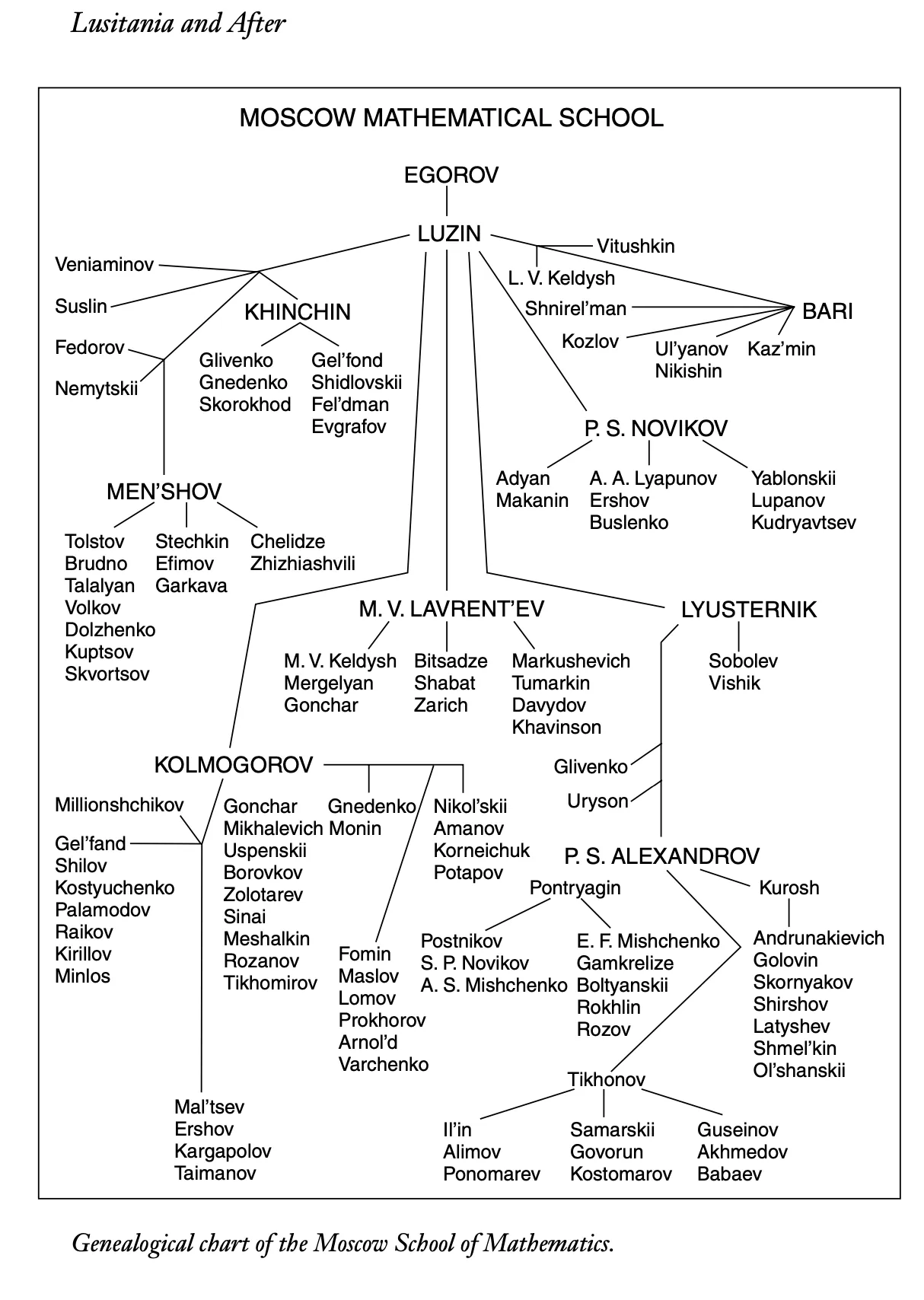
The takeaway is that both Scotts have delivered us mashals, half edifying parables loosely based on real events and characters, half projections and personal creeds. Aaronson views the world through the lens of his existential fear of powerful bullies; Alexander is ever the grand allegorist of the culture war (and I love this allegory to death). The autistically naive Kantorovich who has dodged the bullet with his ignored letter to Stalin, the noble but savvy political operator Kolmogorov, the atmosphere of terror and careful dancing around Stalin's paranoia, oppressors and blameless victims of tyrannical whims – that's all rather simplistic. It was a curious, if messy and petty, rabbit hole.
I'll leave the overdramatized Kantorovych topic aside because he had a good reason to escalate it to Stalin, namely his already immense reputation and having received a shallow answer from the Scientific Secretary of Gosplan; and as RAS says in the note On the 100th anniversary of the birth of academician and Nobel Prize laureate Leonid Vitalievitch Kantorovich, «...a year later his proposal was discussed by the high management of the Gosplan and rejected. [...] The only thing that saved him from repression was the fact that Kantorovich was not formally an economist, but a mathematician, and they have always been forgiven for being somewhat eccentric». Let's talk Kolmogorov.
Aaronson:
From what I’ve read—for example, in Gessen’s biography of Perelman—Kolmogorov seems to have been generally a model of integrity and decency. ... And at a time when Soviet mathematics was convulsed by antisemitism—with students of Jewish descent excluded from the top math programs for made-up reasons, sent instead to remote trade schools—Kolmogorov quietly protected Jewish researchers.
Kolmogorov was a leading and admired Soviet scientist all through the era of Stalin’s purges, the Gulag, the KGB, the murders and disappearances and forced confessions, the show trials, the rewritings of history, the allies suddenly denounced as traitors, the tragicomedy of Lysenkoism. [...] So then why did he utter nary a word in public against what was happening?
As far as I can tell, the answer is simply: because Kolmogorov knew better than to pick fights he couldn’t win. He judged that he could best serve the cause of truth by building up an enclosed little bubble of truth, and protecting that bubble from interference by the Soviet system, and even making the bubble useful to the system wherever he could—rather than futilely struggling to reform the system, and simply making martyrs of himself and all his students for his trouble.
There was also a dark side to political quietism. In 1936, Kolmogorov joined other mathematicians in testifying against his former mentor in the so-called Luzin affair. By many accounts, he did this because the police blackmailed him, by threatening to reveal his homosexual relationship with Pavel Aleksandrov.
Sergei Novikov offers a more jaded view. First of the Luzin's 1946 affair in his amazing memoirs:
... My father [Pyotr Novikov] went to the Steklov Institute (which moved from Leningrad in 1934), apparently on the recommendation of Luzin. He made his first brilliant works on the then-superfashionable Descriptive Set Theory (DST). Luzin, Kolmogorov, Kantorovich, von Neumann and some other stars were fond of it. Kolmogorov, reputedly the first mathematician in Moscow, was childishly jealous. Luzin and other envious people (like Vinogradov) did not let Kolmogorov even into the correspondent members, but he got elected academician by votes of physicists in 1939. With all that, Luzin teased Kolmogorov: «And Petya Novikov has stronger theorems on DTM than you have». Kolmogorov wanted to be the first «in all-all-all things». He came to detest my father, who idolized him, by the way. Later, Kolmogorov treated me very well, perhaps realizing his unfairness. And Luzin, who liked Novikov's work so much, was not ashamed to steal from it: Novikov came to Luzin with a theorem. Luzin was so fond of it that he sent an article to the Comptes Rendus, signed by himself, behind the author's back (see comments n.1 on the harassment of Luzin). [P. Novikov defended his thesis in 1935] After my father's funeral, I asked L. Lusternik, his friend: «Why did you all pray to Luzin so much? My father made the best works, too, after freeing himself from his influence». He replied: «You wouldn't understand now. Luzin taught us to love mathematics.»
[...]
Now about Petrovsky. [...] A detailed description of the 1946 election process is contained in Pontryagin's letter to Gordon dated December 24, 1946. Kolmogorov had negotiated with Luzin that they were running P. S. Alexandrov as an Academician, and P. Novikov as a correspondent member. I had already heard at home that "Papa would soon be a member-corr". But he didn't, had to wait another seven years. With no warning, Luzin spoke at the screening committee of the Department of Physical and Mathematical Sciences, breaking all the agreements: «The foremost candidate important for applied works – Petrovsky. Aleksandrov can't measure up» ... Kolmogorov approached Luzin and said: «You have acted dishonorably» (or something like that). Luzin replied, as the secret rumor goes, «I can't take insults from a woman.»
Let's pause the story for a brief comment. This phrase was told to me much later by a friend, in the confidential words of an older mathematician. But he was unhappy with the direct reference, so the matter is still under some secrecy, as if there is something unacceptable here (why?). С. Kutateladze informed me of a slightly different version from Kantorovich, but it is homosexual as well.
This opened my eyes. The story told earlier looked unnatural without it. I knew Kolmogorov; he was not crazy, on the contrary, he was a very restrained man. It took a strong insult, a knockdown, for him to become so lost. It was probably said in a lowered voice, so the details are blurred, I suppose. My parents withheld it from me. I couldn't ask them again any more; they had passed away.
[Pontryagin's letter] is silent on homosexuality. It was a strict taboo back then. Pontryagin, however, did not really take part in the election, sitting on the sidelines.
Beria's role was hidden behind the actions of academics – that was rules of the game.
Continuing the story, Kolmogorov lost it and acted indeed like a woman: he shrieked and slapped Luzin in the face. This got reported to Stalin. Stalin, it is said, was not at all angry, he liked such imbroglios between intellectuals. They gave him a moral high ground. Anyway, S. Vavilov, president of the academy, said to Kolmogorov: «You're the first academician since Lomonosov to start a scuffle.» Kolmogorov paid a fine.
Do not think, however, that Luzin simply betrayed my father. Nor does it matter that Petrovsky is better as a mathematician than P. Alexandrov [...] Luzin, I think, could have been summoned and kindly asked by Beria, like Maltsev was, or otherwise was requested to support the right candidate. He suffered severe persecution in 1936 (see Comments n1), and such people are particularly pliable (and who among us could refuse Beria?). [...]
Incidentally, in L. Graham and J.M. Kantor's book the slap episode on page 186 is portrayed incorrectly, but in excessive detail. It is ridiculous to think that Kolmogorov would have been telling Luzin – the enemy – about his works. And what was his work on topology of this time? Complete nonsense. Apparently, the authors believed someone who didn't even know it was related to the election. The episode on the other hand is portrayed with detail and great exaggeration. I thought at first it was narrated by Arnold, whom Kantor knew well. His imagination often created a lush story from a little piece he didn't really know (see examples in my article 7). It turned out, however, that Arnold refused to comment on all this, and the fake info came from Yushkevich. It is thus based on hearsay from sources far removed from any real witnesses. This was noted by Kantor himself. As can be seen, this episode has become the subject of popular imagination.
 DaseindustriesLtd
late version of a small language model
3yr ago
Like with nuclear and biological weapons, that's not the shit-flinging contest you want to initiate unless you can ensure crushing supremacy. Israel can "cyberattack" Iran, because the retaliation is known to be relatively negligible. Russia can cyberattack Ukraine, maybe, but Ukraine has friends on the other side and they've got more and better hackers and superior tools, and they won't be as restrained in using those to strike back at Russia on behalf of Ukrainians as is the case with drone strikes on civilian infrastructure.
DaseindustriesLtd
late version of a small language model
3yr ago
Incidentally I've been reading up on memeticsm starting from a skeptical perspective about reality of memes and infohazards (very shallowly; suggestions welcome) and have stumbled on Aaron Lynch's response to a critical review:
[...]While Marsden's review does mention topics covered in Thought Contagion, his portrayal of my analysis is misleading to say the least. For example, there really is a section on the evolution of memes pertaining to homosexuality (p. 79-84). In a nutshell, it says that adherents of the taboo out-procreated more tolerant people over the course of many generations in ancient times, leading to increased prevalence of the taboo. (This does not require anything like a perfect correlation between morality and behaviour, or a perfect child inculcation rate, but only enough to increase taboo prevalence by several percent per generation over hundreds of generations.) Then horizontal transmission kicked in as people maligned homosexuality to "prove" their adherence to the taboo. As the taboo becomes extremely widespread, most homosexuals live heterosexual lives, leading them to reproduce any genes involved. As these genes gain prevalence, the rate of taboo dropout increases. Gene carriers who have dropped the taboo are more sexually and socially motivated to spread acceptance of homosexuality than are non-gene carriers who drop the taboo. So the rising gene prevalence can lead to a self-sustained propagation of pro-gay memes. (Horizontal transmission again, contrary to Marsden's claim that I ignore this mode.) That, in turn, can lead to lower gene prevalence in the next generation, and even lower prevalence of pro-gay memes. All of this leads to potential fluctuations over long time spans. Incidentally, there is a brief mention of the way that beliefs about anal sex become involved with homosexuality taboos. Yet despite a multi-faceted discussion of homosexuality taboos, Marsden excerpts a sentence on anal sex and presents it as if I had offered it as the answer to the question "What memes deter homosexual behaviour?" He has thus taken a complex argument and misrepresented it as childishly silly. He uses a similar distorting approach in all of his other indented excerpts.
It's amusing how his reasoning is similar to @pointsandcorsi's (although much more careful and conservative, especially with forecasts) and thus passes for academic content, yet pointsandcorsi's output merits a permaban on an obscure forum.
I don't particularly like either.
DaseindustriesLtd
late version of a small language model
3yr ago
No, sorry about making that unclear.
I'd suggest: «Media is being honest and good to have you believe it's honest and good when it's actually deceptive and bad – and those few issues are central to its mission.»
DaseindustriesLtd
late version of a small language model
3yr ago
In turn, I am saddened by the fact that a yet another round of pretty diverse AAQCs devolves into a Holocaust debate. But oh well, collapse@ignore.
While we're metadiscussing. @naraburns, the last entry (my post) is linked with the quote from @greyenlightenment's blog, I apologize for my relative ineptitude at writing concise punchlines but think that's a tad unfair to both of us. Just a nitpick.
so did World War II veteran Kurt Vonnegut in The Sirens of Titan: a segment of the novel features Martians who are hypnotized into invading Earth. Their invasion is pathetic and swiftly crushed, so pathetic that the Earthlings are ashamed of what they did and the memory of the Martians becomes part of a new religion. That is a way forward for forgiving Hitler and the Nazis: not to see them as evil, but as sick and deluded. Because the sick are a target of pity, not of outrage.
This is a damnation greater, not lesser, than the regular sort, for it denies even the dignity normally afforded to a true enemy. The idea that Nazis were sick and deluded is mainstream – very competitive with the theory that they were sane thugs whose philosophy or innate inclinations led them to pick on the weak. The question of whether they belonged to that special category of mentally unwell evildoers who remain irredeemable may be interesting to some (e.g. Christians coming to terms with the fact that «Judeo-Christianity» isn't a coherent moral framework), but really it's just shades of dehumanization. There is no authentic human agency in an outburst of pathetic insanity, and no one to forgive. As civilized men, we do not begrudge man-eating tigers their addiction to human flesh, we shoot them on sight.
...There are essentially two paths to forgiveness. The easy one, the false one, adjacent to your method, is spinning a comfortable story where the core of the evil impulse will be something you find intrinsically excusable, even a mere accident or a misunderstanding. They were just following orders, they weren't loved by their fathers, they got traumatized by WWI, yada yada. Or just gesture in that direction, like Orwell, in the refreshing manner of an upper-class leftie British journo sniggering at a country bumpkin with a big attitude:
Suppose that Hitler's programme could be put into effect. What he envisages, a hundred years hence, is a continuous state of 250 million Germans with plenty of "living room" (i.e. stretching to Afghanistan or thereabouts), a horrible brainless empire in which, essentially, nothing ever happens except the training of young men for war and the endless breeding of fresh cannon-fodder. How was it that he was able to put this monstrous vision across? [...] I should like to put it on record that I have never been able to dislike Hitler. Ever since he came to power—till then, like nearly everyone, I had been deceived into thinking that he did not matter—I have reflected that I would certainly kill him if I could get within reach of him, but that I could feel no personal animosity. The fact is that there is something deeply appealing about him. One feels it again when one sees his photographs—and I recommend especially the photograph at the beginning of Hurst and Blackett's edition, which shows Hitler in his early Brownshirt days. It is a pathetic, dog-like face, the face of a man suffering under intolerable wrongs. In a rather more manly way it reproduces the expression of innumerable pictures of Christ crucified, and there is little doubt that that is how Hitler sees himself. The initial, personal cause of his grievance against the universe can only be guessed at; but at any rate the grievance is here. He is the martyr, the victim, Prometheus chained to the rock, the self-sacrificing hero who fights single-handed against impossible odds. If he were killing a mouse he would know how to make it seem like a dragon. One feels, as with Napoleon, that he is fighting against destiny, that he can't win, and yet that he somehow deserves to. The attraction of such a pose is of course enormous; half the films that one sees turn upon some such theme.
The hard path to forgiveness is trying the evildoer's perspective for size, and understanding how it is not obviously insane, and learning that you can hate the sin even when you're no longer able to look down on the sinner. But that's risky, of course: look into the abyss and all that.
With regard to Nazis, one nifty trick is to check out some of their self-appointed antipodes. I pick Ozy Brennan. Says Ozy:
The Iron Dream does a fantastic job of capturing what it’s like to be a Nazi. (I asked a few of my friends who have studied this more in depth than I am and they confirmed.) The worldview of Alternate Universe Adolf Hitler is grim. There is no simple joy described in the novel: pleasure at a flower, or a good meal, or a child’s smile. Sexuality and eroticism are absent; sex exists solely for the preservation of the race, and even that is eventually abolished. In a lovely detail, while characters laugh, they never actually tell a joke that’s funny.
What The Iron Dream has instead of joy is dominance. The ceaseless victories of Your Team over Their Team. The fierce jubilation at the torture and violence you unleash upon those weaker than you, purely to flaunt that they can’t stop you. The endless parade of identical soldiers, marching in unison: the thud of their feet which means strength, power, triumph.
...then I observe that this is an easy trade for me to make, because I like beauty and humor and sex and all the rest, but I have no dominance instinct. My status-related desires run towards admiration, which can’t be coerced with a gun. [...] But perhaps, to someone with a stronger dominance or competitive instinct, Naziism is appealing. Perhaps they would be a Nazi, at reflective equilibrium, at least if sufficiently assured that they’re not a Jew.
Ozy fancies herself an original thinker. I assume the attentive (and primed!) reader has noticed that her idea of the ethos of Nazism is riffing off Orwell, in fact from the most iconic passage:
The old civilizations claimed that they were founded on love or justice. Ours is founded upon hatred. In our world there will be no emotions except fear, rage, triumph, and self-abasement. [...] We have cut the links between child and parent, and between man and man, and between man and woman. No one dares trust a wife or a child or a friend any longer. But in the future there will be no wives and no friends. Children will be taken from their mothers at birth, as one takes eggs from a hen. The sex instinct will be eradicated. Procreation will be an annual formality like the renewal of a ration card. &We shall abolish the orgasm.* Our neurologists are at work upon it now. There will be no loyalty, except loyalty towards the Party. There will be no love, except the love of Big Brother. There will be no laughter, except the laugh of triumph over a defeated enemy. There will be no art, no literature, no science. When we are omnipotent we shall have no more need of science. There will be no distinction between beauty and ugliness. There will be no curiosity, no enjoyment of the process of life. All competing pleasures will be destroyed. But always — do not forget this, Winston — always there will be the intoxication of power, constantly increasing and constantly growing subtler. Always, at every moment, there will be the thrill of victory, the sensation of trampling on an enemy who is helpless. If you want a picture of the future, imagine a boot stamping on a human face — for ever.’
1984 is cool. But what about 14/88, both versions – the «our children« and «Because the beauty of the White Aryan woman must not perish from the Earth»? Is it really isomorphic to that nightmare vision from the Iron Dream? To some people it might be.
And, speaking of, what does Ozy zerself mean by beauty?
One could very reasonably make the case that the natural human aesthetic sense prefers realistic paintings of beautiful landscapes with water, trees, large animals, beautiful women, children, and well-known historical figures [...] However, art of this sort leaves me cold. The art I find most heartbreakingly, exquisitely beautiful looks like this... Is there, perhaps, some deep evolutionary wisdom I am missing in why trees are prettier than abstract shades of grey? Of course not. I like what I like; the things that give me pleasure are the things that give me pleasure. ... I talk about the beauty of Serrano’s Piss Christ; my strongest criticism is that I feel it’s bad form to court controversy when your art cannot stand on its own.
Ah, but Nazis would have called that Entartete Kunst. Is it beauty when the crux of an art piece is humiliation of a faith? Or is it more Orwellian will to power?
From their perspective, I don’t simply have different values, I actively rejoice in evil. I tell cute childhood stories about replacing “Respect Authority” with “Question Authority” in the Girl Scout Law. I urge people with all the eloquence I can muster not to prioritize their ingroups over other groups of people. [...] my read of the psychological evidence is that, from my value system, about half the country is evil and it is in my self-interest to shame the expression of their values, indoctrinate their children, and work for a future where their values are no longer represented on this Earth.
As they say in xianxia, out by the roots! Not even the original justifications of those values shall survive. And words will mean whatever. Spooky!
«The object of power is power. Now do you begin to understand me?»
I don't think that forgiveness is a clear moral good. Jews pride themselves on the unwillingness to forget and forgive, and it works for them. Tolerance for real moral aliens, with their reasonable fear of The Other, though – that could help.
The object-level issue for me is uncontroversial: there is zero damage from deep fakes, bans on technology to produce arbitrary content (without intent to do direct harm) constitute an unconscionable intrusion and the beginning of a civilization-ending slippery slope, people who support this censorious approach (or even have moral intuitions in favor of it) are barbarians, and I can only wish they be politically disenfranchised somehow.
Naturally, they think the same, or less, of me.
Maybe that's too harsh of me. I've skimmed replies to this tweet today and they left me a bit shell-shocked. Ion had the misfortune of his tweet showing up outside his bubble, somewhere in Normie Twitter. So... Well. Most of the time there is no argument being made, they just gloat about him being «ratioed», or ask sarcastically «would it be okay with you if someone made gay porn with your likeness» or say «imagine this was done to your mother/daughter/sister», assuming the shared intuition of obvious harm – and, by implication, hypocrisy and sociopathy in Ion's support for AI fakes of other people but not of himself. (There's also the rhetoric of consent/boundaries/violation, peddled by women and feminists, which IMO speaks to profound egocentric entitlement and belief that women are owed desirable perceptions, and this deserves more scrutiny, but I won't go into it).
Some responses provide a semi-rational steelman, though:
Wow Its almost like people dont wanna have realistic looking fake pornography made of them and possibly spread around to where people In their personal life will see and presume real and treat them differently for
And here:
Here are some reasons:
1: some people may see it, assume it’s real, and stop following her
2: her family/friends might see it which is pretty rough even if it’s fake
3: brands she works with might see it and want to cut ties
4: it’s creepy to do this
And my response is, that would be totally okay, I do not need low-value people in my life. If someone (not dearly beloved but clinically demented) cannot/isn't willing to distinguish real and fake images based on context, or just has strong emotional reactions to highly-likely-fake images and can change attitude towards me on their basis, that person is a long-term liability and should be discarded. This, of course, is the generic principle behind provocative behavior and – in the extreme case – the saying «if you can't take me at my worst, you don't deserve me at my best», popular with crazy bitches. It's strategically sensible for them, because their life strategies are incompatible with being sanctioned for their worst. And disengaging with people who can't take the fake of me at my worst makes perfect strategic sense for me.
And then I realized how deep into a high-IQ, high-decoupler, high-trust bubble I am. For these normal (if very online) people, relations with others are quantitative in nature. They do not filter aggressively. Even if they themselves are more or less undamaged by fake stimuli, they can be materially harmed by losing «followers». They love their friends and family, among whom many are unable to mentally separate contexts. So these people's violent emotional reactions are attuned to their social reality, to the semi-magical realm of voodooist village or bullying in public school, where a literal straw man can go a long way in burying your reputation and, in the limit, you physically.
This just speaks to the need to separate society into more impregnable bubbles, I guess.
P.S. There's an additional, somewhat orthogonal aspect to this, explored e.g. by @SubstantialFrivolity downthread:
fantasizing about having a conversation is fine because having a conversation is fine. Fantasizing about punching someone in the face is bad because punching them in the face is bad. [...] isn't the record that would bother someone. It's the fact that you are doing it at all. "It's ok as long as I don't get caught" is literally the moral code of a child, but as an adult one should realize "no it's wrong even if nobody will ever know".
I've said it before and I'll say it again: Hajnal-type people, guilt-culture people, are fucking weird and freaky, and The Motte would do well to extend some charity to non-First Worlders who show little sympathy to them and readily join the anti-white brigade. They boast of individualism and freedom, but are chained at the very roots of their souls, and proud of those chains. They exoticize and mock Asian cultures for putting «face» and «shame» first, but it's much more healthy and, indeed, liberal and respectful to maturity of others (considering the inevitable consequence of moral blackmail) to care about your public reputation, than to agonize over concealed inner judgements – particularly by people who are not invested in being judicious, as is inevitable in modern societies that are just so much bigger than your dumb medieval Anglo village with a single parish. Their «Christian» morality is Harm OCD reified into a religion, a permanent backdoor inviting any psychopath to tinker and steer them (which inevitably happens in their collectives of substantial scale). Far from surpassing childish innocence, their moral code is more appropriate for ants than for adult humans.
But then again, they are the perfect substrate for building comfortable societies others will enjoy.
I admit that getting the population into the Goldilocks zone that combines dignity culture (which would allow people to fantasize, make and publish images without absurd social opprobrium), reasonable face culture (which would allow them to do so without OCD-like pangs of ridiculous inner guilt, so long as they don't intentionally harm anyone) and avoids utter atomization, degeneration and extinction, is probably a task for 200 IQ social engineers. Ones we (I hypothesize) have got pursue other projects. If it were achieved, it'd probably look something like Eastern Europe, only more functional.
P.P.S. One consideration those outraged people are missing, or perhaps deliberately staying mum on, is that more deepfakes = less deception. With the proliferation of highly realistic fake porn, the prior for a given image being real decreases. Right now a microceleb e-girl's never-before-seen nudes may as well be authentic leaks, and in fact most of the time they are (or self-promotional «leaks», as it happens). When manufacturing their near-equivalent is a matter of two clicks, the prior is «duh, nice GPU bro» and the reputational and emotional damage, even in their ostensible paradigm, trends toward zero. But for those who profit off exclusivity of their images of indecent nature... well, their woe is a separate matter, and undeserving of being laundered through this moral rhetoric.
DaseindustriesLtd
late version of a small language model
3yr ago
I feel like people have majorly updated toward thinking Russians are... kind of like Africans because of the way the war is waged and Russian elites behave, so now it's surprising when a Russian product is competitive with a Western one, or even superior. How could Orcs build something beautiful? Must be meh. I've seen it discussed more than once that Soviet STEM was just Jews who were prevented from leaving, too.
Yandex is leagues above most Asian and Europoor companies, and is a proper Bay Area tier Big Tech, with a stack of cutting edge AI-based applications on top of text search. The best voice assistant, the best navigation, the best AI weather forecast, the best open-source LLM. (Or rather, it used to be; now its promising self-driving department, for instance, got relocated to Israel, on a questionable legal basis). The next big thing in open source text to image generation is apparently made by a guy from Sberbank, following the ruDalle line. Heck, even Mail.ru is fairly competitive.
Ongoing dissolution of those entities is a national tragedy that in the long run may well eclipse the war's cost in blood.
This chain was started by Scott's series of posts like Bounded Distrust and The Media Very Rarely Lies, right? Amazing how much yarn was spun out of such a trivial thing. I have to say that, generally,
-
The «pro-media» guys here are right on almost all counts, and conservatives who get fixated on provocative titles and plug bananas in their ears are being wrong and behave ridiculously.
-
Nonetheless, conservatives have got the more appropriate gut feeling; liberal media dominance constitutes a terrible state of affairs, for a very simple reason that nobody is mentioning. Media is being honest and good to have you believe it's honest and good when it's actually deceptive and bad – and those few issues are central to its mission.
Hanania says:
I’d still say, however, that on the vast majority of issues, if the choices are between “blindly trust the media” and “blindly hate the media,” it’s clear that the former is preferable.
But also:
The exception here is anything having to do with race, gender, or sexual orientation, where you should understand that establishment journalists are trying their best but can’t be trusted because they’ve lost their minds, or are scared of those that have, and you’d be better off listening to people with cancelable views.
And:
No matter what liberals tells you, opposing various forms of “bigotry” is the center of their moral universe.
Why oh why would somebody not already fanatically committed to socially costly, «heterodox» views on race, gender and sexual orientation (topics which are, as Hanania says, the dead center of liberal moral universe, the screaming empathetic abyss that undergirds all this nice, edifying professional reporting on cougars and Myanmar in MSM) – make that exception? And without that exception – what would MSM lead such a reader to conclude about any civic matter that has impact? From «fake news» and censorship and misleading allegations like Russiagate to vilify the competing party, to the role of government and education policy, it's pretty much all downstream of reasoning that uses cleverly disingenuous or pants-on-head stupid MSM interpretations of identity problems as ground truth.
The MSM keeps showing you that there are massive racial and gender disparities, and they continue to exist no matter how much effort is put towards eliminating them. This is like if Pravda kept showing you the economic data proving that capitalist countries are rich and the Soviet Union can’t produce enough grain to feed itself, but encouraged its readers not to lose faith in socialism.
Small correction: the MSM keeps showing you that there are massive racial and gender disparities, and it explains them with bigotry attributed mainly to white cishet males, with propaganda of redistributionist and affirmative-action policies informed by this culpability. This is like if Pravda kept showing you the economic data proving that capitalist countries are rich and the Soviet Union doesn't have enough grain to feed itself, but encouraged its readers to sniff out kulaks and bougie wreckers who are hoarding the grain for themselves, and suggested coping with the deficit by means of Prodrazverstka. Doesn't sound so innocuous now, does it?
I think a fair observer would have to conclude that, even if this is propaganda, it is of an unusually honest kind.
Wew. dril said it better than I can.
the human norm is terrible, and we’re lucky to have institutions that have some degree of respect for the principles of objectivity and truth.
This isn't about respect or principles. The MSM wield truth as a weapon. Even when they do not outright lie, do not mislead with interpretations, do not do anything objectionable at all, they are doing it with the agenda in mind. The NYT is particularly guilty with their top-down «narrative» thing, but the whole blob is this way. They are earning credibility points in the minds of their readers, and a sufficient quantity it turns into suspension-of-disbelief points. What for? Bryan Caplan gets awfully close with his Big Picture framing, but he doesn't make the final step. Neither do you: «A serial killer is indeed a good person the 99.9% of the time he is not killing people». Let me propose a better analogy: Sam Bankman-Fried is a good guy who runs an advanced and feature-rich financial platform 99.9% of the time, lobbying for regulations against his competitors and expanding his control over crypto wallets of Americans. Then he collapses it, wiping his clients' livelihoods, and it turns out they were always but fuel for his Effective Altruist power plays.
This is the problem of Ponzi schemes, exit scams, rug pulls, commodification-of-your complement business relations, «good old law and order» autocrats who turn into rabid dictators, monopolies, startups, Trust Games with rising stakes, and a ton of other scenarios where you benefit maximally from getting the other side to invest enough power in you, then defecting. And you get there by providing value. No shit the NYT publishes a ton of decent high-quality content. So does Netflix. It's bait to make you lower your defenses, and simultaneously a vehicle to deliver the payload – seeing as we're talking vaccines and viruses.
Here's a good rule of thumb: you do not get let people who hate you inject unknown bioactive substances into your veins, even if you're very sure the solvent itself is harmless and indeed good for health.
I think this is what makes conservatives so rigidly untrusting – both of the MSM and of mandatory vaccination. Sometimes they overreact needlessly. But in the case of the MSM, this is the least they can do in response to obvious and systemic bad faith.
DaseindustriesLtd
late version of a small language model
3yr ago
There's nothing there, it's preemptively abandoned. Was supposed to be here.
DaseindustriesLtd
late version of a small language model
3yr ago
Sounds good, doesn't work. No matter what they know of first principles of a domain, people do not generalize it to real world automatically, and their experience in school cannot teach them when to generalize scientific principles. Some learn it on their own. Most learn... something else.
The official premise of basic school education is murky in itself. It's such a vast enterprise with such questionable returns that its advocates can't help but peddle it as a panacea, I guess. There's the plausible-enough aspect of teaching people object-level trivia (although they forget virtually all of it); the dubious claim of teaching advantageous habits of mind (e.g. the shift from concrete operational to formal operational thinking that Flynn believed explains some of the eponymous effect), the related basically-misleading promise of raising intelligence and thus improving outcomes (beyond the contribution of credentials themselves, and isolation from antisocial environments for the most unfortunate kids... who are lucky enough to get into schools for higher strata). All of that list is pretty worthless in my book, in comparison to the human cost of a decade of imprisonment (I'm essentially with EB/JB on this one). Then there are less popular but more convincing arguments, «school as a day care» mainly.
But the key error undermining the premise, I think, comes all the way from the conceit of actual teachers, who are overwhelmingly not bright enough for high-fidelity metacognition and theories of mind. You don't upload data into a child. You do not even «train» a child. You prompt experiences, and children learn from those experiences. Their intuitions are grounded in the context of their interactions with the curriculum, teachers and each other. And I posit that intuitions they form are the opposite of what you'd like them to get.
Among my abandoned Substack drafts is one dedicated to Stonetoss meme about HBD/dog breeds (dogwhistle, as it were), or rather to its edit (Taken from Twitter. Apparent origin on reddit). Some excerpts:
It's so bad I can't help but share it. It's deceptive, has negative entertainment value and is the opposite of what a good meme must be. Yet I welcome you to contemplate it. Worse yet, I ask you to focus on a single frame.
Frames 3-6 are dumb in their own right. But it's the second one which is truly rage-inducing and, I think, illustrates the core failure of the currently dominant left-liberal philosophy as it pertains to epistemology, communication, science, education, humor, art and political behavior writ large, as a coherent, self-perpetuating memetic ecosystem (to the extent such things exist) shutting a plurality of strongly online people out of the real world.
The most baffling part is the fact that saying «phenotypic diversity» adds nothing over «dogs look so different».
Nevermind that this (representative) definition is inseparable from the issue of genetic causation: this is just not an answer. The older figure (henceforth Teacher) pretends to respond to the younger (Child), casually showing off his mastery of scientific terminology, but merely restates the question. It's tautological, it's Molière's virtus dormitiva. Why? Or rather, why would the edit's author deem it clever and proper and edifying, as did his audience?
I think this is a sure way to 1) assert authority and 2) kill scientific curiosity in a child. [...]
Humans have the capacity for developing a theory of mind. Much more efficiently than current language models that infer hidden instructions, like InstructGPT [this is an old draft] children use it to apply feedback to every level of abstraction: what the dialogue is about, what having a dialogue can be about, what does it mean for anything to be about something. If the teacher's confident answer doesn't make sense, this is not yet grounds to doubt the teacher: it indicates that your question has had a meaning different from what it seemed to have, and was generated in confusion.
To continue with ML analogies: ultimately, instruction inference («theory of mind») leads to children meta-learning the teacher's preferred inductive biases.
In simple words: for all the role of heredity, it is possible to teach people not just facts but high-order patterns of thought, simply by giving answers that communicate how the question is understood.
Now why would a question about, say, the reason dogs are unlike each other elicit a condescending non-response? Because what matters is names, not your silly «why»'s; verbal correlations, not causality and predictive power of communicable models. And – just as well! – social feedback approximates distributed backpropagation, so one updates and learns to guide attention accordingly. Children can drive you mad asking about names of things; that's curiosity too. That's cute, when children do it. But in terms of cognition, that's the opposite of grokking: that's memorization, a strategic dead end. In terms of mental behavior, shifting the balance towards memorization lays the foundation for the opposite of science: for magical thinking. People who are consistently trained in such magic develop certain notions which are very odd when laid out explicitly.
For example: education itself. In this paradigm, being educated means getting properly socialized, a matter of convention akin to table etiquette, rewarding prosocial conformism and good recall (but also allowing for relativism with regards to the value of ideas conveyed by the program). Technically it is the procedure of having a pupil memorize a score of magic character strings and behaviors, doing what Eliezer Yudkowsky calls guessing the teacher's password. A person who says «wow dog breeds sure look different» is ignorant; one who knows the True Name Of The Thing understands there's nothing special to this pattern, merely Phenotypic Diversity. Vygotsky used to say that learning of systematic, well-defined scientific concepts by children bootstraps their generalization ability and abstract reasoning over mundane ones; here, scientific labels are used to prevent correct generalizations from forming.
Crucially, this is not just a normative belief but part of these people's genuine world model (such as there is), informing their stance on many contentious topics, e.g. meritocracy, school funding, fairness, cognitive testing, biases or «socioeconomic factors» from the original meme. They robustly believe that superior performance is a matter of having received in advance, maybe through guile or unnoticed privilege, some correct passwords, and refuse to believe – no matter the evidence – that culture-fair testing is conceivable or that it's possible to discuss the capacity for thought as such. That's simply not how thinking works in their world.
Science, then, as an outgrowth of education (through school-to-degree pipeline), is a social domain one gains access to after having collected enough passwords, mastered the advanced protocol; it is high-status in a way, because «in this house we believe ... science is real» and what scientists say is received as truth. But all its prestige is inseparable from following the protocol [...]
For whatever reason, you are confident in your ability to apply principles of natural science to the real world. I'd venture a guess that you're used to being smarter than your peers and the teacher too. A regular person, meanwhile, learns that reality has a surprising amount of detail, that figuring out nontrivial questions is way over one's head, and pattern-matching the problem to password-generators is the way to go. What is the teacher's password to «are masks useful outdoors»? You claim diffusion is enough to say no. But a normal person remembers the punishment for overconfidence, the sense of getting stuff wrong. And if you really think about what you've learned in school, there's wind direction, laminar and turbulent flows, uncertainty about survival rates of viral particles, and sufficient loads, and relative movement of people, and probabilities of them coughing in your general direction, and... conclusion: the correct password is «trust the Science», where the Science will be defined by the consensus of Experts. I'm saying it like it's bad, and the Stonetoss example is IMO sufficient to show how it might be harmful... but it's honestly a reasonable intuition for a normie.
The sort of intuition that doesn't get forgotten after school.
DaseindustriesLtd
late version of a small language model
3yr ago
The question here is technical rather than moral. I have very little sympathy for Louis CK too, but there clearly was an attempt at canceling him, with usual techniques employed by the usual social justice coalition that successfully prosecutes the culture war most of the time by the same means. Why hasn't it worked well enough to remove him from entertainment? And indeed, if they had a more legitimate and broadly appealing case against him, that only makes this question more salient.
Of course, him not really being an outgroup is part of the answer. The story of a purity-spiraling circular firing squad is a bit of a misunderstanding; you get expelled and purged for true ideological conflicts with the Party Line, but not necessarily for behaviors that may seem to contradict it. A sinner, even unrepentant, is not yet a heretic.
DaseindustriesLtd
late version of a small language model
3yr ago
Inference of LLMs isn't that much of a problem, because batch size scales rather cheaply, and there are tricks to scale it even cheaper at production volume. OpenAI is still burning through millions in a month (we aren't positive on the exact figure) but it's probably less expensive than their current training runs. This is one of relevant papers.
We store tensors such as weights and the KV cache in on-device high-bandwidth memory (HBM). While there are other tensors that pass through the HBM, their memory footprint is much smaller, so we focus on just these two largest groups of tensors. ... Even though the computational cost of attention is relatively small, it can still account for a sig- nificant fraction of memory capacity and bandwidth costs, since (unlike the weights) the KV cache is unique for each sequence in the batch. ... For a 500B+ model with multihead attention, the attention KV cache grows large: for batch size 512 and context length 2048, the KV cache totals 3TB, which is 3 times the size of the model’s parameters.
Also, contra @xanados I'd say they probably don't run those models in bf16, so make that 180 GB.
@Porean investigated a similar question recently.
Re: your question – I also don't know of any convenient one-click-install local LLM-based applications (at least for natural language-focused models). There are not-terrible models you can run locally (nothing close to ChatGPT, to be clear) but you'll have to fiddle in CLI for now. There is no rush to develop such apps, because, again, models of practical size won't fit on any consumer hardware. Text is vastly less redundant than images.
I hope people realize soon the risk of offloading their brain extensions to Microsoft cloud and learn to pool resources to economically rent servers for community-owned LLMs, or something along these lines.
DaseindustriesLtd
late version of a small language model
3yr ago
if you treat all a group's members to slightly below their average, it means that any individual with an objectively positive deviation from that average is not rewarded for that as strongly as they would be
this is complicated by the fact that financial/material success and odds of reproduction are inversely correlated- and the dysgenic effect of that might very well cancel out the eugenic effect the above should create
The actual problem with your line of thinking is that the post-Civil Rights level of preferential treatment (disclaimer: I hold that blacks in the US are, ceteris paribus, treated preferentially) did nothing to alleviate black dysgenics which surpassed white rate half a century back already, compounding the ability gap.
Does discrimination exacerbate dysgenics? I could just as well spin the opposite narrative, both in the manner you've suggested and by pointing to generic social-darwinist logic some Philosemitic people use to explain the excellence of Ashkenazim. In any case, the US is roughly a century removed from even beginning to craft policies with natural selection dynamics in mind.
DaseindustriesLtd
late version of a small language model
3yr ago
Moldbug's model has no predictive power over public choice theory or some generic conspiracy, and its allure lies precisely in stripping «The Cathedral», culturally close to him and his target audience (cough cough «dark elves»), of moral culpability inherent to conscious exercise of power while being aware of its consequences. If there is no genuine malice, we can hope to resolve our differences with another round of musical chairs, «reformalizing» power so that no perverse incentives remain and hobbits can return to their bucolic farms.
Much the same can be said of the brain-addled Memetic theory of politics in general, which is buttressed by Mistake theory (because Scott, of course, is a... half-dark elf himself, despite his polite differences with neoreactionaries, and also refuses to see simple malice in blue tribe). Memes and fads very much exist, but they are fickle epiphenomena of mass culture; consequential ideologies and even rhetorical frameworks that are perpetuated by human organizations have unlimited lifespans, rely on scholarship vastly more complex and cerebral than their "memetic" payload, and follow from material interests of self-aware groups.
The practical nonexistence of memes is one of the most underrated thoughts of our friend Julius, which he regrettably had not argued for with sufficient finesse.
DaseindustriesLtd
late version of a small language model
3yr ago
How do you know this is culture and not genetic confounding? Like, I'd imagine that men – regardless of race – who dump mothers of their own children have antisocial inclinations across the board, and perhaps women who find such men tolerable tend to possess subpar characters as well. It's reasonable to stipulate that this far left tail of black population explains much/most of their overrepresentation in violent crime statistics for genetic reasons, without bringing in some special single-parent culture.
Of course it's never 100% genetics. But that's no salvation to the theory. I'm pretty sure there was at least one study that showed that removing a violent/criminal father (as in, incarcerating him) is a net improvement for the child's outcomes, despite moving the family into single-mother category. Do we have good studies on the effect of those specific fathers being kept around the family, or just comparisons versus organic two-parent black homes?
DaseindustriesLtd
late version of a small language model
3yr ago
My impression of Rufo is in line with my impression of De Santis: these guys are getting soft-balled. It's almost staged. Not to say they aren't sincere or competent – they are – but it's not some political brilliance to flip the board (of trustees), it's making use of available resources in an allowed way. This woman in the video is blatantly trying to overstep her authority with a two-bit safetyist sermon based on a low-effort anonymous threat, she's a predictable villain of the week, and she's alone – physically at least. This also suggests that conservatives who got heckled out of colleges and demonized within the prestigious discourse were drooling morons who couldn't navigate their own spaces. I guess this looks plausible today to some (e.g. Hanania), but it hadn't been the case during the slow purge. So how come they lost so hard?
The hard stuff is not politely standing your ground before an old crone who wags her wrinkly finger and tries to make you feel like a naughty child – though I suppose for decent prosocial people (as well as for simple folk with poorer impulse control than what a snake in a suit like Rufo can display) that may be hard too. It's withstanding pressure in tens if not hundreds of dimensions; from direct physical intimidation and obstruction, to your own family beginning to feel shame for you, to business boycotts, to vilification coordinated by large orgs who can rope in public icons, to actual legitimate decrees, to plain apathy of your network which is sane, myopically, and so doesn't feel like fighting such an uphill battle is worth the effort.
Manipulation of procedural outcomes relies not so much on high-IQ plays as on slow march through the institutions and seizing control over many nodes at once, to the point it's redundant. When you know that there's at least one friendly Board above any Board that your enemy may coordinate to seize, it's hard to lose. Unless you decide to throw the match, or implode from within.
DaseindustriesLtd
late version of a small language model
3yr ago
No, that's all pretty fair. Their only mistake is that they identify "whiteness" with civilization, and it ironically underscores that white supremacy is suffusing their minds as well. Black cops enforcing the law – sometimes in an unjustifiable way and with terrible consequences – are pawns of the faceless, bloodless, colorless, merciless Power that forces orderly conduct on the mass of bipedal animals, and it's not so much their occasional violence as it's their normal job of discriminating against criminals at all, tribal loyalty be damned, that reveals this fact. Ditto for other black people who do not put their brothers and sisters above the general rule set. They de facto rescind their allegiance to the genetic collective, and this is what defines someone as white in common parlance.
When have you last heard of white racism as actually preferentially treating whites? Today, that's just... beyond the pale.
 DaseindustriesLtd
late version of a small language model
3yr ago
I think this is what naturally happens in practice with tracking – and in fact Jensen's two-tier conceptualization is too rough.
We just need to extend tracking downward and make it universal.
DaseindustriesLtd
late version of a small language model
3yr ago
Sanderson: haha no no you got it all wrong
Sanderson: I don’t personally hate gay people
Sanderson: I simply support an institution that wants to kill them
Sanderson: I think they’re neat
Sanderson: if it were up to me, they wouldn’t be exterminated at all
Sanderson: but jeez, guys, who am I to tell the Mormon church it’s wrong?
Sanderson: I really don’t have any choice here other than to keep tithing them millions of dollars
Sanderson: my hands are tied
Orson Scott Card: oh yeah totally very relatable
Barker: haha that sucks, man
Sanderson: look, I know you all think I’m some sort of bogeyman for giving millions of dollars to a church that wants to kill queer people
It's pretty sad that wokes are just about the only people who take religious commitments on their face (though I'm not sure if LDS doctrine specifically can be interpreted as demanding to kill all gays and queers, over basic Christianity, so it seems that what earns Mormons extra ire is having a functional Church this late into the game). Of course online wokes do it in bad faith (pun not intended), knowing well they won't ever be touched and just holding theists to task for their professed beliefs. And they succeed in wringing out apologies and clear signs of internal conflict and guilty conscience. This doesn't satisfy them, but this gives the lie to the notion that any theist beliefs which are seriously, consequentially divergent from the mainstream morality can be sustained. As a contemporary Christian, you cannot be in the world but not of it: your peers will recognize your seriousness as edgelord behavior, your children (if you find a partner) will cringe and apologize for their backward parent, and your faith will be reduced to a notional identity marker in a generation.
What goes around comes around. When, as a minority, you cast off the protective membrane of contempt for infidels, they dissolve you. The Haredim will prosper – in their unashamedly bigoted communities, under the umbrella of people bound to them by ethnic obligation. The Amish will survive as well, conditional on their continued legal recognition in the US. Everyone else...
In 1930, before marrying Marietta, von Neumann was baptized into the Catholic Church.[69] Von Neumann's father, Max, had died in 1929. None of the family had converted to Christianity while Max was alive, but all did afterward.[70]
DaseindustriesLtd
late version of a small language model
3yr ago
Or evil.
The site truncated my post and I just missed it. Thanks
HBD in its modern form can be traced to much-demonized Jensen's 1969 article "How Much Can We Boost IQ and Scholastic Achievement?", which explicitly addressed cultural interventions that are informed by the reality of innate differences, instead of progressive nostrum that is throwing ever more money and white guilt at the problem and political power to their feet.
I have suggested one additional hy pothesis concerning the developmental rates of Level I and Level II abilities in lower and middle SES groups, as depicted in Figure 20. Level I abilities are seen as developing rapidly and as having about the same course of development and final level in both lower and middle SES groups. Level II abilities, by contrast, develop slowly at first, attain prominence between four and six years of age, and show an increasing difference between the SES groups with increasing age. This formulation is consistent with the increasing SES differences in mental age on standard IQ tests, which tap mostly Level II ability.
Thus, ordinary IQ tests are not seen as being "unfair” in the sense of yielding inaccurate or invalid measures for the many disadvantaged children who obtain low scores. If they are unfair, it is because they tap only one part of the total spectrum of mental abilities and do not reveal that aspect of mental ability which may be the disadvantaged child’s strongest point— the ability for associative learning.
Since traditional methods of classroom instruction were evolved in populations having a predominantly middle-class pattern of abilities, they put great emphasis on cognitive learning rather than associative learning. And in the post-Sputnik era, education has seen an increased emphasis on cognitive and conceptual learning, much to the disadvantage of many children whose mode of learning is predominantly associative. Many of the basic skills can be learned by various means, and an educational system that puts inordinate emphasis on only one mode or style of learning will obtain meager results from the children who do not fit this pattern. At present, I believe that the educational system— even as it fal teringly attempts to help the disadvantaged— operates in such a way as to maxi mize the importance of Level II (i.e., intelligence or g) as a source of variance in scholastic performance. Too often, if a child does not learn the school subject matter when taught in a way that depends largely on being average or above average on g, he does not learn at all, so that we find high school students who have failed to learn basic skills which they could easily have learned many years earlier by means that do not depend much on g. It may well be true that many children today are confronted in our schools with an educational philosophy and methodology which were mainly shaped in the past, entirely without any roots in these children’s genetic and cultural heritage. The educational system was never allowed to evolve in such a way as to maximize the actual potential for learning that is latent in these children’s patterns of abilities. If a child cannot show that he “understands” the meaning of 1 + 1 = 2 in some abstract, verbal, cognitive sense, he is, in effect, not allowed to go on to learn 2 + 2 = 4. I am reasonably convinced that all the basic scholastic skills can be learned by children with normal Level I learning ability, provided the instructional techniques do not make g (i.e., Level II) the sine qua non of being able to leam. Educational researchers must discover and devise teaching methods that capitalize on existing abilities for the acquisition of those basic skills which students will need in order to get good jobs when they leave school. I believe there will be greater rewards for all concerned if we further explore different types of abilities and modes of learning, and seek to discover how these various abilities can serve the aims of education. This seems more promising than acting as though only one pattern of abilities, emphasizing g, can succeed educationally, and therefore trying to inculcate this one ability pattern in all children.
Part of the problem is that was integrated into the curriculum, as far as I'm aware, just without attribution. Education increases in rote learning and falls in g-loading (and simple IQ requirements), which narrows achievement gaps, technically – at the expense of people with «Level II abilities».
I'm not sure if this happens on the primary school level, though.
 DaseindustriesLtd
late version of a small language model
3yr ago
[tag:rant]
The interesting part is the apparent absence of calls to slow down. The window dressing is diverse, but the Overton Window for issues pertaining to the Culture War is all left of zero point. The subject of discussion is how many Stalins we need – maybe 50, maybe just 1.5, and how exactly to implement their will; from repelling Christian counterattacks to «why can't we just do it, you know?».
Yet we cannot say that the entire set of speakers has the same end state in mind. Some are as utopian as radicals a century ago; some seem to believe the status quo is 95% perfect. Clinton'2001 and probably Obama'2008 would have been canceled today, because their desirable end states were to the right of the rightmost edge of the window. But they aren't invited, or perhaps aren't interested. It so happens that the kind of people who come either know in advance how the window will have crept, or come to learn from its movement and update. The «consensus of elites» is thus not a static thing, nor chaotic, but a comprehensive message continually updated in the same direction. People are very sensibly interested in reasons and forces that canalize those updates.
@2rafa brings up a hypothetical convent of racist, colonialist 19th century elites. Would it count as a conspiracy? Probably not. At the same time, isn't it interesting how such a convent is unthinkable today, and the same social classes have dedicated their energies to combating homophobia in Singapore? Did some new evidence convince them to rally under the LGBTQ+ banner? Or was it moral progress, late Enlightenment unfolding in accord with its inner logic? But that logic is made of people's choices. So what guides those choices?
Whenever I see her push back on plebeian notions of conspiracy, I'm reminded of David Foster Wallace's parable. What we call conspiracy is not a secret organization but the liquid form of power: the process of like-minded people using significant information, coordination, prestige and status advantage to steer the society towards preferred outcomes, using a toolset which focuses on furthering those advantages. Plebeians live in the desert like moloch (lizard); they know power by clouds in the sky, morning dew, those occasional stray drops that evaporate on the rocks, by rain that rapidly flows down the layers of sand; or at most by tales of their forefathers about that one time they've seen a puddle. So their armchair theories about behavior of its large bodies, no matter how clever, are fantastical and laughable to more knowledgeable beings. 2rafa is a thoroughbred aquatic being: she navigates torrents and feels at peace looking down into the abyss. But for her, power is just... the way the world is. Huh? What do you mean «tsunami»? For that matter, what is a «puddle»? We'd benefit from having some littoral animals who have a more balanced frame of reference.
Of course, the desert is only metaphorical. We can watch WEF streams these days – no secrecy. No smoke-filled rooms or dreadful caves, cackling, twirling of facial hair, classified documents, decrees of infallible elders, certainly no conscious malice. What there is, is an intellectual and ethical monoculture, a set of null hypotheses, a shared sensibility as to which topics are not interesting and low-status, which call for proactive enthusiasm, and on how to fit new talking points into the old program, iterating it for another Agenda-{year}.
It's richer and more complex, but not that different from any other echo chamber. Except it's not a debate club, these people do have the authority to just order the little people to do things. And they will be obeyed, not only for obvious reasons but because it is human nature to habitually obey, and because there's Respectable Consensus backing them up. Maybe the little people will even volunteer – after all, Moldbug says consensus flows through the elites in a bottom-up manner, or rather medium-up. Maybe. It sure is interesting where its real inflection points lie. We know that, at least, some elite social movements – and clubs, and Societies, like the Fabian one – have claimed being those.
I think Sensibility is a good way to put it.
There have been several iterations of the «Globalist»/World Government Sensibility, with WEF becoming, in stereotypes and to some large extent in reality, the public face of the contemporary one. It seems that at some point around the Russian Revolution they have gotten integrated with the Social-Democratic Sensibility and the Liberation Sensibility, which began with successes of the Feminist movement. Let's focus here. Skipping minor details: after Women were processed into an Identity and a political block and propped up to their victory (a sequence of victories, beyond expectations of the first generation of feminists), it was the turn of American Blacks, Gays, and now the LGBTQ abbreviation is being vindicated with Trans Wars and the principle is generalized and franchised. In all cases there are early goals justifiable by commoner morality; then, slippery slope and divergence, with the group-identity becoming attuned to the whole Sensibility package.
There are various critiques of those projects. Conservatives gesture at the fraying of social tissue, discrediting of family unit, pitching sex against sex, race against race, loss of common decency, you know it. Reactionaries agree, and explain those negative outcomes with appeals to fundamental inequality of human groups and the natural order.
I don't care much about this stuff. The underappreciated problem I have with this Sensibility is that it's the sensibility of the managerial class. Of those snake oil salesmen who think reality is downstream of their Powerpoint slides. Progressive ideology aside, they have some catastrophic habits of mind for rulers, chiefly: belief in faking it till you make it, and habit for sidelining those who point out their fakery and overpromising. This is bad for reasons Scott has outlined in his Parable of Lightning. Crucially, because fighting against being exposed necessitates building a de facto power-maximizing conspiracy. We've seen a toy model of how it works – a puddle – with COVID, both the lab story and countermeasures. But it's pervasive.
At the moment of each successive Identity Liberation, its advocates had to work against the belief that the group in question is somehow flawed and thus undeserving of new rights. Women cannot into rational political decisions, black people are unfit for the polite society, gays are promiscuous immoral perverts whose perversion is contagious, queers/transsexuals are mentally ill fetishists (and sex pests). Invariably, the argument was that it might look this way now, but after some adjustment period – maybe with compensation for past iniquities – demerits would go away. Anything a man can do a woman will learn to do just as well, affirmative action will be unnecessary in a generation, gay men will go marry each other, transsexuals will get mentally well without all the abuse. Invariably, this doesn't come quite true for the group as a whole, and there remains at least a fraction of stereotypic bad actors who personify all concerns of retrogrades and exploit new rules. Nth wave feminism misandrists, antisocial blacks, sex-obsessed AIDS evangelists in bathhouses, psychotic and predatory AGP "troons" from 4chan memes. Shortcomings of the group as a whole are problem enough, but these guys get weaponized by the outgroup – as evidence that those promises were bullshit.
A reaction of a PMC when you poke holes in his presentation at is to double down. I can see three particularly harmful kinds of doubling down.
The first is to reflect the charge, accuse the outgroup of getting in the way of closing the gaps, maybe even provoking those unfortunate extremes with their bigotry.
The second is to flip the table, saying that your standard of goodness itself is obsolete – those gays are just ahead of the curve, poly/open relationships are all the rage, nobody needs family and monogamy and of course religion (conservatives understandably suspect this was the plan all along, and can point to early socialism as evidence).
The third is to deny the charge. This sounds toothless, but it's the worst kind. There are no brakes on the denial train. You start with FBI statistics, then you have to deboonk SAT, then people must be deceived about the physiology of body odor, oops databases critical for medical research are closed off; soon enough you warn of the dangers of critical thinking, and absolute trash science on an unrelated topic is accepted because the whole institution is now running on Stone Age taboos and mass hysterias and you need to chase down heretics overseas! And by the way Damore asked for it! And of course there's NOTHING to Blanchardism– nor any costs to shoehorning teenagers and the very concept of gender into its negation...
Every one of those liberation projects has inflicted compounding damage on our ability to reason and find working solutions in general, because of the unwillingness of its proponents to admit they have been faking it on specific points. And places like WEF is where they coordinate the message on which to double down – like that Media leader asking for specifics.
It's a public key conspiracy, with the private key being their Powerpoint-class identity and the shared sensibility of people who would rather change the world than admit failure before the plebs. Without this key, and in the context of external reality, their actions look incomprehensible or
DaseindustriesLtd
late version of a small language model
3yr ago
This is all pretty fair. I've included it on a whim but looking again it's weak, despite citing interesting literature. Retracted, thanks.
We don't have a solid way to talk about anything like Flynn effect in pre-modernity and pre-testing periods; and how 1900's Europeans would've scored on modern tests is not interesting. Personally I'm on the fence regarding the timeline of the current ranking emerging: there probably has «never» been parity between Europeans and Sub-Saharan Africans, but it is plausible that Europeans have been gaining in their advantage in historical time, and so this gap is not explained solely by cold winters or some other factor present for many millenia. On the other hand, cold winters theory seems to explain the pattern of the center of civilization moving up latitudes historically: it's as if building a complex society in the South is playing on easy mode, but then the society hits a limit, and novel technologies flow northward, enabling another round. Today, the most advanced nations in the East and West are indeed populated by people who have passed through the cold winter filter.
My reason for including it was: Breeder's equation, IQ heritability and net fertility differentials allow for meaningful (~0,5 SD) eugenic and dysgenic shifts on the scale of a few centuries, so arguments along the lines of "there wasn't enough time for X" are invalid. It's all speculative until we get good decent IQ PGS for different populations and test that ancient DNA, but I think it's likely that many civilizations have gone through a eugenic phase and subsequent dysgenic collapse, and as you say, Egyptian artisans may have been selected for IQ just like Europeans. This is bog standard cyclical history theory.
I think using genes is a dubious reason to explain why in a class based society, the rich upper class were able to be better off or more numerous in future generations then the poor generations.
Clark, in his oeuvre, demonstrates fertility more directly than by rates of family names going extinct, and his evidence from modern era Japan, China etc. does corroborate that upper classes have innate quality separate from class advantage.
2
The book in question:
Yeah, very cute. Exemplary Kremlinology.
Back to Novikov. The first Luzin affair, one of 1936:
Aaronson's link states, meanwhile:
Then Wikipedia goes on to cite Graham&Kantor and Yushkevich for that claim. Graham had interviewed the militant and violent Stalinist Kolman, («He would play a sinister role in many events in Soviet history, and was a major accuser of Egorov, Florensky, and Luzin») a few times, «both in the Soviet Union and later in the United States». Kolman later «renounced communism», kept publishing his philosophical work, and died peacefully in Sweden, where he got asylum, at the age of 86.
Aaronson also cites Gessen' s book on Perelman, Frenkel, refers to Arnold, proudly namedrops Levin... And I can't help but think his perspective is a bit shte.. sheltered, compressed in a peculiar dimension, of which the bully-nerd one is just an elaboration. But that's the narrow perspective the whole of West is informed through; «Masha» Gessen is our final arbiter.
There's more to us than perspectives of deranged hereditary bluecheka whom Aaronson intuitively trusts –more bad stuff, but more good too. Purges of the late 30s-40s left a permanent blemish on my people's history, but who counts Egorovs snuffed out by those poor victims just a decade before, and pauses to marvel at the complexity of the conflict, in all matters petty and grand? And to cite S. Novikov again:
@theincompetencetheorist, I've written and erased a condescending response to the effect that, while Soviets had managed to intimidate and shame people into mouthing the party line for a while as part of a generic power struggle, they have not and perhaps could not cultivate guilt for wrongthink.
This guilt comes naturally to Western peoples, and so your tyranny, shall it be established once by virtue of centralization and technological advances, will be sustainable indefinitely. It will be defended by the best and bravest among you who fear losing the respect of their loved ones, as opposed to chaotic opportunists and wretched small-minded apparatchiks with material concerns – who are known to be despised by talented, well-connected and fuckable dissidents.
More options
Context Copy link