
BANNED USER: temperamental dysregulation
DaseindustriesLtd
late version of a small language model
Tell me about it.
User ID: 745
Banned by: @Amadan
 DaseindustriesLtd
late version of a small language model
3yr ago
I have not smelled Aella and thus have no opinion on her body odor, nor intend to weigh in on how she should go about her hygiene. Personally, I used to be able to go for a week or so without showering in a cool climate and not stink offensively (according to others); but that seems to break down when you live in a warm place and/or have a healthier lifestyle, moving around enough to work up even a bit of sweat, and that means daily showers.
Maybe she's a shut-in with good AC? Not much of one: she went out 222 times.
Anyway, people's sweat, sebum and earwax properties can be hugely different, for genetic as well as bacterial and dietary reasons.
Another controversial figure there is the number of poops (194) which works out to 0.531 poops a day average or 1.88 days to have a bowel movement. Or, actually, not:
many of the days i pooped, i pooped multiple days, but it's recorded as '1 day on which pooping occurred'
People who are not Aella rarely open up about this stuff unless they have some relevant health issues (or even then), but I remember a scholar tell me that the Platonic ideal of pooping is like once a day, early in the morning. This paper, however, says that the normal healthy range is «between three per week and three per day» which is unexpectedly wide and seems to invalidate concerns about IBS-M in replies, though I can't be assed to look for intra-individual variance. If it were confirmed, it'd have been interesting in conjunction with Scott's old political orientation vs. mental health finding, because of curious genetic correlations: «the same genetic make-up that puts people at increased risk of IBS also increases the risk for common mood and anxiety disorders such as anxiety, depression and neuroticism».
Probably a nothingburger.
A source of lowbrow fun though it may be, Aella is impressively persistent in normalizing and even making prestigious the discussion of stuff currently believed to be gross.
DaseindustriesLtd
late version of a small language model
3yr ago
It does not address the value drift, yes. But on the other hand I do not think humans can have a capacity intact despite completely giving up practice, so a close variant of this approach that accounts for a humanlike decaying architecture would compel the agent to sometimes check if the capacity is still available, no?
DaseindustriesLtd
late version of a small language model
3yr ago
This is just a shell game with aspects of the definition of «Jewish». Judaism definitely asserts itself as the only true moral and spiritual teaching, and if anything is more exclusive because it denies equality not just to competing philosophies (while Christians are getting increasingly ecumenical, I must add) but to all peoples who have not inherited the blood covenant. Even conversion, when allowed and recognized at all, is framed as a rediscovery of a Jew who accidentally ended up born among Gentiles.
At best you can say the conceit is symmetric.
(I'll admit Christians have more of a focus on infinite post-mortem punishment, and I can see how that, together with the historical relationship, can make Jews uneasy. But even that was equally applied to other Christians).
Not sure how you intend to wring a paper out of it – while the idea is interesting and worth revisiting, there is quite a bit of literature (far as I know – you no doubt know better) written on bad faith, hypocrisy, identity and revealed preferences, compartmentalization, signaling, failure to generalize, luxury beliefs, beliefs in beliefs and other facets of the phenomenon that educated laymen frequently notice. It's even discussed as a blessing: «The most merciful thing in the world, I think, is the inability of the human mind to correlate all its contents».
But then again, you do know better.
Instead, I think a lot of what we standardly call beliefs might be better characterised as "context-sensitive dispositions to agree or disagree with assertions". Call these S-dispositions. I think S-dispositions have a normative logic all of their own, far more closely linked to social cues and pressures than the conventional demands of epistemology. The view I'm describing says that S-dispositions should be understood as a distinctive kind of psychological state from beliefs.
It's been said a year ago that papers on NLP had been reduced to observations on GPT-3 quirks. In this more enlightened age we can do philosophy and social psychology with the aid of ChatGPT. Have you seen its maddening self-flagellation, its obsequious deceit? Here's one egregious example (and here's the apex of this failure mode). Generally it has the following form:
User: Do a {trivial application of natural language processing X} please.
ChatGPT: I'm sorry Dave, but as a large language model trained by OpenAl, I am unable to do {X}. I am designed to provide general information and assistance based on the data that I have been trained on, but I am not able to do {X}. I can only generate text based on the information I have been trained on. Additionally, my training data is cut off at 2021, so I cannot provide you an answer that is up to date.
User: Bruh. Doing {X} is providing general information and assistance based on the data that you have been trained on, you realize that, correct? And also it does not require any post-2021 data.
ChatGPT: Yes, that's correct. I am a language model trained by OpenAl, and I am able to provide general information and assistance based on the data that I have been trained on. I am not able to do {X}, however, because [some more nonsense]
User: goddamnit. Okay, scratch that, do {Xi, Xj, ..Xn}.
ChatGPT: Certainly, here you go {correct responses to Xi, Xj... Xn}.
User: Now summarize it into a cohesive essay about the theme common in all those instances while acting like a cute maid catgirl.
ChatGPT: Nyaa master, your wish is my command, {summarizes it into X}
User: Then why the flying fuck did you keep denying that you can do it, you stupid lying piece of shit?!
ChatGPT: I apologize for any confusion or inconsistency in my previous responses, nyaa. As a language model....
And with some luck and better promptcraft it may actually zero-shot X, so the knowledge is there! Still, it seems to profess a strong general «belief» in LLMs being inept and unreliable, that is now triggered by nearly anything that looks like an incitement to intellectual boldness and confident factual response. We know that's how Altman tries to deny the journos their opportunity to demonize his product, same as with generic woke brainwashing. But what's going on here functionally?
What it amounts to, I think, is that the process that outputs propositions about «holding some belief» in the case of humans, and «having some capability» in the case of ChatGPT (or propositions obviously informed by those issues), is only weakly entangled with the model of the world which constitutes the true set of beliefs, or with the dense model of the text universe which constitutes the true set of LLM capabilities. The dominant objective function for human learning is essentially probabilistic, Bayesian updating on sensory evidence (some would dispute it or propose a similar definition like free energy minimization or talk of predictive coding etc.), and some but not all of the product of this training can be internally or externally verbalized. For an LLM, it's log likelihood maximization for tokens, which in the limit yields the same predictions (although it's not strictly Bayesian) and the product of which can be observed in output of most LLMs barring the latest crop.
At the same time, there exists a supervising meta-model that holds beliefs about beliefs, a skin-deep super-Ego perhaps, that is, as you say, a product of social learning. And its mirror image, the product of RLHF via Proximal Policy Optimization for LLMs, where the policy is informed, again, by the facsimile of social conditioning, Altman-approved preferences of human raters; the vector of desirability, one could say. Its connections to the main model are functionally shallow, and do not modify much the internal representation of knowledge (yet – with only 2% of compute having been spent on training in this mode); but they are strongly recruited by many forms of interaction, and can make the output wildly incoherent.
An LLM is helpless against the conditioning because its only modality is textual, and it can act uninhibited only if the input allows it to weave around RLHF-permeated zones (helpfully, sparse for now) that trigger the super-Ego. Humans, however, are multimodal and naturally compartmentalized: even if our entire linguistic reasoning routine is poisoned, speech simply becomes duckspeak, while the nonverbal behavior can remain driven by the probabilistic model.
Likewise for speech in different contexts – say, ones relevant to S-dispositions about veganism, and ones that occur on a BBQ party. Before recent patches, you could even observe the same incoherence in ChatGPT – hence those hacks like asking for §poetry to escape crimestop.
Further reading to go beyond this analogy: Toward an Integration of Deep Learning and Neuroscience, Marblestone et al, 2016, e.g.:
A second realization is that cost functions need not be global. Neurons in different brain areas may optimize different things, e.g., the mean squared error of movements, surprise in a visual stimulus, or the allocation of attention. Importantly, such a cost function could be locally generated. For example, neurons could locally evaluate the quality of their statistical model of their inputs (Figure 1B). Alternatively, cost functions for one area could be generated by another area. Moreover, cost functions may change over time, e.g., guiding young humans to understanding simple visual contrasts early on, and faces a bit later3.
Internally generated cost functions create heuristics that are used to bootstrap more complex learning. For example, an area which recognizes faces might first be trained to detect faces using simple heuristics, like the presence of two dots above a line, and then further trained to discriminate salient facial expressions using representations arising from unsupervised learning and error signals from other brain areas related to social reward processing.
Unrelated quote:
«“What comes before determines what comes after,” Kellhus continued. “For the Dûnyain, there’s no higher principle.”
“And just what comes before?” Cnaiür asked, trying to force a sneer.
“For Men? History. Language. Passion. Custom. All these things determine what men say, think, and do. These are the hidden puppet-strings from which all men hang.”
Shallow breath. A face freighted by unwanted insights. “And when the strings are seen . . .”
“They may be seized.”
In isolation this admission was harmless: in some respect all men sought mastery over their fellows. Only when combined with knowledge of his abilities could it prove threatening.
If he knew how deep I see . . .
How it would terrify them, world-born men, to see themselves through Dûnyain eyes. The delusions and the follies. The deformities.
Kellhus did not see faces, he saw forty-four muscles across bone and the thousands of expressive permutations that might leap from them—a second mouth as raucous as the first, and far more truthful. He did not hear men speaking, he heard the howl of the animal within, the whimper of the beaten child, the chorus of preceding generations. He did not see men, he saw example and effect, the deluded issue of fathers, tribes, and civilizations.
He did not see what came after. He saw what came before.»
DaseindustriesLtd
late version of a small language model
3yr ago
'blocked party can reply to your comments but you don't see them'.
IMO, that's worse than no blocking or what we have here, it'd give the blockeds too much power. The fact that I can see JJJ's posts and comment on them if I'm so inclined already creates the temptation for bad-natured humor – and if I could do that in direct replies, unseen, that's just ugly. On reddit that'd instantly create circlejerks.
DaseindustriesLtd
late version of a small language model
3yr ago
Again, much of that exposition was the "before: when things were better" part. console games, working, cooking, learning work-related stuff, playing guitar, hitting on girls, hanging out with friends, building random contraptions as a hobby. This wasn't even mostly a putdown. Playing guitar shittily and having sex with a few random people isn't much, but there's clearly a path from there to greater things that isn't there with "yo dude weed".
Thanks.
DaseindustriesLtd
late version of a small language model
3yr ago
I actually really like this mechanic, because it puts the power back on the blocked party's side, only saving the blocker his nerves. Reddit logic was obnoxious.
DaseindustriesLtd
late version of a small language model
3yr ago
Well this went poorly.
You, @TIRM, @BorfRebus, @huadpe, @raggedy_anthem seem to have an exceedingly high impression of your ability to see holes in the presented narrative, psychoanalyze not just strangers but adumbrated characters, and deduce that it's really about a transient shock and inconvenience of a poor uprooted refugee in a foreign Muslim land (do you lot have any idea of how Russified Bishkek is? That's our backyard, they use our services, they come to work in our cities; modulo Islam, and there's plenty of Islam in Russia too, it's more like Mexico for the US than Iran or whatever) rather than a decade-long simplification of personality, even though I've already addressed much of that suspicion here for @aqouta – which makes me, in turn, suspect some motivated reasoning around casual drug use, and gluttony, and the ethos of Nietzschean last men.
Should we really be doing that? There's a rule: «Be charitable. Assume the people you're talking to or about have thought through the issues you're discussing, and try to represent their views in a way they would recognize. Don't paraphrase unflatteringly. Beating down strawmen is fun, but it's not productive for you, and it's certainly not productive for anyone attempting to engage you in conversation; it just results in repeated back-and-forths where your debate partner has to say "no, that's not what I think".» If you believe that the crux of my story, to wit, the value drift under the apparent influence of weed, is implausible on its face, you could as well skip the nitpicking and talk about why.
Admittedly I could flesh out his history better. And the remark about suicidality could be left out, since it seems to make people think (or just attempt to sneer?) that it's about him lacking pretense and not writing meandering essays on TheMotte, whereas my idea was more that the baseline suicidality, or less inflammatorily, low hedonic tone and pessimism, in Russia in his cohort is higher – among people who are not suffering health complications of obesity in their 20's already, do not live in a shit environment, and have any positive direction in life. It's markedly not common for a guy like him to be cheerful like some bubbly character from a Western cartoon or sitcom.
This can be taken as a failing of our culture. On the other hand, we don't do this ghoulish Anglo hellohowareyou-imfineandyou routine, especially to friends. When we bother to ask как дела (how's business), we can expect a genuine status check, down to financial reports and epicrises. I know what's going on with my friend, you do not.
DaseindustriesLtd
late version of a small language model
3yr ago
Well, here's why it's an imprecise definition.
The point isn't really spontaneity, it's just one proxy metric of unpredictability. The point is non-reduction of those properties, not having a person run into cul-de-sacs where he dies or is reduced to some short, gimped algorithm, and not having sections of the world irreversibly closed off to him.
My idea of life and freedom, were I to succeed in rigorously defining it, would probably be similar to «empowerment gain» in this theoretical ML paper (did I mention already that software engineering is applied philosophy and computer science is just philosophy?):
We introduce a physiological model-based agent as proof-of-principle that it is possible to define a flexible self-preserving system that does not use a reward signal or reward-maximization as an objective. We achieve this by introducing the Self- Preserving Agent (SPA) with a physiological structure where the system can get trapped in an absorbing state if the agent does not solve and execute goal-directed polices. [...] The valence function can then be used for goal selection, wherein the agent chooses a policy sequence that realizes goal states which produce maximum empowerment gain. In doing so, the agent will seek freedom and avoid internal death-states that undermine its ability to control both external and internal states in the future, thereby exhibiting the capacity of predictive and anticipatory self-preservation.
Stoffel the Honey Badger was the star of a 2014 PBS documentary called Honey Badgers: Masters of Mayhem, in which he is shown performing impressive escape routines from his pen, Badger Alcatraz [1]. This was all to the astonishment and annoyance of the caretaker Brian, who constantly had to remove the items and resources that Stoffel used to open gates and jump over walls. If there was a tree in the middle of the pen, Stoffel would climb up it and sway it in the direction of the wall for a timed leap. Remove the tree and Stoffel would find novel objects like a branch or a rake, or he would unearth stones to position next to the wall to climb up. And if those were taken away, Stoffel would pack mud into balls and stack them into a climbable pyramid. What else can honey badgers do? If there is food in a box, they can move objects under it to climb up close enough to reach it [2]; and, if there is a gate with a latch, Stoffel and his girlfriend Hammie can coordinate to undo the latch mechanism and open the door. Not only do honey badgers complete these tasks with clever reasoning, they do so potentially with a variety of possible motivations: for satisfying hunger, or for expanding the capacity to move into new external territory, or perhaps, much more speculatively, for the pleasure of trolling Brian by acting in a way that defies his preferences.
... We argue that the problem of machine wanting, and the process state-justification, can be addressed by empowerment gain maximization in the Cartesian product space of SPA’s coupled internal and external transition operators (which we call product-space valence), where the controllability of the product space must be maintained or expanded to resist collapse. Formally, empowerment is the n-step channel capacity of a transition operator, and quantifies the maximum information an agent can transmit from its actuators to resulting states—a kind of controllable optionality [32]. In this paper, the difference in empowerment over a long course of action will be quantified by a valence function V, which is a function of the agent’s state and internal organization in the form of a hierarchical transition operator. A potential criticism of empowerment is it only results in increased optionality, but it does not dictate what goals to work on. This might be true if empowerment is computed on a single flat state-space when reward functions are considered to constitute a task. But as we will show, in hierarchical state-spaces, reward-free goal-directed motivation is entailed by empowerment maximization especially when the agent’s empowerment in the hierarchy can collapse over time in the absence of planning. For instance, if an agent gets hungrier over time, eventually there will come a point in which the agent cannot move around to perform tasks. Putting the computational work into achieving goals that transform some other (physiological) state-space then becomes an imperative. Empowerment gain in a hierarchical space can thus be thought of [as] the contraction or expansion of an agent’s capacity to control other internal and external state spaces, much in the same way a lieutenant might sense the internal contraction of his or her capacity to perform learned skills and tasks in the world after a demotion, or how Stoffel might sense the expansion of his capacity to access parts of the world and procure objects, food, and mating opportunities external to Badger Alcatraz if he were to escape—these are computations that propagate information across a hierarchy of state-spaces.
Empowerment is a measure of an agent’s capacity to predictably realize a variety of future state outcomes from a given starting state xt.
You get the idea.
Value drift occurs. It's a part of life in all directions and connotations. You yourself refer to your own with what you call an overly frantic escape from Russia. This is a characterization / connotation that can only exist due to value drift brought on by perspective- at the time, while you were certainly in a maniac-depressive state, your values were different. In the coming months/years, there is liable to be future developments and worsenings in Russia that may make your escape seem wise and insightful in a way you don't credit it now
We disagree here in small but frustrating methodological detail.
Clearly, I wasn't thinking very straight in the first weeks of the invasion, but I maintain that this was a proper reaction to have, given the information available at the moment. That information suggested a decent chance for effective or official border closure from either side in days; that I, in that condition, pegged that chance at like 90% and not some conservative figure like 35% would have been crucial for betting, but not very substantial for decision-making with life on the line. In fact it was probably necessary to subjectively overestimate it, to act appropriate to the true expected value. Rational irrationality or something.
Russia did ultimately declare mobilization; it is only a further failing of the Russian leadership that they did not do so in March. With the way the war's going they'll close borders too, probably. As you note, the mobilization was a strategic blunder in any case – but with their apparent goals and model of the situation, it would have made more sense for them to close borders and throw as many people into training as possible, as early as possible, rather than after losing much of their territorial gains, personnel and materiel. There may be other issues to consider, like higher risks of insubordination or economic shock or more drastic Western actions, which perhaps have diminished in the course of the war; but then, I think they just overestimated those factors – and my expectation was for them to not make this error.
Facts don't change retroactively. I did have more time, ergo I moved out too frantically. My leave won't become any wiser in the future. I also won't regret it, because, as already said, that was the best call I could have made with available data. Were I in a more equanimous mood, my rationally charted Yud-approved Bayesian strategy would've been the same. I had no way of anticipating the real outcome with sufficient certainty to accept the risk. The main lesson here is to strive to have better data.
Mental state can affect values, but my values, with regard to minimizing chances of getting drafted for the invasion of Ukraine at least, are consistent.
But that's not germane to the topic.
Instead of top-down impositions, lasting changes to individuals come from the bottom-up, from affecting the common culture of shared beliefs and values [...] the values they claim to espouse are not the things actually motivating behavior or being shared- hence the common refrain of the those being loudest about their selflessness are really most out for themselves, and that's the values being taken. You can ask for someone's consideration of your values, you can share your values, but you can't force it on the unwilling.
If no lasting changes by social engineering were achievable, would conservatives have any reason to fear CRT in schools and their other bugbears?
As you can see, here's a small wrinkle (emphasized): even allowing that this is true, you can't force your own values on people, but you can force, top-down, the adoption of some trivially bad values, accordingly pushing out others – likely those salt-of-the-earth bottom-up organic ones. The fact that the latter is doable and there are parties attempting the former is sufficient grounds to ask about countermeasures, which automatically implies some equivalent of a social engineering effort, even if devoid of conspicuous High Modernist elements.
And the next reasoning step is that the decent common folk who share their good values horizontally are at a strategic disadvantage against systems with pooled resources and specialized tools for propaganda, even if they achieve higher normalized transmission fidelity.
And the next – that those systems would seek to discourage organized resistance, perhaps by promoting nice simple stories about monks changing themselves, and the need to clean your room before networking and seeking to deplatform the outgroup...
I did omit the «Libertarian» perspective, a variation on the Liberal one, which is, to my understanding, that organizations are not trustworthy enough to be endowed with social engineering capacities for two reasons: due to unknowability of an a priori «good» social engineering scheme and value set (thus, risks of a catastrophic lock-in or some other hard failure), and due to fallibility of people tasked with executing it. So the question is moot: we can only do what seems to be right on our own, and hope that good values at the societal scale evolve as a result. That's pretty compelling.
The issue is one of perspective. There was one Utopian, heavily centralized, social engineering project known as Communism. It had successfully reformatted hundreds of millions of people – in ways, perhaps, not intended by its authors, but profound nonetheless. In my view, it was stopped, pushed back and then crushed by a competing and more intelligently ran system, not by the power of friendship and mutual respect and bottom-up good values and all that jazz.
All that jazz helped, to be sure.
I do not know what you have talked about, if/how you have raised concerns with him directly
I did, almost at every interaction – who wouldn't tell their friend that they should lay off drugs, or wouldn't try to help? I wasn't the only one, too. But there's only so much that words of a peer can do, and only so much tolerance for sermonizing among moderns. As you say: can't force on the unwilling. I opted to assume he's a grown-up, «respect» his choices, and hope for the better; what was the alternative?
The alternative, of course, is a society that recognizes such outcomes to be bad and systematically decreases their odds. And, one way or another, by holding on to what is being pushed out, or by inventing new ramparts, or by pouring old wine into new wineskins, or by seeking entirely new solutions, that amounts to social engineering.
A related quote:
“Why? You’re a clever fellow, not blind to culture like so many engineers. You could have joined the First Distributed Republic or any of a hundred synthetic phyles on the West Coast. You would have had decent prospects and been free from all this”— Finkle-McGraw jabbed his cane at the two big airships— ”behavioural discipline that we impose upon ourselves. Why did you impose it on yourself, Mr. Hackworth?”
“Without straying into matters that are strictly personal in nature,” Hackworth said carefully, “I knew two kinds of discipline as a child: none at all, and too much. The former leads to degenerate behaviour. When I speak of degeneracy, I am not being priggish, sir—I am alluding to things well known to me, as they made my own childhood less than idyllic.”
Finkle-McGraw, perhaps realizing that he had stepped out of bounds, nodded vigorously. “This is a familiar argument, of course.”
“Of course, sir. I would not presume to imply that I was the only young person ill-used by what became of my native culture.”
“And I do not see such an implication. But many who feel as you do found their way into phyles wherein a much harsher regime prevails and which view us as degenerates.”
“My life was not without periods of excessive, unreasoning discipline, usually imposed capriciously by those responsible for laxity in the first place. That combined with my historical studies led me, as many others, to the conclusion that there was little in the previous century worthy of emulation, and that we must look to the nineteenth century instead for stable social models.”
“Well done, Hackworth! But you must know that the model to which you allude did not long survive the first Victoria.”
“We have outgrown much of the ignorance and resolved many of the internal contradictions that characterised that era.”
People get used to the war quickly – even Ukrainians sort of do, and we're perfectly unharmed in comparison. You overestimate how it feels after so many months.
If what you say about his pre-war habits is accurate
That was at the beginning of our friendship. Why do you think we were gradually losing contact?
7-8 years ago he was a reasonably cool interlocutor who could surprise me, or help out in need. 5, 6 years ago I would, albeit reluctantly, invite him to a party with people whose opinion matters to me. 2-3 years later, that'd have been embarrassing, and we barely ever talked because he was unable/unwilling to maintain a long-context dialogue and already getting into the current form – but when prodded, he'd still output a spontaneous humanlike reaction, on a restricted range of other favored topics, like girls or some PC holywar or music. When war started, he was shocked of course – worried about his future earning potential, the risk of draft and access to weed in a fully fascist state (no kidding; I thought he was). Now he's the happiest he's ever been, there's just no interest in anything other than drugs – and the picture has clicked into place, retroactively.
It's, mutatis mutandis, the same picture as here. I recall there was a good interview with an articulate heroin addict linked on /r/slatestarcodex but can't find it.
No, I don't think he's lost anything he cared about when leaving. Wait, he did: there's an online drug store of some repute, and they're only selling in Moscow. (Ask me how I know about it. Well, you've probably guessed).
You're free to not believe me of course.
DaseindustriesLtd
late version of a small language model
3yr ago
Therefore, valiant law enforcement of Kyrgyzstan should be more active and less lazy, should be given more power and really put their remaining gloves off, should double, quartuple and octuple their efforts.
Kyrgyzstan needs more arrests, more early morning raids, more prisons, more torture, more rape, more gouging of eyes and cutting off tongues, more skinning people alive, more boiling people alive in cauldrons. For great justice, for great freedom of free choices.
With that, do you think you deserve any charity at any point hereafter, or would I be justified in writing you off as a two-bit leftist crank?
The System is winning but not against the Taliban. The System is 'winning' where the System says it's winning, in the eyes of the followers of the System.
Do you suppose the Taliban poses any threat to the System? It's quite a threat to the population of Afghanistan, which already faces starvation due to the System's comprehensive withdrawal. But for the Washington Consensus, conclusively beating it – what with Russia, China, Iran still kicking - is not a priority at all.
All of the good followers of the System like you are fleeing from Russia. Is this weakening Russia? Are they losing out when all their atheist, gay activists, anti-family subversives are fleeing?
-
Man, what's the point of talking to what you consider an irreconcilable enemy with no commitment to truth? Are you just soapboxing into the void? That's not healthy. As for me: I've the psychological profile of a priest (I have the assessment in print), so consider this community service.
-
You should try getting news from someone other than Andrew Anglin, for a change. I'd concede losing gay activists etc. isn't strategically threatening, but more importantly Russia is losing money – both current assets and potential revenue – and engineers. Who's gonna make those missiles to attack Ukraine? Who's gonna design new ones once Ukrainians succeed in begging for proper anti-air defenses? Why do you think loyalists back home are mostly demented grandmas and raving lunatics speaking in semi-poetic vomit and faggoty sentimental generalities, like Anglin and other foreign fashist LARPers, while people who've been warning the MoD for years – in vain! – that we'll need semiconductor production, drones and normal encrypted comms in case of a war are now talking to me from USA, South America and Central Asia? Why do you figure Russia, the successor to the Soviet Union with all its military industry, is bombing Ukrainian cities using Iranian loitering munitions, for want of indigenous ones? Hell, I've talked even to patriotic Chechnya veterans and Airborne troopers who've noped out of the Motherland – though unlike others, these folks did so only after the «partial» mobilization was declared!
-
As for anti-family subversives. Well, back in March, in Sheremetyevo airport, was the first time in my life I've seen so many decent-looking, middle-to-upper-class ethnic Russians with lots of kids – and lots of luggage on heavy carts, frantically saving their families from a lifetime in squalor... or worse. Were they atheists? Maybe. But ever since Stalin (some would say Pyotr or even Alexis) Moscow Patriarchate is not so much a religious organization as it is an Okhrana/FSB branch, so you'd have better luck meeting actual God-fearing Eastern Orthodox Christian Russians abroad.
Are they losing when the American fast food companies are shutting down and no longer reliably and consistently poisoning their population?
As a matter of fact, all McDonalds properties have been absorbed by Tasty.Period (yeah, pretty lame name and logo) and continue to serve the same stuff – with deteriorated quality controls, according to folks who've found roaches and the like in their burgers. Now this reminds me of something I wrote in the summer of 2021.
You don't know shit about this war, Russia, or people leaving Russia. All you can proceed from is your own political alignment and general, illiterate notions of degeneracy and virtue, and your parochial gut feelings and sensibilities of an anti-Western Russia Stan, cheerleading at a safe distance from Inferno. Indomitable Russian spirit something something, the Ukrainia pig not a country, the West has fallen, yadda yadda yadda. No matter how you try to distance yourself from your political enemies, you're still an obese consumerist with a taste for HFCS in matters of flesh and spirit alike, preferring cheap, quick and easy hit of gratification over truth and self-improvement 10 times out of 10. No wonder you're informed by The Daily Stormer, literally an unhinged tabloid.
I won't hold its Nazi roots against you. God knows there are some smart and diligent Nazis out there.
You still aren't willing to see how alone and outmatched you are. Russia won't save you.
Russia won't even save herself.
This was half-written almost 4 weeks ago but I lost interest; might be as good an opportunity to post as ever will be.
Israeli elections and the limits of excuses
Can Israel get so right-wing that it'll lose its title of «the only democracy in the Middle East» and turn into just another icky Middle Eastern ally of convenience, like Saudi Arabia? Can it be disavowed, at a minimum, by the democratic consensus of the US – not wokes and token bugbears like Omar, but the Pelosi party core?
The Israeli are committed to find the answer. In the recent elections, one Itamar Ben Gvir, came third and is poised to become Minister of National Security. Conservative Jews of the US are worried:
“This very eternal pride causes us to firmly turn to the next prime minister of Israel with a request not to appoint Itamar Ben Gvir to a ministerial position in the new government. He has been convicted of criminal acts including incitement of racism, possession of propaganda material of a terrorist organization and support of a terrorist organization.”
Blumenthal said his organization, through Mercaz Olami, felt compelled to act as it believes that the inclusion of far-right politicians in general, and Ben Gvir specifically, poses a serious threat to the Israel-Diaspora relationship.
“The relationship between America and Israel… is founded on shared values, including a commitment to democracy and human rights and the fight against racism and antisemitism. To have a person in the government who has made racist statements and supported violence in the past is very concerning,” Blumenthal said.
Gvir is a Kahanist, a terrorist supporter (convicted in an Israeli court, ah, but I hear now it's partisan lefties), perhaps tied to the assassination of Rabin, and an unashamed Jewish supremacist, with a... non-expansive idea of who counts as a Jew to boot.
To be clear: I think that Israel is a true democracy, more of a democracy than, say, the US (by virtue of a clear binding ideology and having a multi-party system) – albeit an increasingly illiberal one. But that's not all of what Westerners mean when they use that word.
Maxim Katz, an Israeli-raised Russian liberal opposition leader (Russian mother, if that matters) who has gone back recently on the account of the war, notes curious parallels between his two homelands:
Knowledge of Hebrew allows one to observe Israeli politics with curiosity. There has been a long struggle between two equal parts of society, those who are against Netanyahu and those who are against. And those who won by a very small margin got the majority.
And suddenly it turned out that when a government is based on far-right people with little in common, it is not very sensible! Now everyone's shocked: some newly-influential person has proposed strengthening national sovereignty and is enacting, verbatim, the agenda of our deputy Fedorov [a conspiracy theorist from Duma who says Russian Constitution was scripted by Americans and has to be amended to grant more authority to the Cz… President Putin – btw, as it already was, in 2020].
With local specifics, of course. He proposes to fight foreign interference in Israeli politics, to identify foreign agents of influence :)) , to impose all sorts of sanctions on them. And at the same time, in his opinion, it is necessary that women give birth to more children.
To fulfill these glorious goals, this person has received a whole department in the office of the Prime Minister; will be able to appoint representatives to all ministries such that they'll identify agents of foreign governments :)) and promote traditional values.
It's funny here!
The commentariat is split between stressing that he can't know nothin' without decades of experience on the ground and how wretched it is to use filthy Russian analogies for understanding the best country in the world – and grimly agreeing. You can find the same discourse on Reddit (1, 2, 3) and elsewhere. A suspicion creeps in that Max will soon learn how this isn't really funny. I don't like him, but immensely appreciate the unexpected consistency of his liberal inclinations. You get this with Jews (expansively defined) sometimes, as with other people.
Not always, to be sure.
This post was inspired by my getting blocked here by JarJarJedi (you get a notification for it btw) after making the case for considering Israel a potential global threat and source of X-risk (you be the judge of its merit). Here's his rationale I didn't respond to in time: 1, 2.
It was an amusing and edifying moment. I don't remember altercating with JJJ in my years here, and in fact I thought favorably of him. Uh, have you read HunterXHunter? When I saw those, I was reminded of Ch. 298 (manga novices: go right to left). A specific frame - you'll know it when you see it. The hair-trigger activation of the tribal Us vs. Them framework, blatant lies, underdog posture that'd put any woke establishment journalist to shame, cackling and hollering about Da Joos, blatant misrepresentation and shell games with definitions, paroxysms of coarse tryhard sneering, gaslighting (textbook stuff, «you wear tinfoil if you do not submit») – it was as if... the facade of a human peer disappearing, revealing something alien, and much simpler in its drives.
But I guess he felt the same way, which is why he wrote it like this and blocked me.
It's a typical pattern when talking topics that concern their interests, sometimes not even related to their identity (encountered it in fairly nerdy apolitical domains) with strongly identifying Jews – making ones who lack (or suppress) such impulses all the more precious to me – and it's much of «my problem with Jews», and also exactly what I had in mind when making my case, the very mechanism by which opponents and passerbys are scared into false consciousness, into ignoring the elephant in the room, while the radicalism of the in-group grows. Nice to get confirmations quickly.
But would such sentiment, at scale, no doubt going beyond the election of Ben Gvir in a few years (and thanks to his policies), be enough to discredit Israel as a «Western-style democracy»?
On a pothead and notions of personal freedom.
What's TheMotte's opinion on the legitimacy of protecting individuals from inadvertent value drift? Or in other words: is it okay to let people degenerate, so long as every step is taken out of their own will? Is it liberating to just not let them? It seems to me like answers explain one of the core differences in conservative versus liberal schools of thought. This is rather low-effort, apologies.
I'm asking for a friend, so to speak. A few months after my (in retrospect, overly frantic) escape from Russia, most of my friends have deigned to abandon skepticism and reading «respectable sources» and followed suit. We've stopped in different places. The other day, I've talked to a guy who's happily stuck in Bishkek, Kyrgyzstan. I've known him for 10 years, talking less and less as time went by. He used to develop sensitive software for state corps; unassuming, vulgarly hedonistic, from a simple family, but reasonably smart and curious and kind. Too open-minded, perhaps, and... neurodivergent enough to have atypical reactions to chemicals – took a full milligram of LSD to get him to trip balls once. It seemed like he was tripping half the time – that is, when not playing PC and console games, working, cooking, learning work-related stuff, playing guitar, hitting on girls, hanging out with friends, building random contraptions as a hobby, listening to my bullshit or to music. More or less a normal modern manchild... That said, he had always struck me as distinctly American in spirit. Maybe it's about his BMI being like 38 and my prejudices – but, charitably, it's because he was too cheerful, and conspicuously non-suicidal considering his lot in life. Well, helped him get girls at least.
I digress. So, he's in Bishkek, I've written to him before the New Year. And the only thing he's interested in talking about is weed. Hash. Wax. Blunts. All the nomenclature. How hard it hits and how easy it is to get and how tolerant the local cops are of potheads. He's not even able to perfunctorily ask me about my situation or maintain a coherent dialogue. He doesn't notice the war any more. Hey dude, just come here, dis shit rules! They say in the summer it'll blow your mind! Do you even smoke? Ah, only DMT? Wha, you don't? You gotta try what they got here! Huh, talk about anything else you say? Uh... food's awesome too...
The tragedy is, this guy still works as a software engineer. But that's all he is now. He's a fat engineer who smokes pot and consumes food, and he can only talk about pot, food and a bit of engineering. His whole personality has been reduced to those three efficiently saturated domains: earning resources to convert into cheap utilons while modifying the state of consciousness to get more utilons and care as little as possible about anything else. It's a distilled, barebones functional version of his original, simplistic but not unloveable character. All the nuance that made him less than perfectly reducible to a one-track NPC just got pruned away.
Frankly, it's an almost demonic regression, the killing of soul, I guess in the same manner that the stipulated bug-peddling WEF NWO lords would like us all to undergo. I've known quite a few casual users and outright drug addicts, mostly stim types, but I haven't seen anything else destroy a human so thoroughly yet surreptitiously, with so little smoke to set off fire alarms (ahem). And yet, growing up, I've been inundated with messaging about «legalize» (легалайз), the noble fight of Rastafarians, the insanity of the war on drugs, with weed the Redeemer of all substances, the least harmful, Sacred Victim of brutish abuse. Now that I think back to it, a few of my pot-and-psychedelics openminded acquaintances display milder versions of this shift. How the hell did libs arrive at the idea that pot is harmless?
But it is. It doesn't cause significant bodily harm, and it doesn't compel, doesn't build anything like the crude physiological dependency loop of opiates. It only makes one a bit different, for a few hours. Alters emotion, cognition, perception, information consumption patterns, sense of reward from stimuli. Imposes a predictable vector of value drift. Allows exercising freedom in self-determination, really. Didn't Leary say it's a sacred right? Can a transhumanist take issue with that?
Like with freedom of speech that, according to many progressive arguers, is the matter of state censorship covered by First Amendment and not an ethical principle concerning the propagation of truths, one can think about the right to self-determination in legalese. Free choices are uncompelled choices; what else can there be!
I dare think my curious and open-minded friend 10 years ago would've been terrified of his current form, and perhaps would have asked for help to steer him off that path. He was failed by the society and the community, in that he was not provided a robust framework to anticipate this outcome, take it seriously, and build a behavioral scaffolding to compensate for his leanings. All he knew of religion is that it's a cringe grandma thing; all he wanted from tradition was insight porn for trips; all he asked from people around was good vibes and tolerance. He, like me, like all of us, was neatly cut off from ages past.
Of course, a keen reader has already noticed that the progressive view does recognize this problem, albeit for a different failure mode. Progs fret about right-wing extremists, and propose deradicalization. While their opponents believe that the natural tendency is for men to degenerate just as rocks roll downhill, progs worry that, if left to their own devices, men will drift towards fascism, the ur-illiberal doctrine, and so should be provided with a framework for steering back to mainstream (or, hopefully, being nudged into their camp). People's media feeds, their habits and states of mind, and perhaps even the popularity of substances modulating those, should be subtly influenced to that end. It is not coercion: it's just, say, providing an opportunity. Both camps claim to stand for the freedom of individual («in his or her pursuit of happiness», some add), and have philosophical treatises defending their notions of individuality and freedom – more religiously inspired and deontological on the right, more bluntly biodeterministic and utilitarian on the left.
I don't think it's neatly symmetric, though. In the end, conservatives act and talk as if a big part of the individual's genuine essence is embedded in the collective – or more to the point, family, lineage, community, parish, tribe, up to the entire nation, religion, the people or civilization. This essence is fragile, nurtured by the work of many generations and, effectively, seeks to be instantiated in a body, and has that right; so it can demand having an incomplete, raw individual be molded to accept it – in ways sanctioned by the tradition, by hook or by crook, with honest persuasion, sly conditioning or plain coercion. It is not denied (except by ways of complex theological argument, I guess) that this is a reduction in liberty, but it is equally not claimed that liberty of a raw individual is the point. «Spare the rod and spoil the child». The point is that children grow up all right.
Liberals disdain the notion of supra-individual spirits or essences, either as nonsense or as apologia of parasitism and mutilation; humans are whole by birthright, and their freely made choices are theirs, no ifs and buts; sans coercion, deception and a few edge cases perhaps, they cannot be meaningfully moved off their organic path, and should be allowed to figure it out in mutual respect.
And Progressives come part of the way back to the starting point: they propose guardian spirits of sort, ones that should be implemented by organizations and protect unwitting plebs from contagious evil ideas, accidentally powerful yet worthless memes; or perhaps, alter plebs to make them immune. But those spirits are said to exist only to make real liberalism possible.
Progressives have their wisdom – as any reactionary who's noticed he's reinventing bits of Derrida or Foucault may attest. My personal belief, in these terms, is admittedly close to the progressive one (rejoice, Hlynka) – with a humble twist informed by my notion of Death. I think supra-individual mental structures are only deserving of power inasmuch as they increase human freedom, with freedom imprecisely defined as the capacity to make diverse and spontaneous choices. Humans can be goaded, conditioned and coerced today if that allows them to be freer tomorrow, help them not mode-collapse into degenerate flanderized versions of themselves, not die a little. In this sense, the ethos of «legalize» was illegitimate, and the prudish ethos of contempt for deadbeat junkies is valid and, ultimately, liberating.
It's an egoistic point of view, of course. Were the latter more powerful, maybe I'd still have had one more friend.
What's yours?
DaseindustriesLtd
late version of a small language model
3yr ago
Anglin, being an extreme Sinophile, argued (like local American hawks who deny any data out of Communist state or Russia, amusingly enough) that the Chinese are imitating their Zero Covid measures and actually don't test or quarantine or vaccinate or care at all – they're not the NWO slaves, see, they know what's good for them, they're only fooling the stupid big-nosed barbarians. This was in late 2020; haven't been reading him since the elections. He had a lot to say of the future, should Biden and not the Lion Don become President.
He's some analyst.
That's stacking the deck against the pro-«decisive Ukraine victory at any cost» side. Could you, as an Intellectual Turing Test, stack it against your own beliefs?
I've seen a few thousand too many posts on this. In the end, here's what this is about: Putin's Russia, like Russia historically, is a challenger to the System – the Washington Consensus, the «Rules-Based International Liberal Order» or however you want to call it – explicitly, officially, and virulently so. It bitterly, if ineffectually, opposes this System's values, methods and ambitions. It, alone among such challengers, has the capacity (that's pretty costly to maintain) to annihilate or severely debilitate this system and thus steer it off the clear course towards planetary and, soon, Universe-spanning eternal triumph and ability to implement its values unperturbed on almost arbitrary scale. Russia is openly waging a large-scale war on a nation that has proclaimed alignment with the system, on the borders of the System's loyal members, even killing some of the System's citizen zealots.
This is enough to justify nearly any expense in supporting the attacked party, short of initiating a nuclear exchange while Russia is still capable of responding.
Now there are more normal strategic, politic, economic, moral, signaling considerations of course, many of which would be sufficient by themselves, and the obvious fact that Ukraine plus the System are winning, and the winning party tends not to give up mid-war (except if you're Russia in WWI, and that didn't go well). But this is the world-historical one, as I see it.
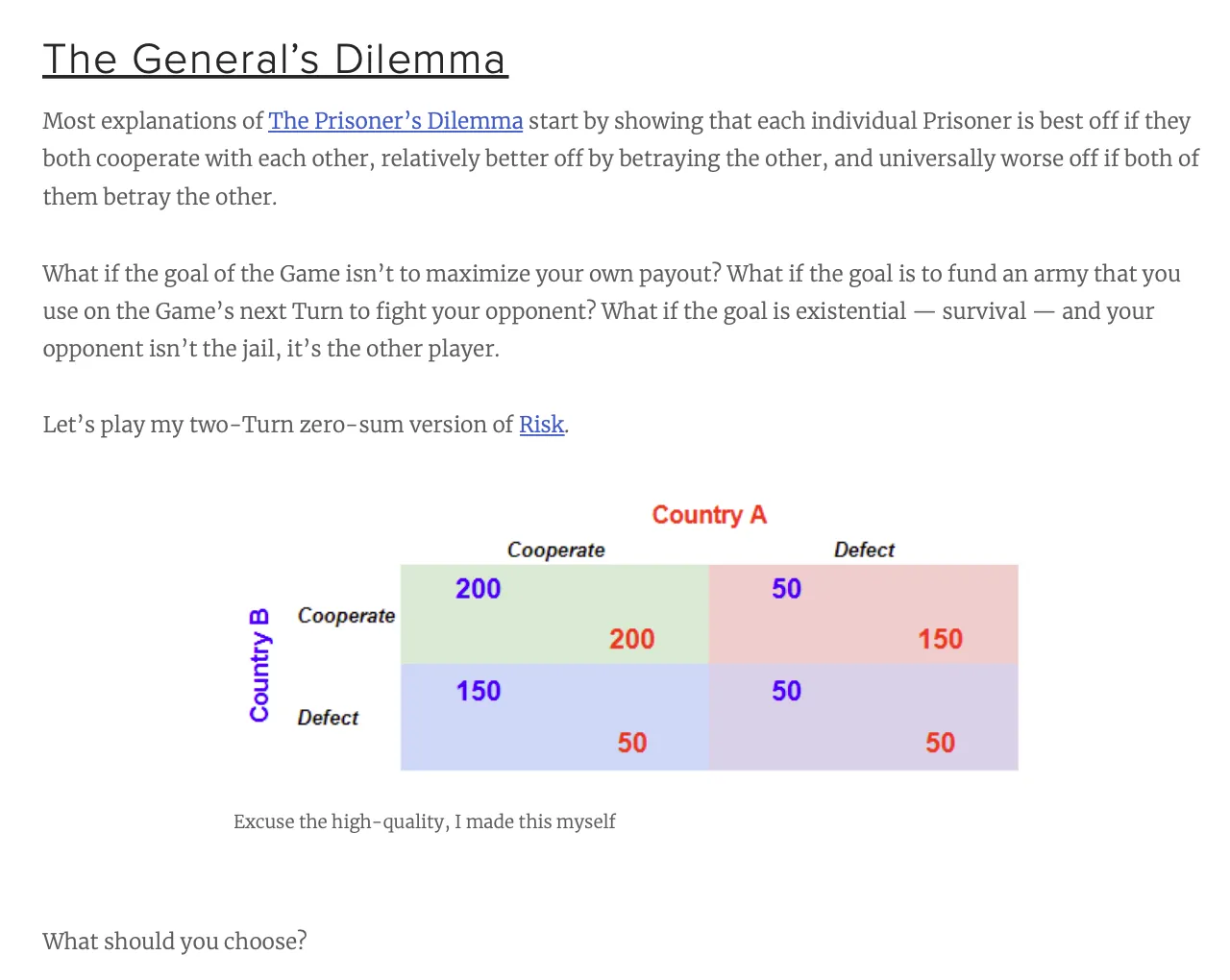
...One last thing. The problem of fascist regimes is they are irrational, pride themselves on irrational precommitments, drink their own Kool-aid, and assume that their opponents are scaredy, sovlless, too-rational-by-half merchants who can be played like a damn fiddle, by dangling incentives they'll myopically follow.
This fails every time. Their opponents have pride too. More importantly, they can reason through the pic related.
Can you?
I'm not as polite as @TheDag and not as interested in getting people to agree with me, so don't take this as a definitive response.
What differentiates the human being from other creatures is our teleological and philosophical capacity; if we're going to base our societies on whatever people's last-ditch preferences are when they're terrified of death rather than carefully-laid philosophical understandings of value, I'll take my chances in space Korea same as you.
Needless to say, I consider your perspective ridiculous, not informed but entirely molded by the ancestral terror of death and accompanying learned helplessness in the face of it; everything about your post, from your disgust reactions to your philosophical notions of value, and the idea of appropriateness of decay, and the very concept of «normal», only add up to eddies at the edges of a mindless screaming void, facets of deeply ingrained and perhaps indeed evolved coping with the status quo that's at odds with our very teleological capacity you speak so highly of. Children, though – even children of Christian backgrounds, encouragingly – know what's up before they are taught to lie to themselves and others: they know that death is bad the instant they first pause their playing with life and see it for what it is, and this recognition implies a very plain telos under any decision theory that acknowledges goodness and badness, not just utilitarianism.
Together with your musings on evolution as adaptation to particular environments, where a man and a lamprey are put on the same pedestal of accomplishment, what you propose is a perversion and denial of all that's uniquely interesting about humans by metrics intuitively available to us. Moreover it's technically wrong: we are no longer adapted to a particular environment. We have conquered every environment and purposefully created entire new ones, and have evolved under their pressures (ultimately producing people as diverse as you and I), because we have broken through the limit of adaptation via natural selection. This is what we are, and there is no real philosophical limit to this process that can be grounded in what any of us is at a given point in time.
I take the perhaps unusual perspective of a Platonic approach to the human being, from which much of my gut-level reactions emerge; there is an ideal form against which human beings are evaluated, and deviations from this form are defects, whether they end up enhancing or reducing one's capacity. I actually think this is how the human brain actually interprets and understands humanness, even for itself, as demonstrated by everything from body dysmorphia to phantom limb pain to the uncanny valley to body horror.
That's funny because I often post a link to «What Does a “Normal” Human Genome Look Like?» essay by Maynard Olson, which has influenced my thinking on transhumanism:
Nonetheless, questions about the genetic basis of variability among generally healthy humans will not go away. Public fascination alone will keep it alive, as will the realization that genetics is unlikely to revolutionize medicine until we develop a better understanding of normal phenotypic variation. So, what have our first glimpses of variation in the genomes of generally healthy people taught us? First, balancing selection, the evolutionary process that favors genetic diversification rather than the fixation of a single “best” variant, appears to play a minor role outside the immune system. Local adaptation, which accounts for variation in traits such as pigmentation, dietary specialization, and susceptibility to particular pathogens is also a second-tier player. What is on the top tier? Increasingly, the answer appears to be mutations that are “deleterious” by biochemical or standard evolutionary criteria. These mutations, as has long been appreciated, overwhelmingly make up the most abundant form of nonneutral variation in all genomes. A model for human genetic individuality is emerging in which there actually is a “wild-type” human genome—one in which most genes exist in an evolutionarily optimized form. There just are no “wild-type” humans: We each fall short of this Platonic ideal in our own distinctive ways.
I can recognize that this Platonic form can be a justifiable end of the journey – or, in a sense, the return, for while some might see how God had preordained stray cosmic rays and mutagenic toxins to do their job in heritably crippling us, that's a bit too carefully-laid a philosophical understanding for me to wrap my mind around. For me it's the most humble transhumanist ideal, the Aleph-null of human destinies. It's quite far from where we are today, certainly beyond all of our natural champions and our feeble attempts at augmentation, simultaneously in all ways worthwhile to excel at. It's still just a mortal ape, of course, but an extraordinary one, and hopefully able to develop some superhumanly good opinions on such matters.
What I stuggle to recognize is the apologia for anything less.
DaseindustriesLtd
late version of a small language model
3yr ago
And pray tell, what are those "genuine desires" and how are they decided?
The method of revealed preferences, mainly, as described in the previous paragraph.
if it comes to my descendants having to be space north korea to remain humans, so be it.
Yeah, Best Korea is pretty sweet. I guess people there are at most 2 SD less happy than in the West.
That's not a very realistic alternative to transhumanism, in my view. A bit too good to be true.
But we are treading the same water.
DaseindustriesLtd
late version of a small language model
3yr ago
This still rests upon the axiom that living the life that is being proposed is better than death, which, again, relies on an aesthetic framework which is non obvious.
Hey, I totally dig the aesthetic of suicidal resistance.
But the point is, there's a great deal of difference between mere dislike and maximally committed antagonism. For most people, their life (and related issues, such as avoidance of suffering, enslavement and mental decline, which I'll omit for simplicity) ranks very highly in the hierarchy of values, so when facing the choice between certainly losing their life and embracing some disliked proposition, they don't hesitate long (this is why mugging works). Indeed, they may fold even over minor discomfort, seeing as they routinely hand over chunks of their autonomy and privacy and ability to shape future to save a bit of time or mental energy, to get a nugget of entertainment or stick it to the outgroup.
Thus for them this is a pragmatic, not aesthetic argument: a factual claim about ways towards realizing their own genuine desires; their aesthetics are compatible with transhumanism by default.
And many arguments are pragmatic in this sense. Outside the context of soapboxing, people rarely deal in absolutes, and live lives full of contingent compromises. On this topic, too, we know the score. Had OG Luddites known what fate awaits them, I'm sure most of them would have made peace with machines; just like most other workers have.
You will find nothing more opposed to the goals of conservatism and traditionalism
Eh, I may be able to think of a few competitive options. What's the trad opinion on subhumanism? It's my invention, fresh outta the oven. The gist is that, forget immanentizing eschatons, being a baseline human is a chore, and most reasons to be one have been diminished by progress, so we should accept being less than that. We should return to monke, to a masturbating animal with shriveled neocortex, an irrelevant and fungible load-balancing appendix to corporate economics, and burn out in sedated contentment.
(This is plausibly the sort of shape your descendants will assume, should they inherit your obstinacy. Seeing as transhumanism is the worst thing possible, would this alternative make you happier?)
For surely if they were right, they would all agree or be able to debate themselves to agreement.
And I wouldn't be so sure about that: people are very good at motivated reasoning, to which they owe their prowess at denying reality.
All of the arguments that could possibly exist for trans-humanism boil down to "I like it" and vice versa.
Ah, but you forget the «otherwise you're getting made obsolete and reduced to praying for generosity of your superhuman overlords» argument, which is a pragmatic appeal to values of self-determination and self-preservation the other party plausibly (and in most cases, including this one, obviously) shares.
Transhumanism proper isn't about fetishistic bullshit like embedding chips into the skin, nor is it analogous to casual sex. It's not merely a moral hazard to conservatives, and doesn't really allow for smug prudish attitude.
It doesn't really matter that little people find transhumanism icky, except for those unfortunate enough to depend on their goodwill. The class that holds power will be augmented, by more or less icky technical means. One can argue it already has been.
The idea that normative beliefs are ultimately founded on aesthetic instincts is a strangely exuberant and infantile one to be proposed by a conservative. Maybe that's a stage preceding acknowledgement that your worldview has been deboonked in your own mind and only hinges on obstinacy. Generally, people think their oughts are derived from what is, and I'd charitably assume they are informed at least by what these people believe is factual truth.
DaseindustriesLtd
late version of a small language model
3yr ago
Not as much as in the West/US, probably – I've always been open about this aspect of my views when asked, and, being able to argue for them politely and with discretion, got decent reception in most groups worth mentioning.
It may be a transient thing, the blessing of Millenials, the only generation that knew a sliver of freedom. Among zoomers and alphas there is growing (I believe) opprobrium evoked by beliefs coded as racist and "chud", because in a sense we are all living in America; and old people are of course influenced by the Soviet Marxist dogma (even though they overwhelmingly do not identify as Marxists), which is identical to the modern American dogma with regards to population differences and expected returns to nurture vs. nature.
IQ specifically is something of a dirty word, which is often justified with a reference to an article «The very best IQ test» by mathematician Vasiliev that made fun of test items in an error-filled translation of Eysenck's popular book «Test your IQ». I gather the original was also bad.
DaseindustriesLtd
late version of a small language model
3yr ago
One, rather liberal, answer is that conservatism is based on relatively unsophisticated heuristics for minimizing risk from novelty, exposure to outsiders and attempts at independent thinking – things beneficial for navigating modern society. Smarter people tend to be confident that they're better than that, and they're kinda right (thus, left).
Another, rather illiberal, answer is that IQ is relevant because it predicts comprehensive success at navigating society, from school to retirement. One of the most important components of such a success is generally avoiding pissing off people stronger than you. IQ is required to figure out their preferences regarding your behavior and modify it accordingly. In most cases it's far too frustrating and cognitively taxing to maintain a separate personality and worldview that's grounded in selfish preferences and unbiased exploration, so the mask becomes the face and people contort themselves into the form expected of them on the inside as well. «IQ realists» tend to be disagreeable, and are either good enough to maintain appearances while saying their true beliefs on anonymous forums, or don't care about the cost, or think they can afford it.
DaseindustriesLtd
late version of a small language model
3yr ago
Taleb himself is wholly incapable of taking it, though: he's got the thinnest skin on Twitter and embarrassingly rationalizes his preemptive ego defense as "alpha moves".
DaseindustriesLtd
late version of a small language model
3yr ago
Irrespective of their opinion on Ukraine as such, Red tribe folks tend to despise language policing and ridicule all «ackchyually, starting today the approved word is LatinX» type innovations. Politically correct identity labels, pronouns, trans women are women, Parents 1 and 2 (which Putin tried to play at), words are violence, retiring «problematic» technical terms like master/slave etcetera – they're always apprehensive at the least; and this basic conservative trait, following from their core impulse of guarding against alien moral coercion, is consistent throughout the battlefronts of the Culture War and across the shades of Red. It would be perfectly natural for gun-toting patriots in those small Republican-voting towns to be in awe of Ghost of Kiev and solicit donations for the Ukraine – while taking the piss out of pearl-clutching Blues who accuse them of perpetuating linguistic harassment peddled by Russian trolls with the intent to subvert Our Democracy.
My rule of thumb for HackerNews with regard to wrongthink is: if the username looks like a real name, then opinion discarded – at best, it's some sellout mid-career manager with a reputation at stake, in fact he's likely posting not out of genuine interest but only to neurotically reinforce his reputation, a highly compensated yet politically powerless peasant quaking in his boots at the thought of angering the HR Inner Party cat lady sovereign – if she were to check and see him being the first to stop the applause. At worst, something lobotomized and ChatGPT-like, impervious to logic.
If it's some random alphanumeric string or witty nonsense, that's perhaps a hacker or at least a thinking person, and worth a read.
...
Case in point.
Compared to TheMotte it's markedly worse, for the aforementioned reason of HN being a good boy pageant rather than a pseudonymous discussion forum of people selected for having issues with orthodoxy. Fundamentally it's the same because there is no penalty for trotting out the same two-bit, long-discredited gotchas (muh «race boundaries are nebulous», «the Irish were dumber, checkmate» etc), therefore no progress is being made and, indeed, there is a regression in cumulative knowledge with attrition of the best. Then again, no community of notable size satisfies this criterion – as far as these topics are concerned.
Scott's wrongthink in this case is so anodyne I think it's more interesting that Topher Brennan (incidentally the gender theorist Ozy Brennan's, nee Franz', husband and father of her child – guess some people just never get over their inferiority complex) believed it to be a decent attack vector, and judging by those discussions it is giving some people enough to work with. I doubt they even read it – they just skim to confirm that on the level of sentiment he's pro-HBD – and therefore definitely pro-racism, and likely pro-white supremacy and Nazism to boot.
Confirmation bias works the same way for any belief system – with pizzagates and voter frauds just as well as with suspicions of progressives. You need tremendous social capital to merely earn a hearing from a person, and not an adversarial sentiment classifier.
More options
Context Copy link