
FiveHourMarathon
a worthless check, a total wreck, a flop
And every gimmick hungry yob
Digging gold from rock n roll
Grabs the mic to tell us
he'll die before he's sold
But I believe in this
And it's been tested by research
He who fucks nuns
Will later join the church
User ID: 195
 FiveHourMarathon
a worthless check, a total wreck, a flop
1yr ago
That's why I cited to Tolstoy specifically, rather than the always contested and complicated historical record.
FiveHourMarathon
a worthless check, a total wreck, a flop
1yr ago
It's fascinating the way people frame what things constitute facts about reality, and what things are supposed to be changeable.
This turn in public opinion was not just entirely predictable given Israel's actions, but it was undoubtedly the plan within Hamas before 10/7. Hamas was never under the impression that they were going to sweep from there to Jerusalem, they were hoping to do something so horrible that Israel would "have" to respond, Israel's response would lead to global backlash against Israel, and bring the conflict back to front of mind.
This was obvious from the word go. The goal from the beginning was to bait Israel into committing atrocities.
Why was world opinion widely treated as something changeable, while Israel's reaction wasn't? "Any country in this position would have to invade!" "You can't expect Israel to restrain itself!" "People need to realize that Israel has the right to defend itself!"
It's interesting to me that people who frame themselves as hard-nosed-unemotional-realists refuse to accept public opinion as an aspect of reality. Especially for Israel, a country that has always depended on western public opinion. I guess we need to have someone write a popular Warhammer 40k fanfic in which a grizzled commissar with some kind of cyberpunk eye patch gives a speech about sacrificing lives for public opinion gains, and then it will fit into their framing of themselves as hard-nosed-unemotional-realists.
I'm realizing that realism is just a different form of woolly headed idealism. In the same way they decry foreign policy idealists who want to see a rules based international order, they live in an imaginary world where war is the only reality and might makes right.
FiveHourMarathon
a worthless check, a total wreck, a flop
1yr ago
I'm not clear where the relevance of your comment to mine is so forgive me if I'm off base.
The devil is in the details, but most of the questions on the immigration forms, I don't really care, bigger fine. Probably not terrorism, though given the broad strokes the new admin is painting with I'm probably associated with a terrorist organization by being on this forum with some of y'all. 生不如意事十之八九.
FiveHourMarathon
a worthless check, a total wreck, a flop
1yr ago
I'm not really sure he could. I don't actually think there's a practical point at which one could recruit a sufficient number of new officers to ICE without serious unintended consequences. There just aren't that many people who want that job.
FiveHourMarathon
a worthless check, a total wreck, a flop
1yr ago
I recently read Barry Lam's excellent pamphlet Fewer Laws, Better People, which has a similar theme around increasing discretion granted rather than focusing on formal discretion-free rules, so that is influencing my thoughts on this. I highly recommend the book
I started off being a bit taken aback by the idea Tyler proposed that we should almost just abandon accountability. I've generally been somewhat pro-accountability...
Two thoughts about what accountability means.
"Nobody ever got fired for buying IBM." When you make people accountable for their decisions, you encourage conservatism. You target not their results, because nobody totally controls results, you can only punish them for bad process. And this leads to conservative process. You stick with the big reputation contractor, you never take a risk or do anything bold. Defensive medicine. Follow the procedure, check the boxes, and whatever happens happens. We don't like this result.
On the other hand, people point to internal loci of control, we need people to want to act with excellence, with skin in the game. But think of War and Peace, of the Grand Armee marching into Russia. If Kutuzov had been held accountable for the loss of Moscow, we'd all be speaking French. Every other general was worried about being held accountable socially, of being judged a coward. Kutuzov alone was willing to take on the social opprobrium of being judged a coward, of losing Moscow, of running away from Napoleon. Napoleon expected Kutuzov to act like every other brave general he'd faced, afraid of being held accountable, when the right decision was to behave like a coward.
The important thing is to pick the right people, and trust them. Give them discretion to achieve their goals. And then hope for the best.
I always think it's worth noting that out of all the kings of Israel in the bible, there are maybe three and a half good ones. Out of 70-some Roman emperors, only perhaps a dozen were any good. Out of 43 presidents, the majority were pretty mid. Ditto kings of England, or France, or Ottoman Sultans, or Chinese Emperors. History consists mostly of mediocrities, a single great leader sets up the system and everyone coasts off that for dozens or hundreds or thousands of years.
FiveHourMarathon
a worthless check, a total wreck, a flop
1yr ago
I have less idea than I did before. Shouldn't a metaphorical sign, be, idk, twelve words max?
FiveHourMarathon
a worthless check, a total wreck, a flop
1yr ago
Odd to talk about Republicans having consistent ideological positions during Tariff Week.
FiveHourMarathon
a worthless check, a total wreck, a flop
1yr ago
And even beyond that, we do not always know for sure what type of fighting a given source describes. It could be for war, for self-defence, for regulated judicial duels, for nonlethal competition...
And even beyond that, we don't know what the informal rules or social prestige goals were within those situations! There was a point made in a BJJ podcast I was listening to recently, that there’s a popular meme that there are “no rules” in street fights (or bar fights or whatever term you prefer). But for the most part, actual people who engage in fights are typically restrained by legal codes and social restraints. The French tradition of Savate, which in Marseille developed among sailors, consisted primarily of slaps and kicks because the law at the time considered using a closed fist strike a deadly weapon, while slaps and kicks were punished more lightly. There are also social rules: most of us in middle or high school would have agreed that if you got into a fight it was wrong to hit the other guy in the balls, and that a guy who did so was kind of a pussy/bad person, so that would be avoided both because of potential social opprobrium and to demonstrate one's courage and toughness. Similarly we can have social goals, like puncicate, the Italian soccer ultra tradition of stabbing opposing fans in the ass, which dates back to medieval first blood duels where stabbing your opponent in the ass was difficult and showed skill. Traditions like counting coup among the Plains Indians were common examples where even in war, actions are optimized for social prestige rather than deadly effectiveness. And even within a regulated and ruthlessly competitive sport like American football you see a team like my Philadelphia Eagles innovating on the Brotherly Shove, and a lot of teams refuse to use the play and criticize it for being distasteful, unaesthetic, a “rugby play” rather than a football play.
All sports start as a way to demonstrate some trait, strength or toughness or grace or speed or skill. And often the process of developing competitive strategies leads to situations where those traits aren't demonstrated in the same way, or entirely different traits end up being demonstrated.
FiveHourMarathon
a worthless check, a total wreck, a flop
1yr ago
We're both guessing.
80% of voters don't vote in midterm primaries as compared to 63% in the 2024 general. Assuming that all of the primary voters did vote in the general, essentially 1/3 of the general election voters voted in the midterm primary. So within that slice of voters in Republican primaries, as long as Trumpists maintain 50% control, you can't win a primary. Even if the anti-Trump candidate would do better in the general, or even among R voters who don't show up, it doesn't matter because they'll lose the primary before any of those people get a vote.
FiveHourMarathon
a worthless check, a total wreck, a flop
1yr ago
In terms of the first novel, may I introduce the "Golden Ass" by Apuleius as another contender. It as episodic as Don Quijote, but also contains an overarching plot that I think would qualify it as a novel.
In my mind Don Quixote is the first novel because the literary tradition that would follow all flows through Cervantes. Stuff like Genji or The Golden Ass or Daphnis and Chloe all have a good argument for being examples of the form that came before Cervantes, and influenced Cervantes, and novel is kind of a vague concept anyway. But I'll return to the Columbus analogy: there's various stories of various European explorers, or occasionally Zheng He, traveling to the Americas; but Columbus is still the guy because his trip lead to continuous open communication with the new world. In the same way, writers had occasionally written stuff that was novel-like without it leading to a continuous flow of novels being written, but it was after Cervantes that the novel becomes a continuous great form written consistently, and the Quixote and the works it influenced would influence all later novels.
It's almost certainly better than what we have now, but it's also a system that produced, in large part, the generation that allowed Europe to commit collective suicide in the First World War. Maybe it's not fair to pin the blame on the war on the education system, but the way the European elite were educated during that era certainly influenced the propaganda, mass hysteria, and doubling down that allowed the war to get so out of hand.
It seems odd to blame the classical European educational system for WWI destroying the world of the classical European educational system. Everything that was worth saving about that world was built by the men who had gone through that system.
And at any rate, St. John's is under no illusions that it is anything other than a set of weirdoes preserving a tradition. They have no need to think about what the world would be like if everyone tried to go to St. John's, or if a hundred other colleges chose to imitate the curriculum. It's not going to happen, not anytime soon. We're not in any danger of suddenly returning to strict standards. The fact that anyone is preserving these strict standards means something.
I hear your point on reading widely and encouraging exploration, but too often that turns into a standard's-free slopfest. At 33, I can balance that literary diet pretty well naturally, without resorting too heavily to listicles, my mind craves Plato and Gibbon; at 16 we need to be working on nurturing a good palette in our young men, and that is going to require some degree of forcing them to read the right stuff. In my mind, your ability to interpret and explore is improved by being immersed in a canon, really any canon. My choice is the classical anglo-high-culture canon because that is my culture, but it is more about taking a bite out of one cohesive set of works as a base from which you can digest other works. China has its own canon of literature and philosophy that can be imbibed profitably. I've heard the Russian Canon praised in that the important works from Pushkin to Pasternak can be read in an industrious year or two.
FiveHourMarathon
a worthless check, a total wreck, a flop
1yr ago
I've repeated my criteria for the Trump administration, and my hesitancy to rush to judgement too quickly. I'm waiting until the mid terms to see if my life has gotten better, or worse.
Then I'd recommend utilizing the little bar next to any post about Trump for the next eighteen months to minimize discussions on it.
This is such a weird reversal in the demand for hugboxing, that I'm seeing on Twitter and IRL as well. Where I felt like last year the story was "SO WHAT IF BIDEN DOESN'T KNOW WHO THE PRESIDENT IS, WHAT ABOUT FASCISM!?!?" Now I'm seeing so many right wingers telling people to stop talking about the tariffs because idk there's a trans fencer or something.
FiveHourMarathon
a worthless check, a total wreck, a flop
1yr ago
Futures markets are reported literally every day. I have no idea what this post on "psyops" is about.
FiveHourMarathon
a worthless check, a total wreck, a flop
1yr ago
If it happens rapidly and you don't have an effective right to appeal, which it's not at all clear you do, then it might be at any time for any reason.
FiveHourMarathon
a worthless check, a total wreck, a flop
1yr ago
At least they'd be paying taxes.
Tbqh, at a sufficiently high fine, I probably don't really care if drug dealers are in the country illegally or not. It's not like we don't have enough native shitheads to work in the industry.
-
Slaves have poor motivation to improve their condition. They have little aspiration to improve their position, and practically speaking you can't beat a cook into making you a great dinner. You can beat them into cooking you A dinner by beating them if they don't cook; but if you're going to beat them unless the dinner is perfect they're probably getting beaten regardless. At which point there's no motivation to make a better dinner. Where a free chef who comes to my house is motivated to enhance his status, make a great dinner, get more business, etc.
-
Free labor typically provides for itself in the long run on a lower wage than it costs the slaver to feed and maintain his slaves. Chattel Slavery only works with continual infusions of fresh slaves from foreign parts, otherwise it doesn't tend to perpetuate itself well.
Of course slavery takes many historical forms, and we can debate details.
FiveHourMarathon
a worthless check, a total wreck, a flop
1yr ago
You're confusing units of analysis. We're not talking about the coalition that elected him in the presidential general election; they only need to be an effective majority of the Republican primary voters in the midterms. Which is a much smaller and more motivated subset. It doesn't even need to be a true majority, just a sufficient plurality that you'd need to run the table otherwise to win the primary.
FiveHourMarathon
a worthless check, a total wreck, a flop
1yr ago
Re:histories vs. historical accounts. I think there is a place for both, but a good history book will a). introduce you to many other primary sources about the period and b). take a step back from some of the bias that is inherent in a primary source account (although you can't really get rid of bias completely). Of course pop history often fails to this, which is why I think trying to read more academic history (Battle Cry of Freedom is my favorite axe to grind here) is the way to go.
A lot of great books courses utilize outside scholarship to give context to works. I did multiple classes studying historiography from primary sources in late antiquity, and we read excerpts of modern "accurate" scholarly works, while reading the entirety of the primary sources assigned. You read all of Herodotus, then you read an excerpt covering the modern view of the Persian Empire, and an archeologist's journal article proposing a reinterpretation, etc.
Few modern histories are important to read cover to cover, from a syllabus perspective.
FiveHourMarathon
a worthless check, a total wreck, a flop
1yr ago
I'm of the belief that all illegal immigration should be punishable by fines. If they can pay the fines, they're clearly doing something worthwhile here anyway.
FiveHourMarathon
a worthless check, a total wreck, a flop
1yr ago
Perhaps, but I genuinely believe that most Trump supporters will not blame his tariff policies for resulting economic damage. The stock market is fake anyway, the woke (((financiers))) are manipulating prices to make Trump look bad. Reports of inflation are either fake or price gouging by greedy businesses. Unemployment numbers are fake or just lazy people who don't want to work.
A) Self deport your entire family back to a country where the average income is $5k a year
Averages are relatively unimportant here. I specified middle class, I'm thinking of my friends, middle class "dreamers" who have relatively responsible jobs, and often college degrees, in some cases professional degrees. I'm not talking about guys who would go back to Mexico and try to get a day labor job there, I'm talking about people I know who work as engineers and lawyers and skilled tradesmen but have no formal legal status (ironic for an ADA). If they went home, they'd have significantly lower standards of living than in the USA, but significantly higher than average in their home country. And anyway, this whole OP is about green card holders, they're by no means all from desperately impoverished countries. People from China and India and Singapore and Italy have all talked to me about thinking about going home!
B) Risk a 1% chance of being deported back to that country and a 99% chance of staying in the country where the average household income is $80k.
It's more like: X%(deported to a Salvadoran labor camp with God-only-knows what odds of ever getting out) + Y%(disorganized deportation in which you might spend significant money or lose significant assets, while spending an indeterminate amount of time in various ICE detention centers) vs. Organized remigration to rebuild a new life in one's home country. Remigration has been pretty common throughout American history, my own family has lots of examples.
And anyway, every brown person who self-deports is one fewer brown person in America, and that is itself a goal for a lot of people within the MAGA movement. It doesn't have to be a main or complete strategy to have value.
ETA: There's also value for some people in illegal immigrants being scared and uncomfortable even if they don't leave. A world where migrants are a frightened, off the books, day laboring underclass that works at prices vastly below American prices; that's different from a world where migrants are buying houses and cars and going to restaurants and acting like normal people.
FiveHourMarathon
a worthless check, a total wreck, a flop
1yr ago
A big part of understanding the purpose of a list of Canon Classics is to understand that it isn't primarily a question of the editor or professor selecting the books to be read, the authors that come after have already selected them and it is just a matter of discovering which books the authors have selected.
Western Literature and Philosophy starts as a conversation with Homer and the Scriptures*. If you continue in chronological order from there, you build your influences. You have to read Homer to (begin to) understand the allusions Plato, Plato to understand Aristotle, the Bible and Plato to understand Augustine, Aristotle and the Bible to understand Aquinas, and it builds from there. This tradition flows through Rome, through the Middle Ages, through the Enlightenment, in a clear tradition of "everyone after X has probably read X and defintely been influenced by X." I'd argue that it ends as a clear tradition with Joyce and Ulysses,** no writer after Joyce failed to be influenced by Joyce or by people he influenced. There's a Hegelian succession, a dialectic, by which you can see how Homer inspired writers who inspired writers who lead to Joyce.
That's the reason for the Anglo-Centrism of the list, it's meant to tell the story of the Anglo intellectual tradition. Take a classic question: what is the first novel? The Tale of Genji is often cited, but it's influence is essentially limited to Japan. Don Quixote is the first novel in the Western tradition. It's a Columbus vs Vikings situation. Cervantes is essential reading if you want to understand the form of the novel, even modern Japanese novels are influenced by it. Genji is interesting to read, but unless you're looking at Japanese literature specifically not necessary.
As for the accusation that lists like this are ultimately poseur-core: Yes. I'm fully aware that my pursuit of reading the Classics and the Canon is a game of LARPing as a Victorian gentleman or something like that. I find that to be a wortwhile goal. One of the biggest weaknesses of those kinds of lists in my mind is that they stop the LARP too early: if you want to read and understand the 100 great books, you should also be going to the Opera and the Symphony and church and watching plays and playing sports and games and going to museums. Participating in that kind of tradition is valuable and good.
*Obviously there are predecessors to both, they came out of a then-existing tradition, but the only extant examples we have are mostly fragmentary, the only one worth considering is Gilgamesh. I have no problem starting with Gilgamesh, the great books course I took did, it's short and it's worth reading, but I don't think you need to start there as its influence is more in the Campbell-Monomyth vague way than in the direct allusion way, you're perfectly safe starting at Genesis and the Rage of Achilles. Much in the same way that pre-Socratic philosophers undoubtedly existed, but we barely know anything about them, so it makes sense to start with Socrates.
**I picked Joyce because I think he's probably the last unanimous genius in the literary tradition, because his work is dense in classical and biblical and canonical allusion and theme and pastiche and criticism, because the publication of Ulysses is a pretty good stopping place symbolically because of the censorship saga it underwent which unleashed the floodgates of smut under the cover of art, after that world literature truly becomes world literature and it's impossible to tell the story of literature without talking about Mishima and Gabo and the Iron Curtain and it all gets pretty messy. That and I'm a sucker for the beautiful circularity of a tradition that starts at the Odyssey and ends at Ulysses, that starts with the Trojan war at the Eastern limit of Europe, and ends in Ireland at its Western limit.
FiveHourMarathon
a worthless check, a total wreck, a flop
1yr ago
Deportation numbers are not higher under Trump than they were under Obama, either in the first term or this one, but there sure does seem to be a lot more stories about illegal immigrants being deported in prominent newspapers
You presuppose that this is a negative tactic from enemies of the administration, rather than a deliberate effort on the part of the administration to frighten immigrants into leaving on their own. "Jump before I get pushed" is the attitude among a lot of middle class immigrants I know personally.
An occupying army, outnumbered by its enemies, must resort to signal acts of violence and terror to impose its will on the subject population. ICE lacks the manpower to actually deport millions of people, and if they set about deportations in an orderly manner then the majority of immigrants on any given day can feel safe. "Oh, they're going after gang members with multiple convictions, I'm just a regular guy with a DUI, I'll be fine for a while."
If you go after people who are more marginal, then everyone has to be afraid. If you go through random people's phones at the airport, if you deport people for any crime, you strike fear into anyone with a DUI or a drunk and disorderly or a bullshit assault.
FiveHourMarathon
a worthless check, a total wreck, a flop
1yr ago
How far do Trump’s ratings have to fall that they are no longer afraid of retribution?
There is no realistic number at which this is true. Trump only needs to maintain a majority of the primary voters, not a majority of the country, or even a majority of Republicans.
The nature of Trumpism is that a GOP revolt is going to look more like various advisers being ousted and Trump having new handlers put in. I don't think open confrontation will happen. The GOP establishment has consistently shown that they lack either the ability or the courage to do so.
FiveHourMarathon
a worthless check, a total wreck, a flop
1yr ago
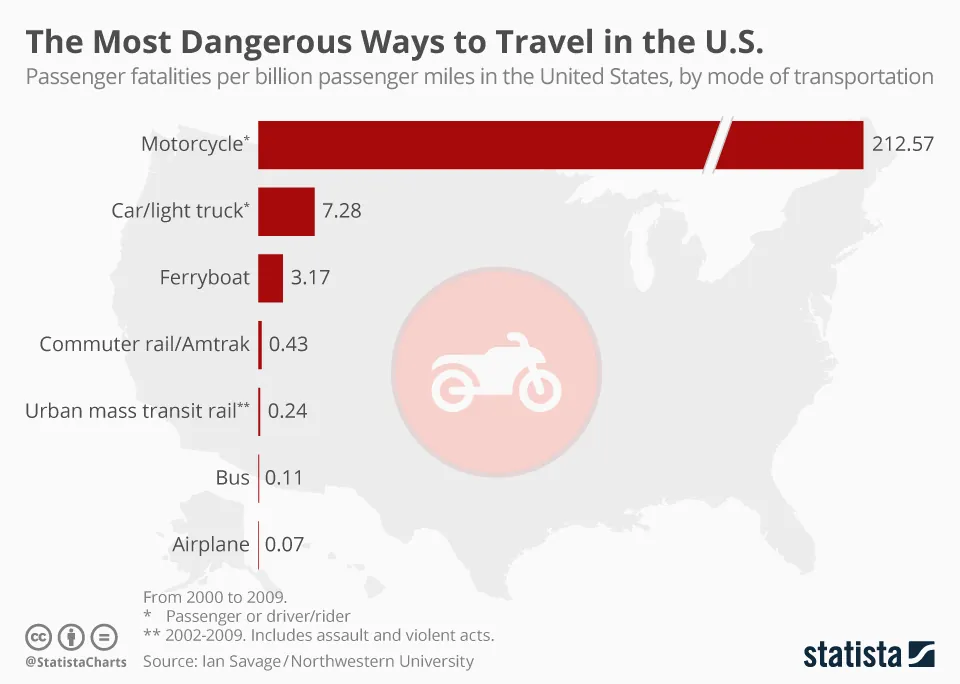
Naively it's Approximately 30 times more dangerous than a car. But, of course, that's on a per billion miles basis, so figuring about 20k miles per year traveled, it would average a fatality every 230ish years if you only traveled by motorcycle. Assuming you have a 30 year riding career left, if you did all your traveling by motorcycle you'd have a lifetime ~1/8 chance of dying that way.
Now adjust for how many miles you'll actually travel on it. Then adjust for whatever percentage of accidents you think are attributable to recklessness above what you intend to stick to. So if you're only doing 5k miles a year, it becomes a 1/32 chance, and if you figure half of deaths are recklessness you won't demonstrate, then it's 1/64.
All numbers after the initial chart are from Myers Young Associated Statistical Surveys.
I feel like "the sign" one taps should be a single sentence. Like the classic tweet:
I meant fuck YOUR feelings, my feelings must be handled gently, like a baby bird.
More options
Context Copy link