

SkoomaDentist
The Greater Finnish Empire
No bio...
User ID: 84
SkoomaDentist
The Greater Finnish Empire
6d ago
It truly is bizarre. How do you even make a recommendation system that bad without immediately recognizing the problems and coming up with some halfway decent fix for them?
that universities are not the people to handle this.
What baffles me about all these situations is that in any sort of sane world (ie. how things work at least outside the US) the university should have zero say in anything that happens between students. Rape allegations would be investigated by actual police and the university's role would be reduced to the same role as eg. a regular apartment building's (ie. providing possible security cam footage etc to the investigators).
The administration literally couldn't go "easy" on a perpetrator because they would be nearly completely outside the process.
SkoomaDentist
The Greater Finnish Empire
7d ago
For me Spotify's recommendations are so garbage that it keeps suggesting different variants of songs I already have on a playlist and songs I've disqualified a dozen times.
This has literally never happened to me. I wonder how we can have such different experiences. Are they A/B testing or something?
See the attached image (top for my playlist and second from bottom for identical suggestion). It's never been able to understand that song A from artist B is the goddamn same song, nevermind whether it's from the album or any of half a dozen compilations.
If it's A/B testing, it sure is persistent as I've had the same problems since I started building that playlist back in 2018.
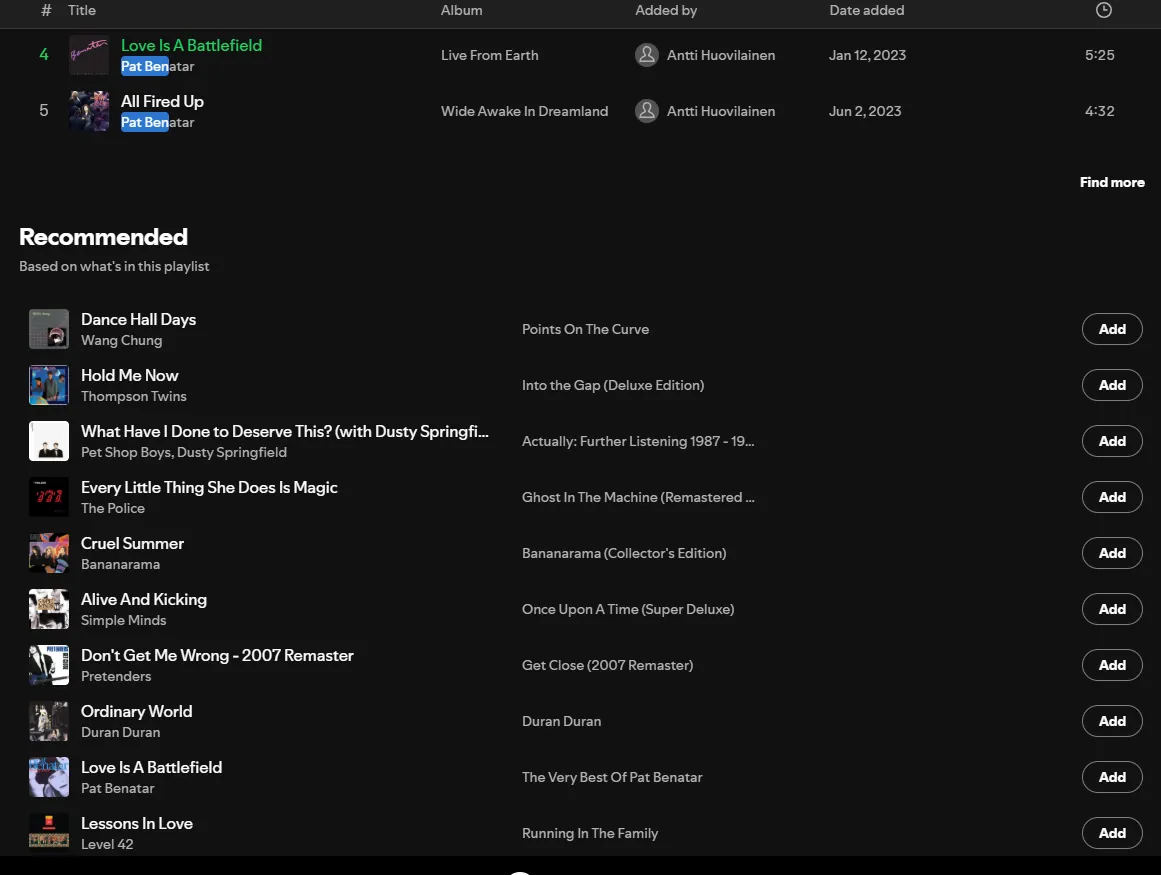
That isn't the only duplicate in those recommendations, btw. Alive and Kicking is also already on the playlist, just from different a different variant of the same album (regular instead of super deluxe).
Yes. I've curated a large 500 song "Best of 80s" Spotify playlist since 2018 which I exported to .csv and just dumped to Spotify with "analyze this and suggest additions that ". Then I gave it feedback on those additions and continued with free form conversation (eg. "I've been a huge fan of Mark Knopfler since seeing him on the Live Aid broadcast" and "I notice sharp decline around 89-91 and complete stop around 96. Explain why") so it ended up asking me a bunch of clarifying questions. It probably helps that I can usually articulate why I like or don't like some song (even if it's just "The song has nothing for me to grab onto" / "it's too bland" / "Catchy AF and I love how intentionally cheesy it is"). I set thinking to high so it wouldn't do only cursory analysis and spent some actual time doing the analysis.
The limitation is that ChatGPT doesn't seem to have much (if any) builtin understanding of the actual musical details of individual tracks, so if you want "guitar riffs exactly like in song X", it can't help you much if nobody has written a review that talks about said riffs in other songs. It does seem to be able to read tabs / sheet music.
SkoomaDentist
The Greater Finnish Empire
9d ago
This is the closest "top 10 things I strongly care about in music"-list I've managed to work out with ChatGPT. You'll have to excuse me pasting it directly from ChatGPT, given that you literally asked for it.
- 1. Strong melodic identity and contour — memorable, shaped lines with recognizable peaks, turns and resolutions; melody should be one of the main carriers of the track’s identity rather than an optional layer over groove or texture.
- 2. Strong harmonic movement and contour — meaningful chord movement, voicing, voice-leading and harmonic trajectory; harmony should contribute real musical identity rather than merely support rhythm, vocals or production.
- 3. Clear musical objects — riffs, motifs, melodies, bass lines, chord figures or other substantial things to grab onto.
- 4. Development with memory — worthwhile ideas recur, evolve and return rather than constantly being discarded.
- 5. Clear arrangement hierarchy and breathing room — foreground/background roles, pauses, decay, handoffs, and instruments knowing when not to play.
- 6. Spatial depth and contrast — a strong sense of acoustic space, with dry/wet, near/far and intimate/huge contrasts rather than everything inhabiting the same plane.
- 7. High musical information with low perceptual clutter — richness is good, but the important ideas must remain separable and intelligible.
- 8. Rhythmic character throughout the musical material — rhythm is especially rewarding when melody, phrasing, riffs, accompaniment, bass, percussion, articulation, syncopation, or their interaction contribute recognizable shape and propulsion, rather than rhythm being reduced to a generic beat underneath the track.
- 9. Production and timbre reinforcing rather than replacing the music — distinctive voices, guitar tones, synth textures, reverb, delay, drums and distortion should expose, intensify or dramatize strong musical ideas rather than substitute for them.
- 10. Contrast and selective emphasis rather than permanent fullness — not everything should be loud, sustained, dense, wet, foregrounded or emotionally maximal all the time; big moments work because quieter, drier, simpler or emptier states exist around them.
Quite a few of them I already knew but couldn't articulate so well while some of it was genuinely new revelations (like "melodic contour" - I always knew I liked strong melodies but that's more detailed and accurate and describes why I strongly dislike some changes in covers while having no problem with others).
The interesting thing is that those had largely solidified by the age of 12 or so with only their relative strength changing after that. Since then my musical taste has expanded a lot but mostly through exposure to more and wider music. It also explains why good music starts dropping off a cliff around '89-'91 (dry, flat, in-your-face style replaces arrangement hierarchy and spatial depth) and completely craters around '96 (groove, vocal delivery and modern production tricks replace melody, harmony, riffs and other pitched musical objects). I never quite understood why so many people get mad when I articulate why I dislike almost all modern music.
So I end up liking songs ranging from 90s Eurodance to prog rock with extremely strange parts to celtic folk to 80s pop while being simultaneously very selective about what I listen to.
SkoomaDentist
The Greater Finnish Empire
9d ago
The trick is to have a really fast ctrl-W reflex.
The recommendations were even worse than Spotify's.
How? Seriously?
For me Spotify's recommendations are so garbage that it keeps suggesting different variants of songs I already have on a playlist and songs I've disqualified a dozen times. It could be trivially improved by multiple orders of magnitude without even requiring any intelligence and all that could probably be done by a fresh junior level programmer if they just added "don't recommend this song ever" and "don't recommend this artist for this playlist". As it is, Spotify keeps shuffling the same two or three dozen songs over and over in the recommendations, none of which I like, just because they're "popular" among people who listen to the artists I have on my playlist.
I don't think it understands music very well.
It doesn't directly understand music (*) and I ran into that when I asked for recommendations about "guitar music" within 80s pop rock genres, as that would have required it to actually listen to a bunch of tracks and analyze specific sub-attributes in them.
It does however seem to have a good understanding of what's been written about music and coupled with being able to follow instructions ("If an obvious major artist isn't already on my list, assume I don't like them") that worked wonders for me in honing out my true music preference profile and then getting recommendations both within the 80s rock & pop genres (more new additions than I'd found in the last 6 months by myself) and in completely different genres ("You don't like any classical music but do like Thomas Tallis? Check out these renaissance sacred polyphony polyphony composers." / "You hate all jazz but somehow don't mind Don Ellis' Whiplash? Try these specific tracks in that same composed, odd-meter, riff-driven corner of Jazz.").
Basically a combination of "analyze the common patterns across a large tightly curated playlist and ask me questions to further hone in on them" and "use prior analysis to suggest compatible music in genre X or across subgroup Y".
YMMV of course.
*Edit: It can analyze uploaded mp3s on some level but doesn't seem to have much internal detailed musical knowledge of existing songs as such.
SkoomaDentist
The Greater Finnish Empire
9d ago
I learned my lesson with Goatse and Lemon Party. In hindsight those were good inoculation against the Real Horrors of the internet.
SkoomaDentist
The Greater Finnish Empire
9d ago
The best thing about the original video is being able to talk about it while having been extremely careful to never watch it.
Have any of you tried feeding a list of your favorite songs to ChatGPT / Claude and have it analyze your music taste?
I've long been bothered by Spotify's utter garbage recommendations, so I sent my 500 track 80s playlist to ChatGPT and had a long conversation with it about other examples I like and don't like. The result is frankly eerily accurate and manages to simultaneously explain my distaste for all post-1996 popular music and how Kraftwerk, trad Irish music, 80s pop and mid 90s Eurodance all fit neatly and consistently under the same "me like"-umbrella.
SkoomaDentist
The Greater Finnish Empire
13d ago
Seriously? I think your peer group is very strange if that is truly your assumption.
If you replace "car's undercarriage keeps dragging on the ground" with "my car has problem X", it sounds very ordinary set of problems to me and I live in a modern western country. Delivery drivers are notorious for not even bothering to make an attempt to deliver goods if they are in a hurry. Car's have various issues all the time (my previous car would try to forcibly turn me on the opposite lane even brand new because the lane pilot was braindead and would forcibly turn itself on every time I started the car). Speech to text is notoriously unreliable. And so on.
But then, naively, wouldn't we expect diseases to form almost exclusively in places like India or Africa where density is high and medical treatment is poor? Why haven't we seen more diseases?
Haven't you watched the news in like the last decade or few at all?
Ebola, Zika, Mpox, plain old HIV.
Diseases form all the damn time in Africa.
SkoomaDentist
The Greater Finnish Empire
13d ago
Generally we start putting boxes in boxes of layered safety and only have tragic outcomes when all the holes in the "swiss cheese model" align.
I’m reminded of a previous job where my coworkers were working on a robotics project. Not only did the control software have the usual safeguards but the robot also had proximity sensors that cut the power to the motors if any of them fired and that was all done with hardwired logic ICs and no software in the loop. It wasn’t even any dangerous industrial stuff. Just a tabletop robot with low power motors meant to be used in a lab and an inherently safe actuator at the end of the arm.
SkoomaDentist
The Greater Finnish Empire
14d ago
You mean like two thirds of The Motte and 90% of SSC/ACX folk?
SkoomaDentist
The Greater Finnish Empire
15d ago
perhaps to the detriment of other skills
Nothing perhaps about it. It's pretty widely acknowledged that many (or even most) new models are benchmaxxed to perform well in agentic and coding tests at the expense of pretty much everything else.
SkoomaDentist
The Greater Finnish Empire
16d ago
First, I very specifically did not say that US control over the resources was good or in Denmark’s interests, only that allowing China to have such control is bad for Denmark’s national interests.
Second, it’s really two factors: US has already had military control over Greenland for six plus decades. So nothing really changes in that respect. Second, China is in cahoots with Russia (mostly in an opportunistic way, not due any ideological reasons) and Russia is an actual live threat to Europe, including Denmark (not in a ”Russia will win a land war” but ”Russian leadership is crazy enough that there is a very real risk they choose to go for an ’everybody loses’-scenario”).
In this particular case no, I strongly don't think that having a choice to allow China control over such things is in Denmark's national interests. It's probably in the interests of specific politicians, parties or governments, but not in the national interests.
This is really no different from eg. mass immigration from MENA definitely not being in the national interests of a whole lot of European countries which hasn't prevented many of the governments supporting it. Politicians, parties and governments do short sighted stupid shit all the time.
SkoomaDentist
The Greater Finnish Empire
16d ago
Any such ban is very likely in Denmark’s national interests and only needed external pressure because like everywhere, politicians tend to be extremely shortsighted and will rate ”Look, we’re getting $20M investment” over things such as ”Wait, how come China was able to control a critical resource and allow Russians to set up permanent spying stations here?”
SkoomaDentist
The Greater Finnish Empire
16d ago
ancient niche chip company
You have a very strange idea of "ancient" if you think a company founded 33 years ago is "ancient".
SkoomaDentist
The Greater Finnish Empire
16d ago
Google search is an AI product, AI is their core business. Google have spent hundreds of billions on AI research, they invented the transformer architecture but have little to show for it.
They have one thing: A search engine that they've intentionally enshittified so much that quite a few people will just ask eg. ChatGPT because Google results these days are so unbelievably bad that it's less effort to verify potential AI hallucinations than try to find the actually useful search result in the googlestack.
SkoomaDentist
The Greater Finnish Empire
16d ago
models generally becoming good at following instructions over long horizons
And yet.
ChatGPT Sol absolutely.
insists on
writing.
Like this.
In a shitty.
broken up.
style.
If I ask it to demonstrate a writing concept or somesuch and there are people in the scene. It will happily tell what the problem is and how to supposedly prompt it away but will then keep on writing like that. So much for "good at following instructions".
SkoomaDentist
The Greater Finnish Empire
16d ago
even though it’s 10x (or more?) safer than average drivers.
Those things only apply on average random samples. As soon as they hit a consistent failure mode, you end up with Problems.
SkoomaDentist
The Greater Finnish Empire
16d ago
More likely it's due to the numerous instances of what's very likely Russian sabotage having been found recently. And of course then there's the basic fact that Russia threatens nearly weekly some European country with war.
What parts of that aren't actually true?
More options
Context Copy link