

incognitomaorach
No bio...
User ID: 1274
incognitomaorach
2yr ago
As regards strangely high eBay or Etsy (etc) prices, this has been a thing for decades and while it’s occasionally a (usually very unsuccessful) attempt at money laundering, it’s often just mentally ill individuals. The same thing is true if you look at weird eBay where people “pay” insane amounts for things - the purchaser is usually challenged in some way and the money never changes hands
Mentally ill individuals being targeted, making the listings, or both? I could buy that. It does seem particularly schizo.
incognitomaorach
2yr ago
Fact checking should have been in quotation marks, amended
So some of you may have seen the latest round of pizzagate type posts on twitter revolving around Etsy digital images. It started with someone bringing back the Wayfair cabinets story from 2020, here's a "fact checking" post from the time as a reminder https://twitter.com/mediawise/status/1281711438462177281. Essentially the idea was that Wayfair were selling cabinets with the names of children on missing person lists for very large amounts of money, so really they must have been selling kids. Ergo, in plain sight paedophile ring.
Anyway, the latest round focuses on Etsy. There are a variety of 'digital images' of foods/children that are selling for $1000-$90,000 such as here: https://twitter.com/littleapostate/status/1734207558905106462 or https://twitter.com/ShadowofEzra/status/1734368320441192593/photo/1. It doesn't help that a lot of them are pizza related, so obviously catnip to Pizzagate believers- presumably this isn't coincidental.
So what is going on here? Assuming prima facie that these aren't children being sold via online distributor stores this leaves four main options:
- "Fake news"/trolling
- A scam
- Money laundering/tax evasion
- Illicit sales of something other than children
1- The listings were real, you can follow links through to some of them (or see them on webarchive). But that doesn't preclude the possibility that they were made by the people whipping up hysteria or engagement baiting, or just trolling the internet nut jobs. All very possible options
The other options are much more interesting.
Scams
On the face of it, there are a few very funny scamming possibilities:
-
It could be a scam targeted at pizzagate truthers. They try and buy the $3000 digital pizza. png to see whether they get a child delivered, and in fact get a pizza picture. Scammer makes free money.
-
It could be a scam targeted at paedophiles! This would be funnier, as above but believe it and want to try and get a child delivered.
-
It could be some kind of weird automation thing, are there algorithms that buy things on Etsy?
-
It could just be trying to prey on people whom make a mistake or kids. But you could presumably just get a refund, so seems unlikely.
Only the first option really makes sense of these imo, if even one brainrotted internet person decided to fork out thousands to expose the Etsy paedophile ring you'd be laughing to the bank. Again though, I don't know how refunds work, so maybe they could just embarrassingly claim it back.
Money laundering
Fairly self explanatory- maybe the customer base is just other accounts set up by the same organisation, where the flows/receipts from Etsy can contribute to the image of a legitimate commercial enterprise. It might help evade certain checks, but surely the FBI or whoever would see something like this a mile off if it was genuinely an attempt to launder funds. Is there a possibility it's to do with capital controls from a foreign country?
Other illicit sales
There is also the possibility that they're selling another product, like drugs or weapons or so on. But this doesn't make a lot of sense either- why wouldn't they make the sales using the dark net or offline?
I lean strongest towards it being some kind of trolling/scamming effort by non-Pizzagaters, but the possibility that it is a false flag to whip up engagement is also possible.
I don't think this is a conscious (from the POV of the candidate) 'enemy of my enemy is my friend' thing with the Tories though, e.g. Zac Goldsmith had a bizarre set of views that didn't line up neatly with Hindu voters, but the PR/election gurus presumably realised that was the way to go.
I think it's generally underrated how the British class system is sort of race/ethnicity neutral- the upper crust were (and are?) MUCH more comfortable in the company of a Maharajah or a Chief of the Whatever tribe vs. Steve from Sunderland or Paul from Poplar. And related, I think it's underrated how the British imperial light-touch multicultural divide and rule system that was used in e.g. the Raj has basically been transplanted to modern multicultural Britain.
Regardless, the main point is that it is pretty circumstantial that in modern Britain we have this Islam-Labour, anti-Islam (Hindu, African Christian) Tory alignment. Go back to say 1920 and the British intellectual class was fascinated by Persianate literature, the Mughals were seen as the civilising force etc. etc. It is almost certainly down to the fact that (mostly) Gujarati East African Indians or the initial waves of upper class Nigerians are incomparable to say the Mirpuris who dominate Bradford. One is a market dominant minority, the other largely rural labourers. Of course in 2023 this isn't necessarily true- many Hindu or African Christian migrants are working class and so forth.
It isn't that far away a world where the initial Muslim migrants to the UK were Nehru/Zanzibari types and the non-Muslims were Dravidian peasants. And I imagine in that world the left-right, Islam-anti-Islam alignment may be different.
incognitomaorach
2yr ago
Muslim population of England and Wales 2001: 1.6m 2011: 2.7m 2021: 3.9m
Christian population of England and Wales 2001: 47.3m 2011: 33.2m 2021: 27.5m
Somewhat tongue in cheek, so 2 caveats:
- 'No religion' has seen a larger rise (although as above, 'no religion' if replaced by the secular, humanist, liberal Western milieu which seems to be commonplace can be seen as a religion in and of itself).
- Large chunks of the Muslim population growth are either new arrivals or 2nd, 3rd gen migrants. It'd have been interesting to see if Islamic adherence over time could have continued if there'd been strong pressure to convert/the legal status of the CoE had been maintained.
I imagine that the replacement of Christianity with a weak 'Western Humanist' religion is not a long term equilibrium. Something else will fill the gap- what that is remains to be seen.
incognitomaorach
2yr ago
You're right- this got covered at some length in the latest Dan Carlin pod. It is up for debate whether these were Slavicised Germanics, just Vikings doing Viking things, or nonsense.
He suggested that the 'filth' part (which is in contrast with other accounts of the Vikings in their homelands) is a function of 'Men away from home on a slaving trip without their wives letting standards slip' rather than an inherent feature of their culture. There was an anecdote about washing their faces in the same dirty water too.
incognitomaorach
2yr ago
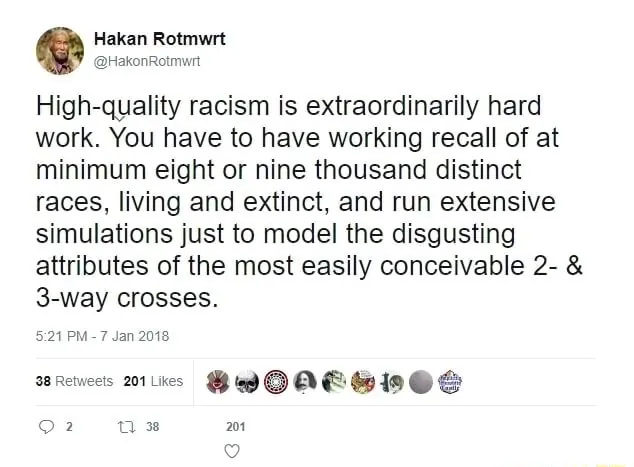
I think anyone who is using the term "Bantu-maximization" is:
a) familiar with the history, using the phrase in the context of the Bantu expansion, and the negative consequences there-of b) familiar with the genetics, Bantu peoples being about as far away genetically as you can get from Eurasians, with the exception of KhoiSan, pygmies, ghost population remnants in Africa etc. c) probably comfortable being openly racist, not designed to disguise the target but in fact making it explicit (this Hakan tweet is relevant: https://images.app.goo.gl/Sr4T1UADRFBM4nCh9) d) and derivative of a, b and c, specifically including African-Americans in their sights.
It is naive to assume that someone using this language would consider a group to be 'more like us Europeans' because they developed iron. It is precisely because of this and a) above that the term is used.
 incognitomaorach
2yr ago
incognitomaorach
2yr ago
I didn't make any effort to defend the premise, but the idea is that that the family of humanist or humanist-derivative ideas in the modern Western sense are a direct result of the Biblical inversion of the weak-strong moral paradigm (Jesus died for our sins despite God, he died for all equally, Jew or Gentile etc). It isn't to say that there can be no atheism (the narrow belief in no God) unless it is Christian, but that the liberal humanist tradition which led to new atheism IS in this Christian pedigree.
I'd be surprised if a religion which has a genealogy that traces a path from Paul the Apostle through to the rights of man, and socialism, and human rights, and freedom of speech and the whole milieu we find ourselves sitting in today could possibly be seen as optimal (as a religion). I suppose if one thinks that a religion that popularises certain mostly beneficial (from the outside view) memes, and then self destructs is optimal then fair enough. I was just expressing doubt that a religion with no defence system could be considered optimal from the internal POV.
incognitomaorach
2yr ago
I don’t think that Christianity is some God-ordained perfect religion — that would be superstitious — but I think it’s approximately the optimal religion, and all other close contenders would look a lot like it.
If you buy that liberalism, humanism and even atheism etc. are all profoundly Christian ideas (Tom Holland's thesis in 'Dominion') then a religion which lays the groundwork for its own collapse is probably not close to an optimal religion. Secularisation, universality, equal value and such are all core concepts of Christianity, and so one may say it was inevitable that such a belief system would eventually be superseded by the current form of itself. Some may argue that these are reformation/Protestant trends, but look at the Pope!
One can imagine an Ontological argument (if a religion is optimal, it exists...) here. Would an optimal religion leave room open (nay, encourage!) doubt and lead to its own demise, or would it be in fact that which had the strongest grip on its population and cultural success over time?
incognitomaorach
3yr ago
This ignores the fact that there is little genetic or ethnic continuity between the 'Greeks' of 1600 BC (Minoans), the 'Greeks' of 300 BC ('Achaeans') and the modern 'Greeks'.
Minoans were pre-Indo-Europeans, who survived the invasions of the 3rd millennium BC, of mostly Neolithic Farmer/Anatolian extract.
The Achaeans were descendants of the Myceneans, who were themselves heavily diluted genetically, but still largely culturally, Indo-European. They were relatively genetically similar to the pre-IE population (i.e. Minoan-like) of Greece, with a minority admixture of Indo-European.
The modern Greeks (with the caveat that there is high variance between e.g. remote island populations and areas like Macedonia/Salonika) are descendants of those Achaean Greeks PLUS huge population exchanges in the Roman period (from Syria, from Africa, from Germania) AND large Slavic admixture in the Byzantine-Ottoman period.
In the classical period, similarly to India, Indo-European admixture decreased as you went south down the peninsula. If we think of Classical Greek ethnicity as essentially Indo-European culture sitting on top of a 1/3 Proto-Greek/IE, 2/3 Minoan-like genetic base, ironically modern Greeks are closest to the northern Mycenaeans- this is due to thousands of years of Slavic admixture (especially during the Middle Ages) increasing the IE/EHG/Steppe Herder genetics.
Picture looks something like:
Age 1, Minoan and Minoan-like 'Greeks': culturally Non-Indo-European, genetically mostly Neolithic farmer, non-Indo-European
Age 2, Mycenae->Classical Greece: culturally Indo-European, genetically 25% IE, 75% 'Minoan'
Modern Greeks: culturally Christian Orthodox/Southern European, genetically similar 33% IE/66% Non-IE
I don't think there is a ton of meaningful sense in which this is one ethnicity. The Greece of Aristotle has been wholly subsumed as a small part of the mixture of Slavs and Levantines and Anatolians, and the culture is gone. It was only really revived as a LARP by Philhellenes of the early 19th Century.
incognitomaorach
3yr ago
As someone who has very little familiarity with US legal culture, can you explain how on earth they arrive at sums like $11m, let alone the $366m in the FedEx case? What is the justification for such huge sums of money?
incognitomaorach
3yr ago
At first blush, this is an absurdity. Then I remember that race relations in the UK are different than in the US, with UK blacks ahead in life expectancy and nearly equal in earnings. I suspect this is largely a selection effect: a much greater share of blacks in the UK are elite immigrants from Africa compared to the US - though perhaps not Somalis.
No, you were correct in your first understanding. It is a relatively small section of London, but in say, Notting Hill, you have large estates mostly divvied up semi ethnically e.g. Somali, Carribbean, Moroccan, cheek by jowl with £15m townhouses.
The road David Beckham lives on for example, is less than a 10 minute walk to multiple estates, and less than 20 minutes walk to Grenfell tower itself. This is (as far as I'm aware) a uniquely (West?) London thing, where the houses by Ladbroke Grove station will be £10-20m and yet 1 road next door will be a very poor housing estate. I used to think it was great, as an example of semi-integration (Ghettoisation leading to say bad shops, bad services). Nowadays, I'm ambivalent, but I appreciate its uniqueness.
incognitomaorach
3yr ago
This is definitely real, and very, very lucky. The primary method of guessing (he's been playing this 0.1 second thing for a while now) is via meta/vibes based stuff, including colour, car tells, photo artifacts etc. The country is easily West African from the 0.1 second snippet, top level players can probably know that it is likely to be Ghana (only some countries are included, Ghana being one of them) based on Meta like this: https://i.redd.it/2ofuurlj61g61.png. (Out of date now, but you get the idea). And then you have a relatively small subset of main roads to choose from. He just got very lucky this time. Even if because of his advanced skills he has a 1 in 1000 chance of guessing the correct road, he must play at least that many games a month.
incognitomaorach
3yr ago
For what it's worth, I could probably dox 3-5 regular posters with overlap on here/reddit/twitter, given say a week or two's work. If you have read 70-90% of someone's comments over the years, you can build up quite a reasonable profile on someone. For example, if you have:
-Age range
-Industry (narrowed to a few places of work)
-Location
-Interests
-Social background (schools etc)
-Ethnicity/Religion
-Sex/gender/sexuality
And at least 2 of their social media accounts, how much harder could it be to dox someone from that, without even having to use data-breaches. If you were a PI I imagine you'd begin by trawling sites like Linkedin (probably the most useful due to the breadth of information and easy access) and quite quickly finding some obvious candidates. I've always assumed I'd be relatively easy to dox and I tend on the lurker side of reddit/blogposts/twitter.
incognitomaorach
3yr ago
And yet, today, if I want to know everything there is to know about the Freemason's, Scientology, or Gardnerian Wicca, I'm a few short internet searches away from it. The mantras of Transcendental Meditation, which normally set a practitioner back ~$1000, can be found on various websites, and the basic technique has been distilled and shared as Benson's Relaxation Response and free apps like 1GiantMind. There is no mystery about what goes on inside a Mormon temple.
By and large, modernity has melted away any barriers for the curious to find out everything about a tradition.
Interesting post. Not the main thrust, but the first groups that sprang to mind when thinking of traditions that have genuinely retained this secrecy are the Alawites and Druze of the Levant. For those who aren't familiar, the Alawites and Druze are kind of off shoot semi-Islamic sects in Syria/Lebanon/Israel, that have some overlap with Islam but also differ significantly. As far as I am aware many of their beliefs remain secret (presumably to retain the pretence that they are an offshoot of Ismailism?) although most Druze say that they aren't Islamic. I think the Alawites do insist that they are however.
Interested if anyone has any other examples, or for that matter, knows much about the Druze and the Alawites (and their secret practices). Are there theories that Alawites are crypto-Druze for example?
incognitomaorach
3yr ago
Just differing circles- I don't know anybody who works at a FAANG on the technical side (a couple in marketing/sales). Everybody I know who works at JS did maths at my university, they hire (graduates at least) from an extremely small talent pool in the UK. I'll try and figure out a way that I can help without doxxing myself!
incognitomaorach
3yr ago
For what it's worth, I know a variety of Jane Street London Office employees and for all of them they either have a great work-life balance, or genuinely love the job, put in more effort/take seniority promotions, and therefore get paid more for more hours, but they enjoy it so it doesn't matter. Hours are usually like 8-5/6ish (depends on whether you're tied to the trading hours or doing behind the scenes work). One person I know moved into their crypto team, so because the market is 24/7 they work Saturdays, but get Mondays off instead. NYC might be different though!
If you do manage to get a Jane Street job, of the 5 staff I know who started in the last 4 years, none have left (and the pay is...impressive), so I'd definitely consider it.
incognitomaorach
3yr ago
I doubt it'll make much difference but to try and clarify again this is an independent film that happens to have been aired on Vice (with the additional interview later, presumably as a quid pro quo for exposure) rather than a Vice production. I used to watch a lot of Vice say, 10 years ago, and it doesn't feel remotely similar to anything they usually put out. I assume you've watched it, which is how you knows it's shitty?
incognitomaorach
3yr ago
I think you've misunderstood - I'm fully aware that most elderly people don't live like this. I'm not from the US, the whole thing was really bizarre and surreal.
This was just a specific response to this particular reaction by a specific group of elderly people, in what felt like a dying society. And I thought it raised some interesting points in a really candid way.
I also don't think it's particularly useful to call it a "shitty" documentary- I get that Vice is hardly prestige cinema but it's merely a platform for what I think is a very well shot and visually interesting film about a little known part of America.
incognitomaorach
3yr ago
Just to answer 3) now- this is one of the other main points on the documentary (I didn't want to get into the inequality angle on this post). In fact it was exactly that part that made me think of the idea of "off-worlding" or escaping. Those who can afford to just nope out.
incognitomaorach
3yr ago
Yeah this is talked about in the doc, mostly in regards to a) water usage and b) conflict between the two sets of people. Thanks for the extra detail.
incognitomaorach
3yr ago
Thanks for pointing this out- at the moment I'd imagine average age is closer to 70-75, but obviously 10 years ago that would mean mostly silents. The demographics data on the wiki page will probably get you an exact answer.
incognitomaorach
3yr ago
Well if the whispers coming out recently about public sector pensions are to be believed (extensive use of incredibly highly leveraged tools to try and deliver increasingly unrealistic inflation linked expectations) then pensions do seem to be an upcoming issue. But no, it is mostly due to healthcare costs. Not unrealistically good healthcare to everyone though, at this point it is nearing basic adequate healthcare to a subset of the population. The NHS is in a really, really bad shape at this point (Emergency response times are sky-high). But that's mostly just an allocation issue like you said.
incognitomaorach
3yr ago
I suppose that's the inevitable response if you start from the individualist perspective. What I meant is the tragedy in comparison to leaving the money to your children, giving them a better life, rather than frittering it away. It's easy for me to say this, nowhere near retirement, and god knows I'd probably do something similar myself if I was in that position. But it's clearly a bit weird that you work all your life, and then towards the end you say "I've done enough now, for my progeny, so I'll just spend the money on eeking out an extra year or two and alcohol and other hedonist expenditure." And I know it's asking a lot and perhaps holding people up to too high standards, especially given they've put a good shift in already, but to me that feels like something which is tragic, over and above staring into the face of your own mortality in an existential way.
A massive chunk of it goes on the Villages corporation itself (I realised I forgot to mention that, but it's basically a semi-private township). And a larger chunk goes on Healthcare- but then that's an argument about accurate allocation of resources I suppose and value for money.
Judging by online reaction there are a hell of a lot of people who believe it. Some believe a CP version (also doesn't pass smell test). It's been amplified by some DR voices online, presumably just as engagement bait.
More options
Context Copy link