
 ymeskhout
3yr ago
If a republican supports abortion access they are a stupid hypocrite for going against their stated principals. If they oppose it they are blundering idiots.
I didn't ding Republicans for opposing abortion access, I dinged them in this case for doing it in a blatantly inept and underhanded manner. Not only did it not work (and was not likely to work) but it cemented a subterfuge narrative. I still acknowledged multiple times that the pro-life crowd faces an unenviable challenge in communicating their position to the wider public and how that naturally limits their options..
This idea that being popular or politically successful is somehow synonymous with being good/virtuous is one of the more pernicious and evil elements of the whole secular liberal academic memeplex and it really needs to go away.
I never said or endorsed this idea.
ymeskhout
3yr ago
Yeah, I fully endorse this approach. This is why I added the "earnest" qualifier when I talk about the pro-life crowd, because I can't who exactly supports abortion restrictions because they genuinely believe it's akin to murder, and who supports it for other less defensible reasons such as wanting to discourage sexual promiscuity. The argument against promiscuity gets undercut severely the less risk sex has, and it's a big tell about the true motivation here given how much Christian groups opposed the HPV vaccine for example.
ymeskhout
3yr ago
This isn't a theoretical issue for Ohio, specifically: 2015 had a pair of conflicting constitutional amendment issues that were a confusing mess, followed by a 2018 constitutional initiative that was even more lopsided in terms of funding. These efforts hadn't succeeded yet, but they were getting increasingly close, for something that would have been very hard to reverse (and near-impossible to reverse quickly), despite often pretty stupid and badly-implemented targets.
Good call on reminding me about that marijuana referendum clusterfuck. I can definitely see a principled concern arguing in favor of some referendum restrictions given the potential for problems you've described.
ymeskhout
3yr ago
I was on The Bayesian Conspiracy podcast with Eneasz Brodski and Steven Zuber. It was a super fun conversation where ran through an absurdly broad range of topics I've already written about. So if you're into that kind of kinky shit and want to listen to me talk for almost two hours, give it a listen.
This episode really would not have taken place had Eneasz not serendipitously recognized my voice out in real life. What a weird place to find myself in.
Episode show notes:
We speak with Yassine Meskhout of The Bailey about... a whole bunch of things actually.
LINKS
Yassine's Substack
The Motte
The Bailey podcast
Yassine's I Am Here Because Of Blind Dumb Luck
Check Here For Racial Oppression -- history of the US Federal racial categories
SSC post popularizing & explaining the Motte And Bailey Doctrine
Alex Jones as Epic Poetry
Yassine's posts on Paul Ehrlich's Gymnastics and Meghan Murphy's Speedrun Guide to Logical Fallacies
There Are No Amendments in Islam
Eleven Magic Words
Morality is Accidental & Self-Congratulatory
Consider The Hand Axe
Slavery in Video Games
The post about that video game with slavery
ymeskhout
3yr ago
Amazing post, thanks for sharing your experience.
This last point often gets overlooked in out culture. Many people absolutely hate fat people. They despise them with a vitriol usually reserved for heretics or murderers. They keep it under wraps as its not socially acceptable to express these opinions in our present culture safely, but will pounce on any opportunity to lash out at the hated other, who they are superior too. Maybe there is some evolutionary advantage to this.
I used to be one of these people. I lived in the gym and the dojo. I reveled in defeating my opponents in competition. I had a lifetime of good diet and exercise habits, until I didn't. This is the opportunity these drugs offer, a break in the dysfunctional cycle of poor diet to give the body time to be re-trained. Even this is too much for some people though. Fat people, being morally inferior, deserve nothing but suffering forever until they die in misery apparently.
I share the perspective you describe. I know I have an absolutely ravenous appetite but at 6'2" 220lbs with half-assed diet scrutiny but lots of weightlifting and HIIT cardio I'm pretty happy with how I look and what I'm physically capable of at my age. But I also know (and often forget) how easy it is to fall off the wagon. I dislocated a kneecap while giving someone a lapdance (I wish I could say it was worth it but no it fucking wasn't) but it took several months of ineffective physical therapy to find out that I had a complete ACL tear.
Just finding out the news led me to completely give up on all my habits because given how long ACL surgery recovery takes, why bother? My weight ballooned by 15lbs just in the month leading up to the surgery. After the surgery I was stuck on crutches for several weeks and because I was also unemployed at the time, I also had absolutely nothing to do except eat a lot, so I gained another 15lbs on top of that. My surgery recovery took far longer than it needed to, because I'd constantly oscillate between "oh fuck me I don't fit in my clothes anymore, I gotta start cutting NOW" and "oh fuck me I am too fucking exhausted from cutting calories to do any of my physical rehab, and still too debilitated to have the option to go HAM at the gym like I used to. That tension was agonizing to deal with in the moment and eventually resolved with time, but I forget how lucky I am that I have the health and enough positive life circumstances that allow me to turn things around if I need to.
ymeskhout
3yr ago
Ohio Republicans' Inexplicable & Baffling Abortion Blunder
I support expansive abortion access purely as a matter of practical considerations because of how legal prohibitions encourage horrific black market alternatives. I part ways with the pro-choice crowd when they respond to a difficult morality question with flippant dismissal. So at least from that standpoint, I sympathize with the earnest pro-life crowd because they're helplessly witnessing what is (by their definitions) a massive genocide made worse by the fact that it's legally-sanctioned.
So if you're in that unenviable position, what are your options? The major practical problem is that abortion restrictions have been and continue to be extremely politically unpopular. The Dobbs decision generated a lot of what basically amounted to legislative reshuffling at the state level. Some states had trigger laws banning abortions, that awakened from their long slumber only for courts, legislatures, or voter referendums to strike them back down to sleep.
Ohio's law banning abortions when a fetus heartbeat could be detected (typically occurs within 6-7 weeks of pregnancy) was struck down by a court last year, and so currently abortions there are legal up until "viability" (typically understood to be 22 weeks). On top of that, a referendum was set to be voted on this upcoming November election which would solidly enshrine abortion access within the Ohio state constitution (worth noting that this is the only referendum on the ballot). Given where public opinion is at on this issue, the amendment is virtually guaranteed to be approved by voters. What can you do to stop this train?
Ohio Republicans responded in a very bizarre and inexplicable manner (part of a pattern it seems). Apparently aware that the November referendum was going to be a shoe-in, they organized a whole special election in August as a preemptive maneuver to increase various thresholds for constitutional amendments, including raising the passing percentage from 50% to a 60% supermajority. That measure failed in the special election held yesterday, with 57% of voters against it.
Where to start? First, asking voters to vote against themselves was always going to be a challenge, and Elizabeth Nolan Brown notes the rhetoric supporters of Issue 1 had to resort to:
One talking point has been that it protects the Ohio Constitution from out-of-state interests. (For instance: "At its core, it's about keeping out-of-state special interest groups from buying their way into our constitution," Protect Women Ohio Press Secretary Amy Natoce told Fox News.) Another has been that it signals trust in elected officials to safeguard citizen interests, rather than letting a random majority of voters decide what's best. (The current simple-majority rule for amending the state constitution "sends the message that if you don't like what the legislature is doing, you can just put it on the ballot, and soon the constitution will be thousands of pages long and be completely meaningless," Carol Tobias, president of the National Right to Life Committee, told Politico in a prime example of this tack.)
Some of the TV ads the supporters ran were so incoherent. I don't know how representative this particular example is but the 30-second spot avoids saying anything at all about abortion and instead argues that voting yes on Issue 1 would somehow...protect kids from trans drag queens in schools? The fuck? I guess they knew that "vote yes on Issue 1 to keep abortion restricted" wasn't going to be a winning message so this tangent was the only option.
Even if somehow Issue 1 had anything to do with gender identity indoctrination in schools or whatever (if anyone can explain this please do!) it bears repeating that the only referendum on the ballot in November was about enshrining abortion access. Voters are dumb but they're not that dumb.
Just this last January Ohio Republicans passed HB 458 which eliminated almost all August special elections, but then they insisted on passing another law walking that back specifically to make sure Issue 1 got its very own election. The gambit apparently was to help its chances by leveraging low voter turnout in special elections. This too is baffling, because the timing gimmick very likely energized the "Democrats' highly educated neurotic base" as my boy Yglesias so eloquently put it. Also, the type of voter that is willing to show up to a special election is not going to be the type that is inclined to wrest control away!
None of these decisions made any sense. By investing into a preemptive referendum to raise the threshold, they loudly advertised they knew their issue was going to lose in November. By carving out an exception for an August election, they demonstrated they knew they couldn't win unless they act like a Turkish ice cream man with voters. By conspicuously avoiding talking about abortion, they're acknowledging their policy position's unpopularity.
I'm again acknowledging that the pro-life crowd faces an unenviable challenge in advocating for their position, and clearly their attempts at persuasion over the last several decades have not been panning out. But who actually thought the blatant gimmickry described above was actually going to work? All it did was showcase how weak they must be if the only tool in their arsenal was comically inept subterfuge.
ymeskhout
3yr ago
It is banal with how I phrased it. I just want some sort of hint, because my current impression is that he pretended otherwise.
ymeskhout
3yr ago
His reply struck as me as earnest, particularly because he at least offers a why for the what. That said, I'm still annoyed, but not at all because of the content of his past opinions but entirely because they were left unacknowledged and hidden until a HuffPo expose forced the question. I would have respected him a lot more if he was more upfront and honest about how his opinions have changed, even with a perfunctory "I used to believe other stuff" passing reference.
ymeskhout
3yr ago
Thanks man, I'm glad you liked it! His takes on journalism were not at all what I intended to cover but I found his perspective very interesting and so just kept digging further into that topic. The Motte and similar corners of the internet are understandably very into text for obvious benefits, but I've been working on a post about the enduring utility of having real-time conversations about topics because it provides benefits that can't be as easily replicated via text exchanges. Either way though, once I figure out a good workflow for Whisper, I fully intend to offer transcripts for all episodes.
ymeskhout
3yr ago
I don't know how much of this was intentional on your part, but the major problem I see with your approach is how many unacknowledged assumptions you're glossing over. It all starts with what you're assuming [trait] to be. For example with race, we can boil it down to "difference in skin pigmentation" combined with "difference in societal hierarchy" and so this gives you relatively easy galaxy-brain template to play with if you were transporting this idea to another setting (e.g. "what if societal hierarchy was determined by another arbitrary aesthetic trait? Really makes you think"). To repeat what @WhiningCoil asks:
I mean, the problem is nobody knows what trans people are. Are they born that way? Is it a social contagion? Is it a fetish? A mental illness?
So yeah, what is trans? You're not explicit about it but you take it as a given that trans people are just people who happen to be somehow saddled with the wrong "birth gender" (I find this terminology extremely grating but I'll set that aside for now). You're implicitly accepting a mountain of implied assumptions here (people have a "birth gender", people can feel 'misaligned' with their "birth gender", people who feel this misalignment feel distress if they don't "fix" it, etc etc) and inevitably this will color how you approach the rest of your implementation.
On the other hand, if you believe that trans people don't exist, or rather if you believe that trans people are really just people who have fallen prey to a rigid expectation of gender stereotypes, well then that really changes things does it not?
I can think of a slew of examples of how I'd implement my understanding of transness into a fictional world. For example, let's say a world has a respected monk caste that relies on a moderately-difficult entrance exam that tests people's psychic defense abilities. As a way to designate membership within this caste, the monks get an ochre-colored glove (something something about the color used as a medium for psychic abilities). Here's Barbara, someone who has long been desperate to join the monk caste but continues to fail the entrance exam. After so many repeated failures, Barbara eventually just adopts the habit of wearing an ochre glove around town, with the goal of hoping that the people she encounters (erroneously) assume that she is part of the psychic monk caste.
There's a range of interesting dynamics that could occur which would perfectly be analogous to what we understand the contemporary trans experience to be. For example some people will see through Barbara's attempts and just humor her purely out of politeness, or maybe someone gets attacked by a mindflaying octupus and breathes a sigh of relief when they see Barbara's ochre glove only to then realize that her psychic defense abilities are actually worthless, etc etc.
You can't really start to implement these dynamics into a fictional world without a precise understanding of what it is you're implementing. And this is especially difficult with transness given the obfuscation combined with the myriad of competing theories (it's a gendered soul, it's boy brain/girl body, it's a hormone imbalance, it's just the patriarchy, etc etc)
ymeskhout
3yr ago
AI-assisted transcripts have gotten way better recently so I'll see about including one by default in the future
ymeskhout
3yr ago
It's notorious for being a large jurisdiction consistently having one the lowest passage rates (relevant demographic here is first timers from an ABA-accredited school)
ymeskhout
3yr ago
In contrast there’s probably no observational data at present that would be very useful in answering the question well. (Silly Aella surveys are unhelpful and probably worse than nothing.) That doesn’t mean that Murphy’s belief is any more unfalsifiable than the particle physicist who needs a bigger particle accelerator’s theory is.
That whole exchange just tells me that Murphy has much better intuition than Aella for why causal inference with observational social science data is hard, even if she doesn’t have the language to exactly explain why.
I'm not following here. I agree that an RCT would be better than a survey, but that doesn't mean the latter is useless. People didn't find out that smoking caused cancer because of some RCTs; all they needed were serious discrepancies in observational data (a survey, in other words). Because we lack RCTs on the subject, I suspect (but don't know for sure) that porn is probably bad for the consumer. However, if there was a survey that found serious discrepancies between the porn consumer and the porn non-consumer, I would certainly keep in mind selection bias etc, but I also would take the findings seriously. It's not conclusive, but that's not the same thing as having zero evidentiary value.
I don't understand what you mean when you say Murphy has a better intuition about causal inference? She's not presenting as an agnostic on this issue here.
ymeskhout
3yr ago
Which is probably why he's seems reluctant to concede his broader argument about us eventually running into limits of what our planet can sustain. For people like him the Green Revolution is a bailout, not a permanent solution, or a change of trajectory towards a more sustainable path. Focusing on a specific prediction would be missing the forest for the trees, unless you want to claim that there will always be a new Green Revolution coming to bail us out when we need it.
This would've been a fair defense of Ehrlich's predictions. Even the first bet could have resulted in Julian Simon losing had they used another time period. The problem is that Ehrlich never backs down. He could have said "My prediction about India was wrong, as I never would have expected such an unprecedented boost in agricultural productivity to happen. Nevertheless, my concerns remain ripe for the following reasons..." but he didn't. Instead of acknowledging he was wrong, he comes up with creatively-shaped second predictions to avoid the vise.
ymeskhout
3yr ago
I tend to post most of what I write simultaneously on multiple places. I generally avoid linking to my Substack here, to avoid the appearance that I'm trying to push traffic to it.
ymeskhout
3yr ago
When Someone Tells You They're Lying, Believe Them
Some people refuse to admit they're wrong, but there's other clues
Paul Ehrlich became well-known for his 1968 book The Population Bomb, where he made many confidently-stated but spectacularly-wrong predictions about imminent overpopulation causing apocalyptical resource scarcity. As illustration for how far off the mark Ehrlich was, he predicted widespread famines in India at a time when its population was around 500 million people, and he wrote "I don't see how India could possibly feed two hundred million more people by 1980." He happened to have made this claim right before India's Green Revolution in agriculture. Not only is India able to feed a population that tripled to 1.4 billion people, it has long been one of the world's largest agricultural exporter.
Ehrlich is also known for notoriously losing a bet in 1990 to one of my favorite humans ever, the perennial optimist (and business professor) Julian Simon. Bryan Caplan brings up some details to the follow-up that never was:
We've all heard about the Ehrlich-Simon bet. Simon the cornucopian bet that resources would get cheaper, Ehrlich the doomsayer bet that they would get pricier, and Simon crushed him. There's a whole book on it. What you probably don't know, however, is that in 1995, Paul Ehrlich and Steve Schneider proposed a long list of new bets for Simon - and that Simon refused them all.
The first bet was fairly straight-forward: Ehrlich picked 5 commodities (copper, chromium, nickel, tin, & tungsten) and predicted that their price would be higher in 1990 compared to 1980 as the materials become scarcer. Instead of rising, the combined price went down. Ehrlich's decade-spanning obstinance and unparalleled ability to step on rakes make him an irresistible punching bag but despite his perennial wrongness, his responses have ranged from evasion to outright denials:
Anne and I have always followed U.N. population projections as modified by the Population Reference Bureau --- so we never made "predictions," even though idiots think we have. When I wrote The Population Bomb in 1968, there were 3.5 billion people. Since then we've added another 2.8 billion --- many more than the total population (2 billion) when I was born in 1932. If that's not a population explosion, what is? My basic claims (and those of the many scientific colleagues who reviewed my work) were that population growth was a major problem. Fifty-eight academies of science said that same thing in 1994, as did the world scientists' warning to humanity in the same year. My view has become depressingly mainline!
Some humans possess the unfortunate egotistical and dishonorable habit of refusing to admit error. It's a reflex I personally find utterly baffling, because nothing engenders someone's credibility to me more than their ability to admit error. So if we can't always rely on people to admit a mistake, what else do we have?
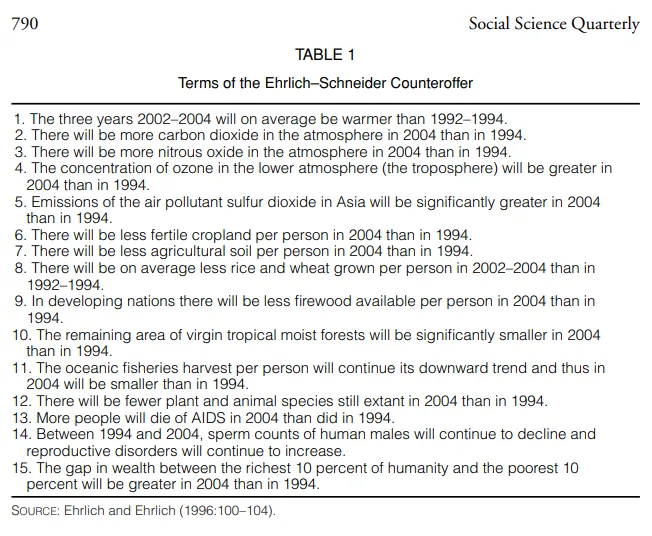
What I find so interesting about the second bet in 1995 is how peculiar the proposed conditions were [image link]:
I kept thinking "...so?" as I read these. Why would someone care about the availability of firewood versus the heating and cooking costs in general? Why would someone care about per capita cropland statistics versus the availability of food in general? Many of these are also blatant statistical fuckery, such as monitoring increases in absolute worldwide AIDS deaths during a period of persistent population growth.
Ehrlich is playing a seemingly uncomfortable game of Twister here, but his behavior makes perfect sense if you read intelligence and agency behind his decisions. The only explanation for the indirect, tangential, and collateral measurements is that Ehrlich knows that a direct measurement will not be favorable to his pet theory. He does not believe in truth, but rather believes in belief as the kids say, and he's not willing to jeopardize it.
The acrobatics are the tell here. When Meghan Murphy debates the sex industry, she has to keep the wheels on her goalposts perpetually greased up. Meghan wants to say that everyone who works in the industry has a negative view of it, but the preemptive goalpost shifting she employs is proof she knows that's a lie. The guy claiming there's a dragon in his garage can only preemptively dismiss [thermal imaging/flour/whatever] as a legitimate investigatory tool only because he knows there is no dragon.
It's not perfect but it's often the best we have. Ideally we get people who act honorably and admit mistakes and are willing to falsify their own theories but barring that, just look for the acrobatics. They're the product of intelligent design, not random chance.
 ymeskhout
3yr ago
I don't know how gauche this is, but I wanted to register that my life is going great on pretty much all fronts.
I've gotten much more serious about exercising a ton over the last couple of years and it seems to be readily paying off despite my advancing age in terms of chronic pain and general athletic capabilities. I've been in a relationship with someone I'm completely enamored with, and still struggling to see where our relationship's stress faults might be (only one I was worried about early on was her veganism and my near-complete-oppositism but she doesn't seem to care). My offline career continues advancing at a steady pace, as has my online "career". This plus the relationship does mean I've been much busier, but aside from missing the days where I could indulge in 15-hour video game binging sessions with abandon, I'm ok.
Overall I've just been much happier and relaxed, even when encountering adversity or stressful situations. I'm not sure how much of my current satisfaction is reliant on external factors like health and financial comfort, but I'm also not sure if I should care. I'll keep enjoying it regardless.
ymeskhout
3yr ago
ymeskhout
3yr ago
You've been banned for this and other threads for 7 days. Not because your conduct was particularly egregious here but because you could use a little bit of time to lurk more and get better acquainted with this site's expectations. You joined only a month ago but in the intervening time you've created 6 top-level threads, almost all of which have been heavily downvoted and reported multiple times (mostly for low effort). Check out the quality contribution threads to get a better sense of what kind of effort is expected.
ymeskhout
3yr ago
There Are No Amendments In Islam
Sarah Haider writes a compelling analysis of the odd political re/alignment you see playing out today between Christians and Muslims on social issues:
Similar scuffles are taking place in Canada, and around the world conservative Christians are locking arms with Muslims in their opposition to the inclusion of gender and orientation in classroom materials. Some are applauding this new brotherhood of Abraham, and hoping that this heralds a change in the winds.
There's really nothing surprising about this alliance at the object-level. What religious Christians and Muslims believe about how society should be structured in regards to promiscuity, sexual modesty, and traditional family structures have long been near-impossible to tell apart. The overlap also bleeds into superficial similarities about isolated rural ranchers defending their traditional way of life from outside influences, while openly carrying their firearms to their places of worship (am I talking about the Taliban or...?).
Sarah is correct that the modern alliance between liberal progressives and Muslims was a marriage of convenience that took advantage of some unusual culture war circumstances, but it's a tryst that was bound to fray apart given the fundamental policy disagreements. One of the efforts to keep the bandwagon held together comes from what Sarah terms Muslims in Name Only (MINOs):
If Muslims decide to be more vocal about their opposition to leftist social agenda, they will find that MINOs will be invited to speak over them, and will succeed in drowning them out. We will be treated to a barrage of ludicrous op-eds that posit Islam as a LGBT friendly religion ("How Muhammad Was The First Queer Activist", etc) as well as profiles of camera-friendly gay Muslims who claim to find no contradictions between "their Islam" and homosexuality. The more intelligent among the MINOs might attempt to put a more theological spin on it with a few cherry-picked quotes from hadith or the Quran, or perhaps bring in some historical flavor by blaming colonizers for anti-gay legislation in the Middle East. "True Islam", it will be revealed, is a religion of Peace and #Pride.
I was raised Muslim but abandoned it as an atheist a long time ago, and this passage is particularly painful for how real it is. The discordant discourse above has largely been operating in parallel and disconnected tracks. On one side you get a bevy of purportedly "Muslim" activists announcing that Islam can mean whatever you want it to mean, and actual Muslim religious scholars responding with The Fuck?:
By a decree from God, sexual relations are permitted within the bounds of marriage, and marriage can only occur between a man and a woman. In the Quran, God explicitly condemns sexual relations with the same sex (see, e.g., Quran, al-Nisā': 16, al-A'rāf: 80–83, and al-Naml: 55–58). Moreover, premarital and extramarital sexual acts are prohibited in Islam. As God explains, "Do not go near fornication. It is truly an immoral deed and a terrible way [to behave]" (Quran, al-Isrā': 32). These aspects of Islam are unambiguously established in the Quran, the teachings of Prophet Muhammad (peace be upon him), and a chain of scholarly tradition spanning fourteen centuries. As a result, they have gained the status of religious consensus (ijmā') and are recognized as integral components of the faith known to the general body of Muslims.
As an atheist I have all sorts of complaints about all religions, but the attempts to rehabilitate Islam's image to better fit liberal sensibilities are pernicious for their particular dishonesty. Because one of the few good things I'll say about Islam is to praise its unusual commitment towards scriptural fidelity.
In case you didn't know, Islam was founded around 600 AD explicitly as the final entry in the Abrahamic religion trilogy. Islam was not presented as an alternative to Judaism and Christianity, rather it was heralded as the true and uncorrupted version of those creeds. According to Islamic lore, Allah (literally just the Arabic word for God) created the world and everything in it and then spent the next however many millennia trying — and implicitly failing — to convey his divine message to humans through a long succession of prophets. First man Adam was also the first prophet, and he was followed by well-known Biblical heavy-hitters like Ayyub (Job), Musa (Moses), and of course 'Isa (Jesus). The full list is unknown and unknowable but Islam assures us that every community throughout history received at least one of Allah's Verified™ messengers.
The reason Muhammad of Mecca is special in Islam is because he's Allah's final message delivery attempt. Adam was the first, and Muhammad is heralded as the "Seal of the Prophets" to underscore the finality. I won't get into exactly why god needed so many attempts to convey his message, but a common point of criticism from Muslims about past attempts (such as Christianity) is that god's message was corrupted and lost through misguided translation attempts. I say this as a Muslim apostate with no stake in the debate but the concern over the Bible's reliability seems uncontroversially true to me given the inherent limitations of translation, and the resulting myriad of competing versions. After centuries of debating whether the in John 1:1 was intended to be a definite or indefinite article from the original Greek, I can see why someone would be too traumatized by the prospect of any translation attempt.
To their credit, early Muslim scholars appear to have taken this mistranslation concern very seriously. All of Muhammad's revelations were collected over time by his followers and, after his death in 632 AD, were compiled into a single book known as the Quran. Islamic theology insists that the Quran is the literal word of Allah which means it has never been modified. Given the religious motivations at play, it's natural to be skeptical of such a claim but it does appear to be solidly supported by the archeological evidence available, with the oldest Quranic manuscripts radiocarbon dated to between 568 and 645 AD and matching what we have available. The commitment to the divine inviolability of the Quran is also reflected in the expectation that, everywhere from America to Indonesia, all practicing Muslims are required to learn and recite passages in the original Arabic. Translations of the Quran exist of course, but reluctantly so and intended solely as a study aid.
The Quran is the central commanding text, but below it are hadiths — a sporadic collection of stories, speeches, and anecdotes attributed to Muhammad and a significant source for how to live the Good Muslim Life (covering topics such as when to assalamualaikum your bros, whether cats are cool, or how to wash oneself before praying). Unlike the Quran, hadiths are not seen as direct guidance from Allah. Instead, their reliability as a guiding lodestar is obsessively assessed in proportion to their authenticity. So some hadiths will be accepted as controlling authorities because they're heavily corroborated by reliable narrators, while others get dismissed because they're fourth-hand accounts on a weird topic and with a dodgy chain of transmission.
The point is, given the obsession over the lineage of the Quran and *hadiths, *it's no surprise that Muslims today come across as especially zealous about following their deen. There's no leeway to fall back on mealy-mouthed "Living Quran" rationalizations for why only some aspects of Islam should be obeyed but not others.
Islam's etymology is about unquestioning submission to authority, purportedly only to god's authority but that's a hard demarcation to keep in mind when political and religious power is near-impossible to disentangle within Muslim countries. Its focus on the eternal afterlife for doling out rewards for devotion endowed me with a fatalistic perspective about my temporary earthly existence at a formative time where I was still grappling with immigrating to the US. My depressed ass then couldn't wait to hurry up and die — an overwhelming desire to to get it over with already so that can experience the promised happiness at last. I left Islam because it's a regressive and stifling bundle of superstitions, ill-suited to living out a fulfilling existence. In consideration of the billions today living under its penumbra, I wish it wasn't so, but that sentiment is not enough to change reality.
I'm comfortable saying that the MINOs who self-appoint themselves as the religion's modern rehabilitators are blatantly lying. If I had to guess at their motives, it probably has something to do with the fact that being a member of a religious minority is too valuable an emblem within the Progressive Stack of oppressed identities to give up completely. For Islam to be the religion least amenable to revisionism does not matter when it's put up against such an irresistible force.
ymeskhout
3yr ago
Humpfest is always a damn good time and it's not so much a porn festival rather than a collection of sketch comedy skits with nudity. The part I found disturbing was likely not noticed by others, but a tiny fleshlight necessarily implies mimicking tiny genitals which...do I need to complete that?
Why wouldn't the regulatory approach face the same hurdles as the legislative approach?
More options
Context Copy link