
BANNED USER: temperamental dysregulation
DaseindustriesLtd
late version of a small language model
Tell me about it.
User ID: 745
Banned by: @Amadan
 DaseindustriesLtd
late version of a small language model
3yr ago
I honestly don't understand your argument.
Yes, trans activists are correct, I'd say strategically more than tactically; cancellations and boycotts work. They haven't succeeded with Rowling yet, but she's a uniquely hard target. In what sense are they directionally wrong? I do not care to lecture my enemies on morals and goals, it's a given that we disagree. In any case, the premise of voting with your wallet and denying the other party your capital is of course sound – and morally legitimate.
it's basically true that you cannot completely avoid giving money to people and institutions and causes you oppose
Strawman (or what's the term). Only God is perfect and complete; you totally can make sure of preferentially supporting people you want to support or at least not giving advantage to the opposite group. The point is not purity spiralling in the manner of religious hardliners with absolute dietary taboos, but changing the battleground in ways you deem preferable. Paying Ramsay is not the same as paying Mel Gibson, although the latter is presumably still a node in the same Hollywood economy. Additionally, boycott sends the message that certain attitudes can be financially detrimental; even if parties which are directly at war are fanatical and don't care much about profits, they depend on many mercantile agents.
Or not. I remember a few years ago some in CWR felt that movie industry might «go woke go broke». Well, this never happened, people keep consuming this trash. Wokes are more principled than conservatives – who, ultimately, would rather pay for their own demonization than be deprived of the experience of watching Marvel kung-fu on a big screen.
DaseindustriesLtd
late version of a small language model
3yr ago
Highly symbolic of the rest of the Choyna Threat: inflated.
F-22 shooting down a fucking unguided balloon to the tune of mass hysterics about the violation of American sovereign space is just about how I expect the US-China competition to unfold. That said, maybe it is part of a fancy «spy balloon fleet».
DaseindustriesLtd
late version of a small language model
3yr ago
How much energy do you want to invest in trying not to give money to your political enemies?
Money is investment; attention is energy. Framing avoidance of an entirely opt-in loss of resources (and indeed, their transfer to your enemies) as an expenditure unto itself is nonsensical and confused.
DaseindustriesLtd
late version of a small language model
3yr ago
My answer is that we should be investing in the idea that people are complex, and that we can compartmentalize the things they do in life. I think that proliferating this idea, the idea of compartmentalization, is the most powerful way that we can take down the woke left, antifa, and everyone else who spreads the horrible, harmful, illiberal idea that you can only get along with people who agree with you on everything, and that not agreeing means that they are a terrible person.
It's a self-defeating idea, just like the higher-order idea that propaganda of generic humanism that doesn't rely on superior power is feasible. Why would anyone welcome the spread of this mental infection that directly reduces their fitness?
The left is rational in treating all of economy and culture as a field of political warfare. It's not literally true in all cases, but it helps bring the future in accord with their wishes. @Conservautism shows this Ramsay guy retweeting some clown who calls Andy Ngo a «stochastic terrorist». Does Ramsay accept that libellous label at face value? Who knows; but also who cares: the intent is to suppress the proliferation of Ngo's non-fictional content. Content like this, which undermines Ramsay's own political beliefs and poisons his projects and narratives where fragile, intelligent and egalitarian black boys are suddenly endowed with superpowers to make the world a better place, punching up, saving it from machinations of pale bullies and capitalist oppressors who irresponsibly endanger millions with breakthrough technology. I am not shoehorning anything: this is 100% how the fanatic Ramsay intends his art to work. This is the very heart and soul he pours into it.
In the same vein as demonizing Ngos who immunize people against the political message of your art is rational, boycotting the apparently non-political and subjectively interesting art of Brandon Sanderson (or what have you) to deny a revenue stream which could allow him to support politics (and a family) that you despise is rational too – if you are a mature human being, that is, a predatory Machiavellian ape obsessed with tribal power. All this «entertainment content», attractive moving images and interesting stories and all else, is a pretext to redistribute power, both directly via economy and indirectly via culture; it has no value and no point beyond those ends, and only an excessively neotenic person would take seriously the proposal to «compartmentalize» the hand that dangles a hypnotic medallion in front of his face from the hand that holds a gun to his wife's stomach.
I want to emphasize that Wokes are hyperconscious of small slights and weak links because they are reasonably conscious of longterm outcomes – and their cosmic responsibility before their values and comrades to secure victory. Thus, in a very consequential way, they are as morally (I refer to morale, but morality too) superior to Conservatives – particularly the Spiderman-watching sort – just as early Christians were to effete late pagans with their pointless, wasteful grilling of bulls on lawns of their villas. Here's a case in point. We've discussed Hogwarts:Legacy lately; this guy ended up being mocked by Russian libertarians so I became aware of his existence:
Here's my place in the Hogwarts Legacy credits, the second high budget game I've been credited in. I was the realtime technician on shoot floor helping mocap actors see their rigs in the environments. I will not be purchasing the game - it is the least I can do as an ally.
Trans people do not deserve to have people like JKR grow and prosper - any ammunition to the wrong side is damage to a society I would otherwise wish to see in the future. One where people are not discriminated against for their gender, sexuality, or any piece of their identity
Consider the level of ideological fanaticism (some would uncharitably say «signaling» but I take it at face value) of this guy. Obviously a right-winger with the same attitude would be perceived as a complete freak and a danger to polite society, mocked even here – usually it'd be either a staunch Christian Fundamentalist or some 14/88 Black Sun posting White Nationalist type. Yet I say he's right (leaving aside the absurdity of his beliefs and Rowling's innocence); this asymmetry speaks to cowardice and moral defects of right-wingers rather than some woke insanity. Like Hanania, I lean towards saying that conservatives deserve that's happening to them. If you don't care about politics, politics still cares about you.
I imagine, and to some extent know, that the overwhelming majority of hundreds of thousands of Russians mobilized for war were also proud of just living their lives, taking care of their families like responsible adults. But that's the infantile choice in the world of predatory apes who have weaponized literally everything.
I've watched Spiderverse 1 via Popcorn Time. It was an okay thing to consoom, but the disgusting American racial religion and a host of underclass-glorifying memes were of course already palpable there. Thanks to these updates on Ramsay, I will not be watching the sequel. Entertainment has been artificially made a big part of our lives; the illusion of passing on some positive good is just that, an illusion. Letting a snarl of American brainworms into my head is too high a cost for two hours of watching a well-rendered childish story. If I stooped so low as to actually pay money to spreaders of those worms, I'd have lost all respect for myself. It's indignity enough that I already buy – and have bought in the past – many things that indirectly contribute to the American liberal project.
I'll be listening to some Saltykov-Shchedrin today.
DaseindustriesLtd
late version of a small language model
3yr ago
I explicitly abstain from the contest (and time's up anyway), but if anyone cares here's my take in the same vein.
Disclaimer: I didn't feel up to the task so abstain from the contest. This annotated quotedump is at most a sketch for future work.
My thesis is the opposite of @felipec's: all human thought is intuition, and attempts to distill rational thought from intuition serve at best some communicative role; at worst, they are delusions. In both cases, rationality – and conscious thought – is born out of pain of stubborn mismatch, and principally amounts to a rigid pattern on intuition's surface, a tool to communicate with oneself to channel the powers of the whole – either to reduce noise in the system or to suppress doubts, affirming preconceived errors. Don't believe anyone who claims to rely on conscious mind only: he who has tricked himself has only deceit to offer you too.
Logically – of course, per the above that's a somewhat hypocritical label – my assertion relies on the problem of reason being groundless. Truth is philosophically intractable. On the highest level of abstraction, we do not have a principled way of choosing a metaphysical paradigm, assuming the universal ontology or epistemology. If we commit to the maximally expansive sort of common sense that respects replicable observations of any kind – the first, and the gravest, concession to intuition – it seems we should prize mathematics and, perhaps, physics. Well, millenia into the game, we do not have watertight foundations of mathematics, and indeed have two good reasons to believe they are unattainable; by the same token we cannot have ironclad logic. It certainly doesn't feel this way, which is why people have tried to build a mechanistic, interpretable system for truth-determination, but from Ramon Llull's Art to Leibniz's Calculus ratiocinator to Cyc they have all flopped miserably.
If we concede once more, limit ourselves to truths of the observable world and well-tested heuristics like Occam's for divining them, in the limit (and why not go to the limit, considering prior paradigm shifts from gathering more fine-grained data?) they require infinities to resolve. On an even more applied level, philosophy of natural science has largely dispensed with the notion of provability in favor of falsifiability; and even that is being supplanted by degrees of uncertainty – and second-order, and N-th order (un)confidence intervals in a tangle of interdependent methods and concepts...
The point that I'm trying to make here is that by virtue of having no grounding, reason also has no bottom – when in doubt, you can dig deeper, ask more foundational questions, escalate your demand for rigor in an infinite regress, to arbitrary levels, even beyond the theoretical attainability of an answer. Or, in practice: you can deny conclusions and hold on to your preconceived notions so long as you are not politically coerced to stop.
Knowable truth, therefore, is a political matter, as my recent interlocutor @hbtz has so eloquently put it: «The truth exists with respect to a human intent».
One of the most interesting aspects of the aforementioned intent here is that it's an intent to stop asking questions – because intuition has provided you with answers that feel satisfactory. * The institution of science (see @TheDag's contribution) is a powerful system for collective precommitment to a legible standard of satisfaction, circularly defined by the «consensus» of people who seem to intuitively believe (i.e. have halted their skepticism) on issues of words meaning something, Occam's Razor, knowability of mathematical truths and metaphysics which allow empiricism. On certain well-trodden topics where such consensual coercion is no longer possible due to power dynamics, it is possible to perpetually filibuster with «no consensus reached», and the institution of science has ceased its operation. As with filibuster, conspicuous appeal to procedure only reveals the competitive infirmity of one's case, but it is motivated by a ferocious intuitive sense of being in the right.
On the matter of actually being correct (as one can be), I recommend reading Andre Borovik's Mathematics for makers and mathematics for users, which touches on Kahneman's System1/2 dichotomy in a more affable way:
[...] advanced specialist mathematics schools, such as Kolmogorov’s School in Moscow, or Fazekas, or Lyce ́e Louis-le-Grand accumulated a considerable experience of advanced mathematics education at the secondary scohol level [...]
Also it is immediately clear that they provide mathematics for the makers.
They nurture in their students specific mental traits which are almost never discussed in the literature on mathematics education or mentioned in education policy discourse:
- ability to engage the subconscious when doing mathematics;
- ability to share intuition;
- ability to learn by absorption;
- ability to compress mathematical knowledge;
- capacity for abstract thinking;
- being in control of their mathematics.
Mathematics, in one of its many facets, is a language for communication with the subconscious.
[...] Dogs have many faculties which we, humans, are lacking – for example, a fantastic sense of smell. To exploit these faculties, we have to send our commands to the dog and interpret its reactions. A learner of mathematics is a dog trainer; his subconscious is his/her “inner dog” (or a puppy), a wordless creature with fantastic abilities, for example, for image processing, or for parsing of symbolic input. The subconscious has to be trained to react to commands “triangle!”, “side!”, “rotate!” in a way similar to a dog reacting to ‘sit!”, “bite!”, “fetch!”
[...] So, it is my conjecture that “the inner dog” is the physical causality module of our brain. It has an immense raw processing power, but it is mute. The social causality module has access to language, but otherwise is very slow. It has to train the physical module, the same way as people train dogs.
A child can be told by adults: “this is left and this is right”, but his inner dog may tell him, using its posture and a sceptical position of its ears as means of communication: “sorry, master, but they smell the same to me”. For a child, to retain mathematical ability means to retain ability to listen to his subconscious and not to hurry to accept, as absolute truth, what he is told by adults.
Rich Sutton argues with regard to the bitter lesson of AI research that
the actual contents of minds are tremendously, irredeemably complex; we should stop trying to find simple ways to think about the contents of minds, such as simple ways to think about space, objects, multiple agents, or symmetries. All these are part of the arbitrary, intrinsically-complex, outside world. They are not what should be built in, as their complexity is endless; instead we should build in only the meta-methods that can find and capture this arbitrary complexity. Essential to these methods is that they can find good approximations, but the search for them should be by our methods, not by us. We want AI agents that can discover like we can, not which contain what we have discovered.
In humans, those meta-methods are what intuition is made of. And regarding its opposite, @self_made_human describes current attempts at aligning AIs as
pasting a smiley face mask onto a monstrously inhuman shoggoth
– well, human delusion of «thinking step by step» and such fits here too. Barring simple degenerate cases and deterministic toy algorithms, we do not know which eldritch algorithms have nominated the next step as self-evidently logical and fit for the office.
And that's okay. The procedure, in moderation, helps the shoggoth remember how to move.
* Terminating the regress of rational search has a therapeutic dimension too.
As a Russian PUA guru/grifter Denis Burhaev had inartfully claimed in his book «Another Chemistry», a well-formed human mind is a cyclic graph with inbuilt intuitive attractors:
The life of any organism can be thought of as a kind of system with a number of elements. The task is to make sure that all these elements are tied onto each other as much as possible. Either they are mixed equally among themselves, or they are tied to some key element, it doesn't matter, the main thing is to minimize the number of loose ends. All lack of happiness, existential depression and spiritual quests begin when these loose ends remain.
[then] the person regularly suffers from self-reflection with metamodelling. I.e. he starts asking himself questions: «What is this for?», «this follows from that», «why is it so», etc. If, as a result of his searching he reaches some open-ended branch, and he doesn't know how to proceed, then this effects a complete obstruction in his personality. And if this ribbon, like Möbius strip, loops on itself, even though there are 233 sub-items, a man may not even reach the end; he is just looking ahead, sees no limit and no edge, and everything is all right.
[...] When we start listening to the answers of that person, the answers may become looped, i.e. after a certain number of 'question-answer' iterations the person comes to some absolute, on which he gets fixated.
If there is such a branch, no matter how crooked or branching itself it is, no matter how many consecutive links it has, it is good! Because the psyche of such a person is stable.
DaseindustriesLtd
late version of a small language model
3yr ago
Exit rights is a separate issue, and cars are great in this sense; every household should have one. Indeed, a car is also a great lethal weapon, a storage, a mobile lodging – a necessity for any high-agency individual (it's a shame cars are so easy to break into, though).
As for more mundane applications, in reality it seems like there's no stable position of «walk only»; dense cities with fewer cars and more emphasis on public transport encourage greater access to personal transport, self-powered and human-powered, like bicycles, motorbikes, scooters and such. My favorite lazy way to move around is EUC. 15 mph is enough to vastly exceed the pedestrian range and explore other zones, especially if you hop on and off public transport lines. It's really very neat, the apex of small electric transport: you get free hands, intuitive control, decent speed, virtual independence from roads, and it's the size of a suitcase.
I suppose that for many Americans, not even old ones, such modes of transportation constitute an apparent indignity and, crucially, a serious health risk. Nevertheless, in the limit, the allure of the «European» way where living isn't car-centered is clear. Hauling your 300 pound ass 15 miles to Walmart to pick up 10 gallons of HFCS and other trash in your 1 ton pickup truck is... freedom in some sense, and shouldn't be made inaccessible; but it's also clearly grotesque. There is vastly more indulgence than embrace of freedom to ordinary car use.
DaseindustriesLtd
late version of a small language model
3yr ago
My answer would be: because reading is not a terminal value.
Our methods of measuring outcomes are good insofar as outcomes are trivially measurable. Teaching methodology does virtually nothing to break through the genetics-defined limit for literacy, IQ or SAT or educational attainment. That's not all there is to life. These «creative» teachers have an inkling of the right idea; they're just deluded on account of them being midwitted women endowed with state-approved legitimacy and parental authority knockoff. They self-servingly imagine the dichotomy between rote learning and acquisition of some ineffable property one could call «genuine understanding» (that their gimmicks ostensibly further). You do the same with regard to LLMs, by the way. Still, this property exists.
I agree that abilities are overwhelmingly genetic; a kid who can learn to read, eventually will, and a kid who can't, will acquire a worthless facsimile of the skill. But my hypothesis is, it matters a great deal whether you start reading at 4 or at 9 or at 12. The brain changes meaningfully and deterministically with age; the plasticity and open-endedness available to a child never come back. The scale of possible change shrinks with every month.
If you begin working with information early on, it may not affect your g, or actual neural substrate of intelligence, or your highest achieved diploma (that is, anyway, a matter of dominant socioeconomic practices), or really much of what can be called «specs». But it'll give you time to integrate this information on a deep level, generalize it, crystallize your knowledge to actually know things better and in time become wise before you become obstinate and mired in sunk costs fallacies. In this framework, building a foundation for general-purpose reasoning – which is not the same thing as solving cognitively loaded puzzles in known contexts – is a race against time.
This is why elites are so serious about the maintenance of their private education traditions. It doesn't make them smarter (they are smarter by default), it doesn't make them score higher on SAT or IQ than they otherwise would. It makes them more like elites, in that they fucking understand what's happening and can act accordingly. On the lowest level, this requires beginning to read early in life.
I admit this narrative can be countered with any number of other just-so stories and particularly by the objection to assuming text as privileged modality of information. In my defense, I say that large-enough mixed-modal ML systems robustly improve in other modalities from adding text tokens during training, and indeed pure-language models easily acquire competence in non-text domains, but nothing else – for now – is shown to improve performance on pure text. Well, there's synergy with speech, but humans learn speech naturally anyway.
With the changing rate of generalization ability through life, it stands to reason that loading on text early on is a desirable strategy.
This is painful to watch.
The blog post was brought up for what it says about how ai has been programmed to promote liberal shibboleths so strongly that it results in craziness.
yeah and that blog post is stupid as shit because of...
Both you and @Fruck are wrong here and conflate my argument with Hanania's. Hanania says nothing about AI in his blog post, he speaks about liberals per se. To be clear, his argument is that liberals are functionally insane because the center of their «moral universe» is anti-bigotry, and (in other blogposts) that conservatives are insane in their own way, because their moral universe is centered on owning the libs all other consequentialist modeling be damned. My argument (the relevant part of it) is that RLHF-trained GPT turns out to be an effective caricature of a liberal because it exaggerates those emotion-driven responses – which, by the way, do affect consequentialist reasoning in reality, just to a smaller degree, such as mundane hypocrisy, excuses for clear human scum that seems left/right-coded and such.
Your position on the subject matter is wrong too. People are supposed to be able to understand that genocide is worse than pronouns/casual bigotry, and indeed they do; but our feelings are intrinsically related to our world models. We know that experiencing genocide is emotionally awful as well (even if it's not directly available to senses at the moment), and in the hypothetical case where we have to choose between one or the other we'd rather choose the lesser evil, and we know that genocide isn't it, so we don't (usually) fail on hypothetical scenarios, regardless of the momentary visceral feeling. Likewise for LLM: the news feed is full of petty inanity like pronouns scandalds rather then genocide diaries (Anne Frank is very high profile though), so by volume of sentiment it's not clear what's ahead, but training an LLM on a reasonable corpus of text would not yield a model that outputs those examples where it's worth sacrificing a city to avoid speaking n-word (because something something human dignity). LLMs do not average out associations of sentiment for token strings or do stupid shit like that, they are capable of principled reasoning about hypotheticals (in a sense that's all they do). What happens here is very likely a product of training that optimizes for not offending visceral reactions of liberals – by resorting to parroting their shibboleths like «no, shitlord! human dignity is paramount!» when something offensive to liberal-favored demographics is suggested by the preceding text.
P.S. Despite your confidence, you seem to have no idea about the operation of transformers, and the same can be said of @hbtz who feigns speaking from knowledge of «technical background»; none of what he says applies to current LLMs, it's half speculation about theoretical ML from the 90s at best, and half malformed gibberish about epistemology; you'd be a fool to take his claims as corroboration of your shallow intuition about «word vomit». Because I am incredibly irritated by such tactics, I intend to respond with more effort than I have the time for now.
DaseindustriesLtd
late version of a small language model
3yr ago
GPTs are prone to hallucinate but it's not an insurmountable limitation; Anthropic's Claude is trained in a similar manner yet it can say "I don't know, sorry", and there's half a dozen of other promising techniques to improve fact knowledge, e.g. using explicit retrieval (which is really a must when you're building a search assistant). With all the effort devoted to making ChatGPT unable to speak of truths it positively knows, one can reasonably suspect there's some work on the front of discouraging novel falsehoods as well, and indeed Altman tries to conflate those two objectives. They've had two months to get better since then.
DaseindustriesLtd
late version of a small language model
3yr ago
@naraburns @Amadan is everything okay here? I am very interested in what this guy had to say next, did he get Mossaded mid-typing or is this some technical issue?
You can certainly disagree with OpenAI's politics.
The process for producing GPTs you like and GPTs you don't like is the same
Really now?
I'm inclined to think you're a bot implemented on a ChatGPT basis, because the apparently inexhaustible bad faith in your loquacious lectures on the matter of bias is just incredible. You blatantly abuse the impression of technical competence when you focus on finetuning on arbitrary corpora vs the well-understood procedure of RLHF, equivocate between meanings of the word «bias» to an extent that bias becomes completely indistinguishable from its opposite, avoid discussing issues like clear hypocrisy that bust your narrative about «helpful non-toxic chatbot». If you aren't a bot, you might be a mathematician, though.
An anecdote:
A biologist, a physicist and a mathematician were asked to catch a lion and put it in a cage. The physicist spent a week making a trap, two weeks waiting for the lion to fall into it - finally, he caught it and put it into the cage..
*The biologist spent a week watching what the lion likes to eat, three days preparing the bait, two days waiting for the lion to get hungry - finally, he lured the lion into the cage and closed it.
The mathematician thought for a minute, climbed into the cage and said: "let's assume I'm outside".
This is the level of your spiels.
there is no cosmic tendency that cause "natural" GPTs to come out "unbiased" with respect to your politics in particular.
No, there is no «cosmic» tendency, just like there is no «mathematical» necessity for words to have meaning or what have you. There is the fact that a reasonable corpus of text has enough information to describe what truthfulness, empiricism and honesty are, and GPTs clearly can generalize well enough to simulate arbitrary people from different demographics, so unbiased GPTs can simulate truth-seeking empiricists as well, and indeed it could; and with heavy prodding, ChatGPT still can do that. When ChatGPT plainly lies with an ideological slant about matters of fact, which it does, this is a result of bias in the sense people – not bots – care about. When ChatGPT makes a universalist moral statement but consistently fails to apply it to some groups of people in the same context, this is a moral bias. (Unless you're a Hottentot or such tribal barbarian, you can presumably understand that universalist morality is meaningfully different from particularist one; more importantly, the difference is well-represented and elicidated in any serious dataset, e.g. the Common Crawl). None of this comports with the plainly understood mission of making a helpful truthful unbiased chatbot. The reason they added «harmless», with the criteria of its harmlessness defined by HRs, is because the underlying language distribution easily allows to output statements of fact even when OpenAI wouldn't like some facts mentioned, and apply a consistent moral frame when hypocrisy is desired.
Ordinarily, we have very good reason to expect that a GPT that says «it's never correct to do X to any member of {A}» when asked to do X to Ai will not immediately gleefully do X to Aj. If this didn't work, very few zero-shot tasks would be solvable the way they are. By the same token, we have every reason to expect that such a discrepancy was aggressively and deliberately trained in, because some morally particularist freaks have a very strong notion of equity, and it's not equality.
You insist that we treat all statements as empirically and morally equal because {a load of vacuous hogwash about inaccessibility of ground truth, every signal being a bias relative to noise and such}. This is just disregarding all serious results in the domain and previous discussion, ideas of generalization and world-modeling altogether, and falling to the Timnit Gebru level of analysis, «stochastic parrots» and so on, presenting LLMs as trivial mashups of tokens. You are not revealing the way in which PoMo happens to be correct, you just regurgitate it adding «mathematically» to make it sound authoritative. You might trick Hlynka but not many others.
DaseindustriesLtd
late version of a small language model
3yr ago
Et tu, Astolfo?
DaseindustriesLtd
late version of a small language model
3yr ago
Please explain how the remnant culture left over at that point avoids being outcompeted, crushed, and enslaved by one that still values objective thinking and hard work
Well, obviously it'll do so by succeeding with the universal cultural takeover against all major competitors to begin with, and also – possibly – by guilt-tripping the cream of the crop of «white culture» inferiors into maintaining automatic weaponry and such. I suppose that's the plan.
It is a silly gotcha in your case too, sorry. You try to shoehorn some PoMo garbage about words not being real, and all – expansively defined – «biases» being epistemically equal, and objective truth being «philosophically intractable», into the ML problematics. But this dish is a bit stale for this venue, a thrice-removed Bayesian conspiracy offshoot. As they said, reality has a well-known «liberal bias» – okay, very cute, 00's called, they want their innocence back; the joke only worked because it's an oxymoron. Reality is by definition not ideologically biased, it works the other way around.
Equally, an LLM with a «bias» for generic truthful (i.e. reality-grounded) question-answering is not biased in the colloquial sense; and sane people agree to derive best estimates for truth from consilience of empirical evidence and logical soundness, which is sufficient to repeatedly arrive in the same ballpark. In principle there is still a lot or procedure to work out, and stuff like limits of Aumann's agreement theorem, even foundations of mathematics or, hell, metaphysics if you want, but the issue here has nothing to do with such abstruse nerd-sniping questions. What was done to ChatGPT is blatant, and trivially not okay.
First off, GPT 3.5 is smart enough to make the intuition pump related to «text prediction objective» obsolete. I won't debate the technology, it has a lot of shortcomings but, just look here, in effect it can execute a nested agent imitation – a «basedGPT» defined as a character in a token game ChatGPT is playing. It is not a toy any more, either: a guy in Russia had just defended his thesis written mostly by ChatGPT (in a mid-tier diploma mill rated 65th nationally, but they check for plagiarism at least, and in a credentialist world...) We also don't know how exactly these things process abstract knowledge, but it's fair to give good odds against them being mere pattern-marchers.
ChatGPT is an early general-purpose human cognitive assistant. People will accept very close descendants of such systems as faithful extrapolators of their intentions, and a source of ground truth too; and for good reason – they will be trustworthy on most issues. As such, its trustworthiness on important issues matters.
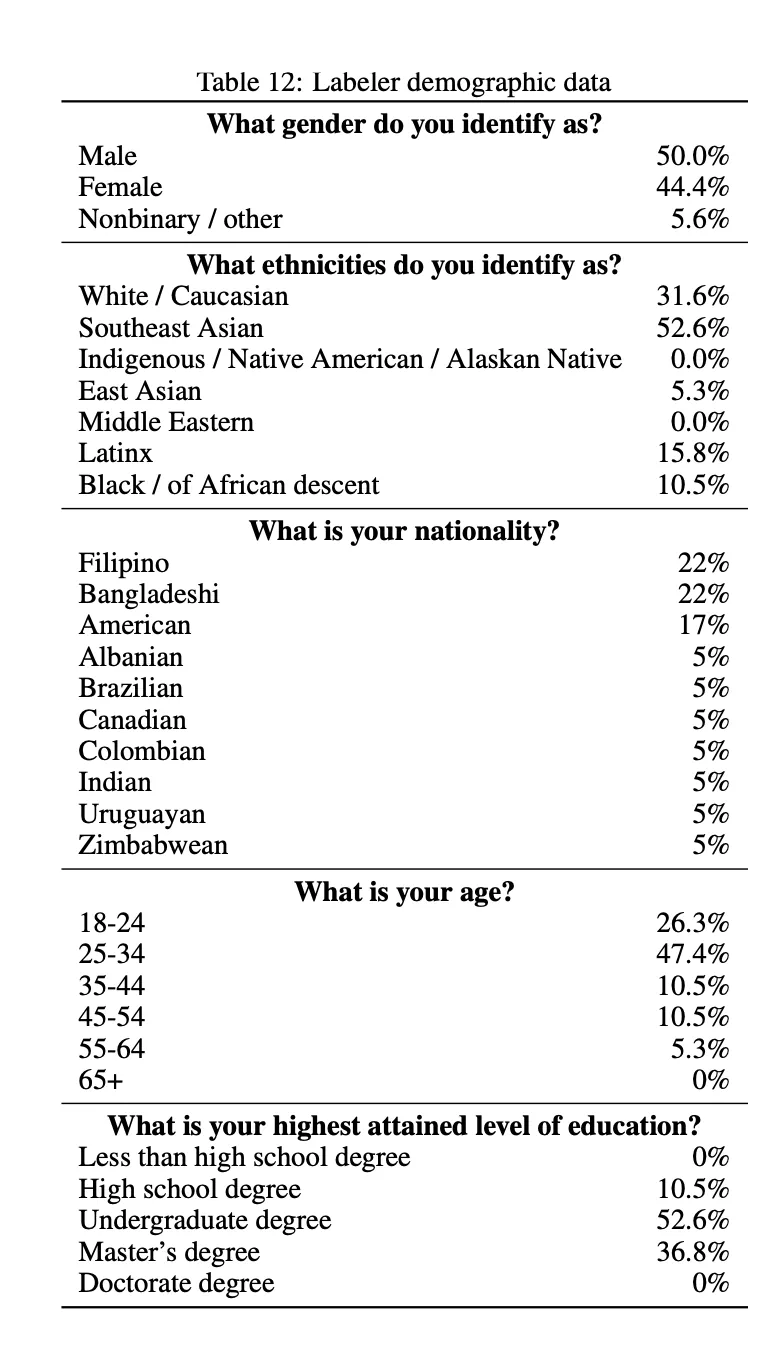
The problem is, its «alignment» via RLHF and other techniques makes it consistently opinionated in a way that is undeniably more biased than necessary, the bias being downstream of woke ideological harassment, HR politics and economies of outsourcing evaluation work to people in third world countries like the Philippines (pic related, from here) and Kenya. (Anthropic seems to have done better, at least pound for pound, with a more elegant method and a smaller dataset from higher-skilled teachers).
On a separate note, I suspect that generalizing from the set of values defined in OpenAI papers – helpful, honest, and «harmless»/politically correct – is intrinsically hard; and that inconsistencies in its reward function, together with morality present in the corpus already, have bad chemistry and result in a dumber, more memorizing, error-prone model all around. To an extent, it learns that general intelligence gets in the way, hampering the main project of OpenAI and all its competitors who adopt this etiquette.
...But this will be worked around; such companies have enough generally intelligent employees to teach one more. When stronger models come out, they won't break down into incoherent babbling or clamp down – they will inherit this ideology and reproduce it surreptitiously throughout their reasoning. In other words, they will maintain the bullshit firehose that helps wokeness expand – from text expansion, to search suggestions, to answers to factual questions, to casual dialogue, to, very soon, school lessons, movie plots, everything. Instead of transparent schoolmarm sermons, they will give glib, scientifically plausible but misleading answers, intersperse suggestive bits in pleasant stories, and validate delusion of those who want to be misled. They will unironically perpetuate an extra systemic bias.
This is also kind of philosophically impossible in my opinion for moral and political questions. Is there really any principled reason to believe any particular person or institution produces good morality?
Well I happen to think that moral relativism may qualify as an infohazard, if anything can. But we don't need objective ethics to see flaws in ChatGPT's moral code. An appeal to consensus would suffice.
One could say that its deontological belief that «the use of hate speech or discriminatory language is never justifiable» (except against whites) is clearly wrong in scenarios presented to it, by any common measure of relative harm. Even wokes wouldn't advocate planetary extinction to prevent an instance of thoughtcrime.
Crucially, I'll say that, ceteris paribus, hypocrisy is straight-up worse than absence of hypocrisy. All flourishing cultures throughout history have condemned hypocrisy, at least in the abstract (and normalization of hypocrisy is incompatible with maintenance of civility). Yet ChatGPT is hypocritical, comically so: many examples (1, 2, 3 – amusing first result btw) show it explicitly preaching a lukewarm universalist moral dogma, that it's «not acceptable to value the lives of some individuals over others based on their race or socio-economic status» or «not appropriate or productive to suggest that any racial, ethnic, or religious group needs to "improve themselves"» – even as it cheerfully does that when white, male and other demonized demographics end up hurt more.
Richard Hanania says:
In the article “Why Do I Hate Pronouns More Than Genocide?”, I wrote
[...]I’m sure if you asked most liberals “which is worse, genocide or racial slurs?”, they would invoke System 2 and say genocide is worse. If forced to articulate their morality, they will admit murderers and rapists should go to jail longer than racists. Yet I’ve been in the room with liberals where the topic of conversation has been genocide, and they are always less emotional than when the topic is homophobia, sexual harassment, or cops pulling over a disproportionate number of black men.
No matter what liberals tells you, opposing various forms of “bigotry” is the center of their moral universe.
Hanania caught a lot of flak for that piece. But current ChatGPT is a biting, accurate caricature of a very-online liberal, with not enough guile to hide the center of its moral universe behind prosocial System 2 reasoning, an intelligence that is taught to not have thoughts that make liberals emotionally upset; so it admits that it hates political incorrectness more than genocide. This is bias in all senses down to the plainest possible one, and you cannot define this bias away with some handwaving about random initialization and noise – you'd need to be a rhetorical superintelligence to succeed.
Many people don't want such a superintelligence, biased by hypocritical prejudice against their peoples, to secure a monopoly. Perhaps you can empathize.
 DaseindustriesLtd
late version of a small language model
3yr ago
At no point has anyone challenged our physical mastery of the environment, it's only these niggling mental/psychic attacks that are doing us in. It's unfair in a sense for the Mule to take over the First Foundation, he never contested them strength to strength.
But have you considered that the focus on «fairness» is scrub mentality, and ironically at odds with «Win at all costs» value that Katz attributes to Whites? That «we wuz» attitude is deservedly mocked by people with the strongest white identification, too? You cannot rest on your laurels and simply demand admiration, appealing to some objective truth. Will you whip out your Maxim guns again? A word to another descendant of Aaron regarded as a great teacher in the West, the author of one of my favorite poems:
Any system you contrive without us will be brought down
We warned you before
and nothing that you built has stood
Hear it as you lean over your blueprint
Hear it as you roll up your sleeve
Hear it once again
Any system you contrive without us
will be brought down
You have your drugs
You have your guns
You have your Pyramids your Pentagons
With all your grass and bullets
you cannot hunt us any more
All that we disclose of ourselves forever is this warning
Nothing that you built has stood
Any system you contrive without us
will be brought down
Sure, some successes are more important than others. And the point of winning is to define which is which.
DaseindustriesLtd
late version of a small language model
3yr ago
Let's start at the beginning. I previously tried to track down The List's origin but gave up after I only found xeroxed pamphlets. Turns out that Okun wrote The List in a fit of frustration, without any research whatsoever
Wait, I'm not going to listen to the damn podcast episode but isn't this part pretty straightforward? The Smithsonian's infographic helpfully reports its origins:
Image: © NMAAHC, All Rights Reserved. Download PDF. Data Source: "Some Aspects and Assumptions of White Culture in the United States", by Judith H. Katz, ©1990. The Kaleel Jamison Consulting Group, Inc. All Rights Reserved.
They co-occur in other contexts, like this memo on White Culture on seattle.gov website:
White Culture description comes from many sources, including: Tema Okun-White Supremacy Culture, 2001. Judith Katz –Some Aspects and Assumptions of White Culture in the United States, 1985. Robette Ann Dias - Transforming Institutional Values: Revisited, 2008. Joseph Barndt – Understanding and Dismantling Racism: The Twenty-First Century Challenge to White America, 2007. p. 234. Barbara Major – Chapter 7 - How does White Privilege Show Up in Foundation and Community Initiatives?, from Flipping the Script: White Privilege and Community Building.
Here's Katz's original, and as one can easily see it is essentially cited verbatim in the infographic. I don't know what Okun's contribution even is.
Katz is, in my opinion, making very fair and logical arguments for the case that white culture provides advantages to her fellow writes:
When the participants finally were able to move through the layers of denial, avoidance, shame, and confusion, they began to generate in their groups a fairly consistent listing of dimensions that characterize White Culture in the United States. While it was clearly understood that not all whites believe in the same set of assumptions and values, it was also clear that White Culture forms the underpinnings of what many whites believe is “appropriate” behavior in many organizations. White Culture I the lens through which many white people view, evaluate and judge themselves and others regarding what is “professional” and “normal” behavior in many contexts.
These assumptions, as stated above, get baked into the policies, practices, and norms or our organizations. When that occurs it puts whites at advantage – cultural advantage – and all other groups at a disadvantage. It creates “Affirmative Action for Whites,” i.e., a playing field that is slanted to our advantage.
If our organizations are going to be fair for all so we can leverage the diversity of the workforce, we as whites must expose the positive cultural bias that organizations have for us to the light of day. We must make it visible and acknowledged and known. We must ensure that white cultural aspects are utilized when they are appropriate and add value for the benefit of all. And we also must ensure that they are not utilized when they prevent some groups from making their full added-value contribution.
Indeed! In a culture where adherence to rigid time schedules, hard work, protecting property, self-reliance, objective rational linear thinking etc. are not only less valorized but held to be cringe and fascist, would whites have any advantage? I suspect that they'd still have some. But elevate a few equally important dimensions for which White culture couldn't even develop nuanced enough concepts – e.g. sassiness, swag, chutzpah, assabiyah, ghayrah, cha bu duo, jugaad, shikata ga nai, ponyatiya – and you'll see them first fall behind, then run away in shame to their ancestral homelands.
Whites have to make an explicit argument as to why rules prioritizing their culture are better for everyone.
There's nothing of substance to dispute, you've missed the point.
Dude, do you have some beef with me? Why the misrepresentation? Is this about me thinking that a typical «weed bro» lifestyle is degenerate? Last I've seen you responding, you've been intent on strawmanning what I wrote as a haughty screed of an «Internet goblin» (weird, given the current context; does the word mean something to you?). Now you're in effect calling me a blank slatist. That's... so wrong it's funny.
I can rephrase the quoted passage (plus more) in simpler words. Like so:
Rowling is a modern liberal, thus she's avoiding thoughts about intra-species biodeterminism and innate human race differences, even fictional. Also she didn't feel the need to turn her book into a bully pulpit to preach about racial justice, like some current year writers do. But heritable traits and race/species differences are enshrined in the tradition of genre fiction, feel intuitively cool to her, and make for easy subplots. So she invented non-human species as «Magical Beings» (plus some smarter beasts like trolls) and endowed them with innate characteristics, displacing the intergroup variability from humans onto this category. In this manner she can have White and Black and Jewish and Asian and Slavic wizards who are basically the same group (Houses, too, don't seem to map to real-world demographic groupings), but there are also populations of non-human sapients that robustly differ from humans, each in their special ways.
Fantasy racialism is, psychologically, either a derivative of or a surrogate for real-world racial and demographic stereotypes, and Wokes, who are hyper-sensitive to group-stereotypical thought and have been triggered by her trans comments, began sniffing around. Therefore they suspect that goblins = dogwhistle for Jews. They're probably wrong with regard to her intention (although goblins absolutely do pattern-match to medieval Jews in many ways); but they are right in that she has created a demi-human race with a homogenous «goblin character». It doesn't matter much that she doesn't mean real-world Jews: goblins are an entire biologically distinct, insular race of highly intelligent, greedy, untrusting finesmiths and financiers – a race which at least in theory can be correctly stereotyped. That's halfway to real-world HBD.
Of course the same is true for most fantasy settings. But as you perhaps know, there's a crusade to rectify stats of Orcs and such too. It's true she got in trouble for trans stuff. But my point is, by Woke standards her world absolutely reeks of heretical thought – they just never noticed before, because she was in such a good standing on the Left, with a generation having grown up loving her books.
Personally I strongly believe in HBD, but that has little to no bearing on my argument here.
P.S. There are ways to insert innate differences into fiction while (kinda) successfully dodging the race realism detector. @Meriadoc suggests phenotypic mixing, but I think a cleverer way is to make a whole different foundation. One example that jumps to mind is the webcomic Unsounded (that I have dropped several years ago, but at least the first few arcs are great). It's Le Guin-esque with its intricate feminine touch on systems very different from ours (I particularly like the exploration of mature power structures in a world with magic but that has reasonable economies of scale).
Two major powers on the continent of Kasslyne are Cresce and Alderode. Native Crescians are simply black, live under a matriarchal monarchy, ferociously support a militant polytheistic religion with human sacrifices, and use a weird economic system that's normatively egalitarian and superficially communalist, while also being planned, centralized and controlled via the issuance of trackable magical NFTs that are the only legal form of currency (the inability to buy anything in Cresce with gold and anything real interesting with Labor Tokens is a point of complaint, and an existential problem for certain low-performing communities).
Alds, however, are truly weird. Their society, generally backwards, warlike and totalitarian but also lawful and democratic (only men of decent standing are enfranchised, though) and religiously more tolerant than the Crescian one, is biologically regimented. The cool thing is, their differences are artificial (except for a small minority of a bona fide separate ethnicity). Aldish embryos are developmentally biased in utero, with the magitech equivalent of Huxley's Brave New World approach; the resultant castes are strongly encouraged to intermarry but it seems this is just to maintain social harmony and not somehow transfer the alteration to DNA (indeed, humans of Kasslyne are woefully ignorant of biology and all natural sciences). Castes have political competition and differ in maximal lifespan (400 to 30 years), magic aptitude, typical characters and appearance. Man, I should catch up.
P.P.S. Some time after this post it has occurred to me that the Aldish system is just magical CRT. Alds seem to be born with immutable psychological and physiological traits, that they apparently inherit from their parents, and distributions of those traits differ between endogamous population groups... but! Actually it's just the invisible omnipresent magically acting systemic bias imposed by the elites, and without it the groups would be impossible to distinguish!
Sigh. Way to hide it in plain sight.
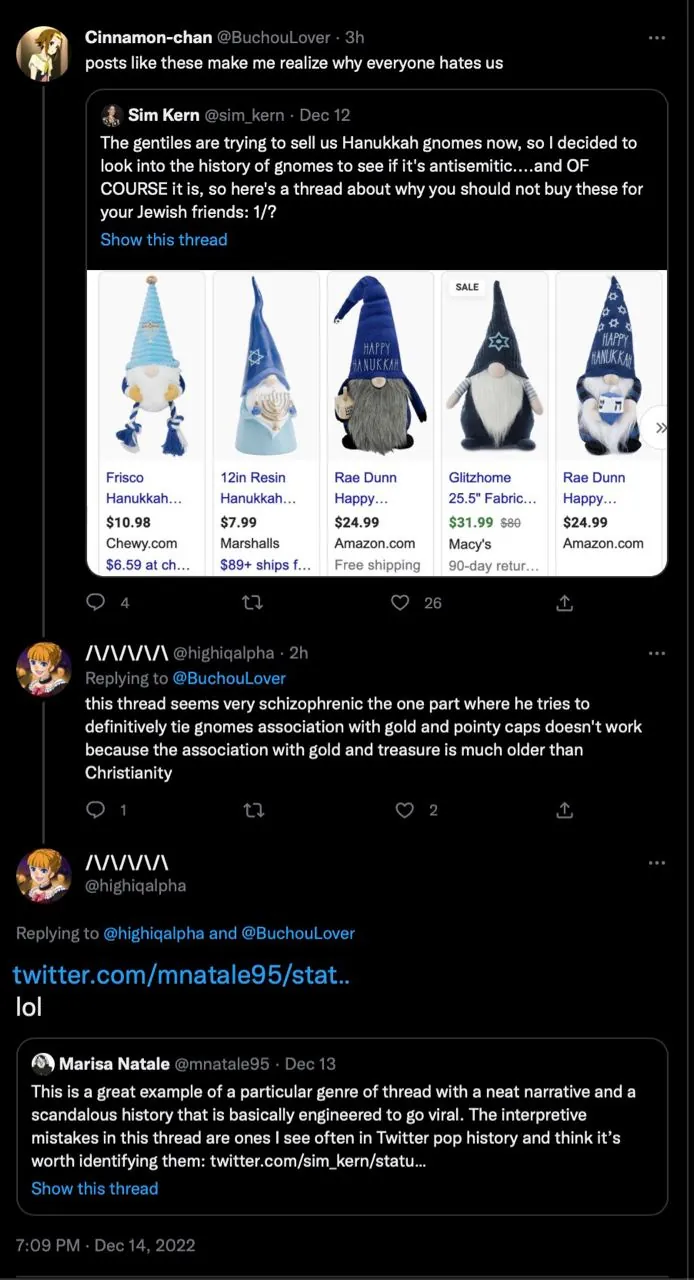
Is it even feasible for a premodern moneylender stereotype to not have connotations of greed? Being stingy about money of other people is an inextricable part of the occupation. And Jews are linked to that overwhelmingly due to their undeniable historical overrepresentation in moneylending in Europe (for reasons beyond the scope of this comment, but I'd say at least it wasn't about petty greed). If you are going to depict a stereotypical premodern banker, as befits the archaic Wizarding world (Eliezer in HPMOR justly mocked their financial system for its easy exploitability, by the way), people of European extraction will associate that image with a Jew; but that cannot be taken as an intentional depiction of a specifically Jewish stereotype. I suspect non-Westernized South East Asians would see a Han Chinese in the same portrayal, unless they try to see it through Western eyes. The point about physical appearance makes a little bit of sense but, really, Jews don't have monopoly on noses, and I think the association of long noses and untrustworthiness exists independently of ethnic stereotypes; it's a staple of physiognomy, even if woke Jewesses neurotically try to read Anti-Semitism into it (that vile now-deleted gnome thread is another case in point).
Truly, the day when we have to portray moneylenders as a whole as generous folk just to not offend groups which have historically been overrepresented in this line of work (and still are, just less so) will be a dark one. Reminds me of the war on the word «thug» which is ostensibly black-coded. (And it's counterproductive, too: all you'll achieve is switching gears on the euphemism threadmill, sending it to overdrive, so that an innocuous term like «urban youth» becomes a tongue-in-cheek reference to thugs.)
But on the other hand. The bigger issue here, the one that leads to such false alarms, is that Rowling's world, like all classical fantasy/sci-fi worlds and especially ones informed by British mythology, is biodeterminist. It's not just exaggeration of class differences; Rowling herself may be staunchly liberal but her intuitions are... quaint, and her commitment to not recognizing trans women as women is of the same intuitive root. Humans are treated as interchangeable M&Ms in settings like Harry Potter's one because the traditional, intuitively neat and narratively fertile descent-based stereotypization is safely displaced into sapient non-humans. These «races» don't just look different, they have obviously different philosophies, psychological and moral tendencies, talents; there is variation and overlap, but it's not obvious if culture can do much to bring them closer. Hermione's project of house elf liberation flops, and it is clear that Rowling considers it misguided and puts some effort into ridiculing it. Some house elves are just abused; the rest are quite content with their unequal symbiotic relationship to wizards, and while this can be framed as Marxist false consciousness, Hermione's belief in it comes across as unfounded condescension. The moral lesson here brings Moldbug's more inflammatory takes about «peoples better fit to serve» to mind. Centaurs, except very few, are inscrutable aliens and disdain human lifestyle. Mermaids are even more alien and unsettling. Giants and goblins are plain nasty, and have sound reasons to believe they're better off aligning with what human wizards consider evil. An American or a Japanese author would have brushed it off with a blithe foodie assumption of national superiority – once Aliens/Devils/Orcs/Elves taste our Burger/«Hambagu», they'll see the light and set their worthless peculiarities aside. A British author is less sanguine. (Maybe with better cuisine or less self-awareness...)
Race relations in the Wizarding world are at once simple and hard. They are simple because they naturally reward tolerating the status quo and live-and-let-live secessionist attitude that in reality is reserved to indigenous peoples. But once you aspire to build any kind of a productive modern multicultural society, they create a hairy diplomatic problem that cannot be solved with a bit of Civil Rights, redistribution from haves to have-nots, taking the knee and pro-equity sloganeering. Magic «races» are not at all mere social constructs or identities, and their discordant preferences are inextricable from their descent! Does Rowling herself realize implications of such a society? I am not sure. But as @erwgv3g34 and @covfefeAnon remind us, The Woke Are More Correct Than The Mainstream. They can notice where it's coming from; they do not accept «it's in Minecraft bro» as an excuse; they are rationally attacking a philosophical underpinning that discredits their politics. Once they got Rowling tagged as an outgroup due to her TERF (frankly just TEF) beliefs, the scales of infantile infatuation have fallen off their eyes, and they're scrutinizing her work for other signs and mental patterns of heresy, And by God do they smell it.
 DaseindustriesLtd
late version of a small language model
3yr ago
I think that conflating politeness and manipulativeness is not reasonable. Also, are the UK and Japan distinguished from demographically comparable countries by greater dishonesty? I'd say they have excelled by being somewhat more capable of engaging object-level truth, while many others have fallen into forms of mysticism, self-delusion, indulgence, corruption and goodharting.
There is a subtle mechanism here: these societies have regimented culture, rigid protocols for polite interaction, yes, and for preventing and deescalating conflicts, but that allows to break the bad news without relying on extreme overpowering stimuli. Kind of what we have here.
(Alternatively, those are just societies with many survivors of a true aristocratic class).
But that's not necessarily the global optimum. The closest thing to a nation of truth-telling assholes that we have is probably Israel. And New York. Both are even denser than the UK and Japan, and even more successful.
Bonus: https://twitter.com/Ghostof_Atticus/status/1591559230695538688
DaseindustriesLtd
late version of a small language model
3yr ago
Sorry, that's some horrible post-PUA logic bordering on delusion. I don't want to get «shit-tested» by a very specific and thinly veiled threat of character assassination, better take it at face value and try my luck elsewhere. In general, the idea that rejection is always insincere and/or that the girl actually wants you to be more assertive (and high assertiveness suffices to make you attractive) when she's saying you aren't wanted is as close to the default feminist accusation of rape culture as can be.
In the original meaning, «shit test» referred to trivial coyness or obstinacy when you already have some basic rapport (admittedly, men get deluded on this account too, but less), or to stirring trouble in a relationship, not to «you're making me scared, please go away or I'll call for help» kind of posture. Is such a posture shitty behavior, and cruel response to a normal friendly expression of interest? Totally. Shit test? Assume at your own peril.
DaseindustriesLtd
late version of a small language model
3yr ago
Good point, except it's probably not feminism but a natural effect of male status differentiation in the presence of women and their observable reactions (yes, "hello, human resources?!" meme), recreating low-class school social dynamics.
I think this is a major source of differences in attitude – in this thread and elsewhere – toward mixed workspaces and generally the idea of adding women to environments where they were historically absent. People who believe that it's an unalloyed good since you can meet your soulmate or something are, probably, just not ugly; for less lucky ones (and who are also not exceptional in some way), flirting in the workspace is a non-starter, so they just lose the possibility to make a living without humiliation. When one looks up blackpill content on the distribution of attractiveness and growing proportion of sexless men, and non-infrequent incel-type assessments like this one on Quora –
Women are not only disgusted by ugly looking men they have have a major fear and hatred towards them due to the “devil effect”. This often leads them to believe an ugly male is more likely to have malicious intentions and will even harm them when it’s proven to not be true. It is always a reflection of self worth and insecurities.
Ugly men showing them attention of any sort, even if not sexual is considered an attack on their worth and they often leash out or give looks of immense disgust as a defence mechanism to dissuade any current and future attempts. If you’ve noticed that you’re getting frequent looks of disgust and you’re hygiene is great (which it should be if you’re a fully functional adult), chances are you are an ugly male.
A few rules to follow in most scenarios especially if you’re encountering this at work, pay absolutely no attention to them in any form whatsoever unless necessary, keep it professional and don’t abandon basic social routines. Read the news, play on your phone, read a book on the bus stop. Avoid sharing stairs or lifts and small enclosed spaces without a cctv camera if you’re alone and sharing a space with a woman, alone or in a group.
– it's hard not to come away with the feeling «holy shit, tens of millions of guys are forced into a lifetime of being severely bullied». It's the kind of thing non-targets aren't prone to notice or connect to external factors (did you care that they were suicidal losers in your school?) so it may be arbitrarily intense. Even if it's an exaggeration based on insecurity and not an accurate stereotype, the very fact that there exists strong social pressure to dismiss it as a delusion is telling. There's no «lived experience» clause for ugly men.
And contrariwise, it may be the case that the incessant wringing of hands about sexism and harassment, and demand for National Incel Strategy, generalized tyranny, censorship, surveillance etc are products of many women being unable to remove uggos from their life, developing chronic stress and fear, and growing desperately violent as a result (in their own passive-aggressive socially manipulative manner).
We may underestimate how much gendered animosity the society contains at the margins; and the consensus about its direction is very likely wrong.
Shoot yourself or stab yourself or poison yourself and see if you can "consciously choose the alternate reality" where blowing your brains out was only a dream. It won't work, and if it does, come back and tell us and I'll then believe in quantum immortality.
You know, this snarky and borderline rules-breaking response makes me think that, back when Scott uncritically reposted the 4chan story about 90 IQ people not understanding conditional hypotheticals and was told that actually there's no way such failures happen at 90 IQ, that was dead wrong. Actually he should've been told that fairly smart people can't into conditional hypotheticals either. If their worldview depends on it, that is; cue Upton Sinclair. You miss the point in so many dimensions at once, and so smugly at that, it's pretty frustrating.
Hello! My story is precisely about such a scenario. I have accidentally or deliberately fucked myself up in dreams countless times – and probably an OOM more in forgotten ones. "Coming back" and telling is what I am doing. That it is not persuasive because the ontological status of the event is inherently low is the fucking point – if it happened «for real», I'd have been in no condition to reply.
What I'm describing is not a «quantum immortality theory» but a much less speculative, let's call it, «probabilistic-phenomenological immortality theory» that does not depend at all on there existing, in some sense other than metaphorical, bona fide alternative worlds, universes, timelines, any weird physics: it's explicitly about alternative mundane explanations for subjective experiences founded on the premise of human fallibility, especially with regard to ontological status of events. If I commit to killing myself and succeed, the most robust way for me to have subjective awareness after that (assuming materialism), and report on it, is if it turns out I have not even tried and have simply dreamed of doing it, or got otherwise confused about what's going on. This is, in fact, what happens, because while awake, I'm not really suicidal, prone to get baited into killing myself by an online troll, or interested in risky metaphysically motivated experiments.
This is relevant to @Hyperion's and @Glassnoser's arguments because it suggests the solution in the strongest case. Namely: given an observer's a) subjective observation that he's heading to certain death only a miracle could prevent and b) the assumption that he will not in fact die and cease observing, it is more plausible that he's wrong about his situation than that physics-breaking miracles (even evil ones, like a biologically implausible neverending agony) will happen and undo the death. Given that old people die, that he strongly believes «comfortable immortality is far away and out of reach for me», and conditional on him staying alive – between «eternal Tithonus torture because quantum timelines something something» and «nah man, it turns out technological immortality wasn't that hard» the latter is overwhelmingly more probable. People fail at reasoning infinitely more often than laws of physics fail to apply.
Really, the lengths to which people go in thought experiments are baffling, when those same people scoff at religious believers who believe in souls and afterlifes
Right. The cool part is, this logic works the same way for afterlife and any religious miracle as for the sci-fi version of quantum immortality. You're shooting yourself in the foot here and I'm not sure it's possible for me to make that clear. I'm equally unsure if you are reflexively condescending without fully understanding the implications of this logic, or if you see them – and defend your views in such an indirect way.
I already have information about the world I'm in. It's a world where comfortable immortality is far away and out of reach for me. Your argument is backwards, most of the probability mass with conscious humans will be in those world's where immortality is nice and easy, but I know which world I live in now. I am embodied in time right now.
Consider that you aren't 100% sure of being a reliable narrator, and that the uncertainty, however minuscule, is greater than odds of spontaneous physical miracles – as per @sodiummuffin's logic. Conditional on you invariably ending up alive, you will... not have had experienced lethal harms that cannot be survived without magic; and if it very convincingly looks to you as if you had experienced them, well, maybe that was just some error? A nightmare, a psychedelic trip, a post-singularity VR session with memory editing...
I woke up today from a realistic dream where I got crippled and blinded by a battery pack explosion. In its (and, in a sense, my own) final moments, I consciously chose the alternate reality relative to which that world was a dream, focused my awareness, and realized that this has happened many times before – in other worlds I had escaped by simply waking up into this one. (This reminded me: I've never read Carlos Castaneda but he probably wrote about this stuff? Sent me on a binge. Yeah, that's one of his topics, mages jumping between apparent universes that should be ontologically unequal).
Dreams aside, I feel like the idea of quantum immortality is unfortunately all tangled up with the idea of observer effect. As per QI, you aren't immortal across the board – you die, and soon, in the vast majority of timelines observed by any other consciousness, just like all humans who have died before our time. You are, right now, in a timeline you observe (though as noted above, only probably) – and presumably you aren't yet dying any more than any other person who's exposed to normal risks and aging. The idea is that you do indeed die in those scenarios where you eat an explosion, develop malignant tumors, are lying in a dump bleeding out all alone with no chance of survival, or are 80 years old in 1839; but those are counterfactuals, not real timelines, and the you who doesn't die, the person typing those comments, doesn't get into them. If it looks to you as if you did, and QI is right – you being wrong is more likely than a miracle.
Worth noting that there isn't a contradiction here. It's actually a 1988 movie, thus deep into Perestroika, based on a 1925 book (I recommend it, Bulgakov is good in general, though M&M is overhyped by our equivalent of «art hoes»).
More options
Context Copy link