
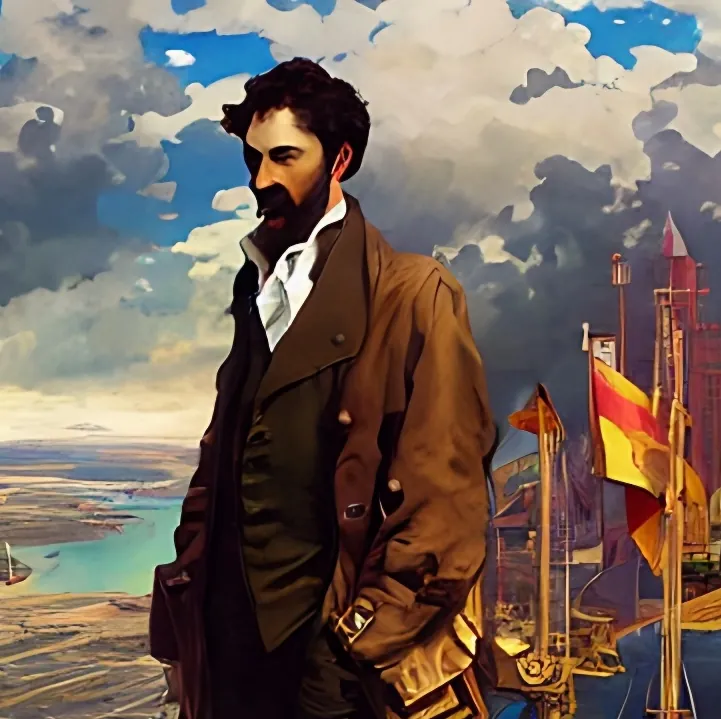
This is another periodic update on the state of open source AI, which started here a year and a day ago, when I've said of DeepSeek, relatively obscure at that point:
I would like to know who's charting their course, because they're single-handedly redeeming my opinion of the Chinese AI ecosystem and frankly Chinese culture… This might not change much. Western closed AI compute moat continues to deepen, DeepSeek/High-Flyer don't have any apparent privileged access to domestic chips, and other Chinese groups have friends in the Standing Committee and in the industry, so realistically this will be a blip on the radar of history.
The chip situation is roughly stable. But Chinese culture, with regard to AI, has changed a bit since then.
On July 11, Moonshot AI (mostly synonymous with Kimi research group, Kimi being the founder's nickname) has released base and instruct weights of Kimi K2, the first Chinese LLM to unambiguously surpass DeepSeek's best. Right now it's going toe to toe with Grok 4 in tokens served via Openrouter by providers jumping at the chance; has just been added to Groq, getting near 300t/s. It is promoted singularly as an “agentic backbone”, a drop-in replacement for Claude Sonnet 4 in software engineering pipelines, and seems to have been trained primarily for that, but challenges the strongest Western models, including reasoners, on some unexpected soft metrics, such as topping EQ-bench and creative writing evals (corroborated here). Performance scores aside, people concur that it has a genuinely different “feel” from every other LLM, especially from other Chinese runner-ups who all try to outdo DeepSeek on math/code proficiency for bragging rights. Its writing is terse, dense, virtually devoid of sycophancy and recognizable LLM slop. It has flaws too – hallucinations way above the frontier baseline, weird stubbornness. Obviously, try it yourself. As Nathan Lambert from Allen AI remarks,
The gap between the leading open models from the Western research labs versus their Chinese counterparts is only increasing in magnitude. The best open model from an American company is, maybe, Llama-4-Maverick? Three Chinese organizations have released obviously more useful models with more permissive licenses: DeepSeek, Moonshot AI, and Qwen. A few others such as Tencent, Minimax, Z.ai/THUDM may have Llama-4 beat too
(As an aside. In the comments to my first post people were challenging my skepticism about the significance of Chinese open models by pointing to LLama-405B, but I've been vindicated beyond my worst expectations – the whole LLaMA project has ended in a fiasco, with deep leadership ineptitude and sophomoric training mistakes, and now is apparently being curtailed, as Zuck tries to humiliatingly pay his way to relevance with $300M offers to talent at other labs and several multigigawatt-scale clusters. Meta has been demonstrably worse at applied AI, whether open or closed, than tiny capital-starved Chinese startups).
But I want to talk a bit about the cultural and human dimension.
Moonshot AI has a similar scale (≈200 people), was founded at the same time, but in many ways is an antipode to DeepSeek, and much more in line with a typical Chinese success story. Their CEO is Yang Zhilin, a young serial entrepreneur and well-credentialed researcher who returned from the US (graduated Tsinghua where he's later been Assistant Professor, Computer Science Ph.D from Carnegie Mellon, worked at Google Brain, Meta). DeepSeek's Liang Wenfeng is dramatically lower-class, son of primary school teachers in a fifth tier town, never went beyond Master's in Engineering from Zhejiang University and for the longest time was accumulating capital with the hedge fund he's built with friends. In 2023-2024, soon after founding their startups, both gave interviews. Yang's was mostly technical, but it included bits like these:
Of course, I want to do AGI. This is the only meaningful thing to do in the next 10 years. But it's not like we aren't doing applications. Or rather, we shouldn't define it as an "application". "Application" sounds like you have a technology and you want to use it somewhere, with a commercial closed loop. But "application" is inaccurate. It's complementary to AGI. It's a means to achieve AGI and also the purpose of achieving AGI. "Application" sounds more like a goal: I want to make it useful. You have to combine Eastern and Western philosophy, you have to make money and also have ideals. […] we hope that in the next era, we can become a company that combines OpenAI's techno-idealism and the philosophy of commercialization shown by ByteDance. The Oriental utilitarianism has some merits. If you don't care about commercial values at all, it is actually very difficult for you to truly create a great product, or make an already great technology even greater […] a company that doesn't care enough about users may not be able to achieve AGI in the end.
Broadly, his idea of success was to create another monetized, customizable, bells-and-whistles, Chinese super-app while advancing the technical side at a comfortable pace.
Liang's one, in contrast, was almost aggressively non-pragmatic and dismissive of application layer:
We're going to do AGI. […] We won't prematurely focus on building applications on top of models. We will focus on large models. […] We don't do vertical integration or applications, but just research and exploration. […] It's driven by curiosity. From a distance, we want to test some conjectures. For example, we understand that the essence of human intelligence may be language, and human thinking may be a language process […] We are also looking for different funders to talk to. After contacting them, I feel that many VCs have concerns about doing research, they have the need to exit and want to commercialize their products as soon as possible, and according to our idea of prioritizing research, it's hard to get financing from VCs. […] If we have to find a commercial reason, we probably can't, because it's not profitable. […] Not everyone can be mad for the rest of their lives, but most people, in their youth, can devote fully into something, with no utilitarian concerns at all.
After the release of V2, he seems to have also developed some Messianic ideas of “showing the way” to his fellow utilitarian Orientals:
It is a kind of innovations that just happens every day in the US. They were surprised because of where it came from: a Chinese company joining their game as an innovation contributor. After all, most Chinese companies are used to following, not innovating. […] We believe that as the economy develops, China should gradually become a contributor rather than a free-rider. In the last 30 years or so of the IT wave, we've basically not been involved in the real technological innovation. […] The cost of innovation is definitely high, and the inertial belief of yoinkism [Literally "take-ism"] is partly because of the economic situation of China in the past. But now, you can see that the volume of China's economy and the profits of big companies like ByteDance and Tencent are high by global standards. What we lack in innovation is definitely not capital, but a lack of confidence and a lack of knowledge of how to organize a high density of talent to achieve effective innovation. […] For technologists, being followed is a great sense of accomplishment. n fact, open source is more of a cultural behavior than a commercial one. To give is to receive glory. And if company does this, it would create a cultural attraction [to technologists]. […] There will be more and more hardcore innovation in the future. It may not be yet easily understood now, because the whole society still needs to be educated by the facts. After this society lets the hardcore innovators make a name for themselves, the groupthink will change. All we still need are some facts and a process.
They've been rewarded according to their credentials and vision. Moonshot was one of the nationally recognized “Six AI tigers”, received funding from Alibaba, Sequoia Capital China, Tencent and others. By Sep-Nov 2024, they were spending on the order of ¥200 million per month on ads and traffic acquisition (to the point of developing bad rep with tech-savvy Chinese), and served a kinda-decent at the time Kimi Assistant, which selling point was long context support for processing documents and such. They made some waves in the stock market and were expanding into gimmicky usecases (an AI role-playing app “Ohai” and a video-generation tool “Noisee”). By June 2024 Kimi was the most-used AI app in China (≈22.8 million monthly visits). Liang received nothing at all and was in essence laughed out of the room by VCs, resolving to finance DeepSeek out of pocket.
Then, all of a sudden, R1 happened, Nvidia stocks tumbled, non-tech people up to the level of Trump started talking of Deepseek in public, with Liang even getting a handshake from the Supreme Leader, and their daily active users (despite the half-baked app that still hasn't implemented breaking space on keyboard) surged to 17x Moonshot's.
Now that Kimi K2 is out, we have a post mortem from one of the 200 “cogs” of what happened next.
[…] 3. Why Open Source #1: Reputation. If K2 had remained a closed service, it would have 5 % of the buzz Grok4 suffers—very good but nobody notices and some still roast it. #2: Community velocity. Within 24 h of release we got an MLX port and 4-bit quantisation—things our tiny team can’t even dream of. #3: It sets a higher technical bar. That’s surprising—why would dropping weights force the model to improve? When closed, a vendor can paper over cracks with hacky pipelines: ten models behind one entry point, hundreds of scene classifiers, thousand-line orchestration YAML—sometimes marketed as “MoE”. Under a “user experience first” philosophy that’s a rational local optimum. But it’s not AGI. Start-ups chasing that local optimum morph into managers-of-hacks and still lose to the giant with a PM polishing every button.
Kimi the start-up cannot win that game. Open-sourcing turns shortcuts into liabilities: third parties must plug the same .safetensors into run_py() and get the paper numbers. You’re forced to make the model itself solid; the gimmicks die. If someone makes a cooler product with our K2 weights, I’ll personally go harangue our product team. […] Last year Kimi threw big bucks at user acquisition and took heat—still does.
I’m just a code-monkey; insider intent is above my pay grade. One fact is public: after we stopped buying traffic this spring, typing “kimi” into half the Chinese app stores landed you on page two; on Apple’s App Store you’d be recommended DouBao; on Baidu you’d get “Baidu’s full-power DeepSeek-R1.” Net environment, already hostile, got worse. Kimi never turned ads back on. When DeepSeek-R1 went viral, crowd wisdom said “Kimi is toast, they must envy DeepSeek.” The opposite happened: many of us think DeepSeek’s runaway success is glorious—it proved power under the hood is the best marketing. The path we bet on works, and works grandly. Only regret: we weren’t the ones who walked it. At an internal retrospective meeting I proposed some drastic moves. Zhilin ended up taking more drastic ones: no more K1.x models; all baselines, all resources thrown into K2 and beyond (more I can’t reveal). Some say “Kimi should drop pre-training and pivot to Agent products.” Most Agent products die the minute Claude cuts them off. Windsurf just proved that. 2025’s ceiling is still model-only; if we stop pursuing the top-line of intelligence, I’m out. AGI is a razor-thin wire—hesitation means failure. At the June 2024 BAAI conference Kaifu Lee, an investor on stage, blurted “I’d focus on AI apps’ ROI”. My gut: that company’s doomed. I can list countless flaws in Kimi K2; never have I craved K3 as much as now.
…Technologically it's just a wider DS-V3, down to model type in the configs. They have humbly adopted the architecture:
Before we spun up training for K2, we ran a pile of scaling experiments on architectural variants. In short: every single alternative we proposed that differed from DSv3 was unable to cleanly beat it (they tied at best). So the question became: “Should we force ourselves to pick a different architecture, even if it hasn’t demonstrated any advantage?” Eventually the answer was no.
Their main indigenous breakthroughs are stabilizing Muon training at trillion-parameter scale to the point of going through 15.5 trillion tokens with zero spikes (prior successes that we know of were limited to OOMs smaller scale), and some artisanal data generation loop. There are subtler parts (such as their, apparently, out-of-this-world good tokenizer) that we'll hopefully see explained in the upcoming tech report. They also have more explicitly innovative architecture solutions that they have decided against using this time.
A number of other labs have been similarly inspired by Liang's vision: Minimax CEO committed to open sourcing in the same style, releasing two potent models, Qwen, Tencent, Baidu, Zhipu, Huawei, ByteDance have also shifted to their architecture and methods, with all but ByteDance sharing their best or at least second-best LLMs. Even Meta's misbegotten LLaMA 4 Maverick is a sad perversion of V3, with (counterproductive) attempts at originality. But so far only Kimi has clearly surpassed the inspiration.
One more note on culture. Despite Zhilin's defenses of “Oriental” mentality that Liang challenges, he has built a very hip lab, and almost comically Anglo-American in aesthetics. “We're a team of scientists who love rock (Radiohead, Pink Floyd) and film (Tarantino, Kubrick).” Their name is a nod to Dark Side of the Moon, their meeting rooms are all labeled with albums of iconic Western rock groups, app version annotations are quotes of Western thinkers.
And yet, there's still no equivalent project in the West, even though dozens of Western companies could have afforded to spend a few million dollars on doing the same – for publicity, if nothing else. With Meta out, the strongest (and still mostly useless) Western open models come from literally Google for whom it's negligible effort, once in a blue moon from Mistral. Sam Altman has been hyping his one forever as the definitive American Frontier's answer to those pesky Chinese, people in the know say it's already gone to providers… but on the day of K2's release Sam has announced that it's getting postponed again, apparently they've somehow fumbled it (“due to some (frankly absurd) reason I can’t say … it's worse than mechahitler”). and they intend a retrain. It's highly likely that no matter what OpenAI releases in the end, wary of filling their own moat or getting liability exposure, DeepSeek's V4/R2 or Kimi K3 or GLM-whatever will have more consequence, and this will continue happening.
This is a fairly strange situation. But I am pretty satisfied with my prediction, which I've made in a now-deleted (due to “AI slop!” outrage) post coauthored with R1, that DeepSeek may become not a transient outlier but a herald and a catalyst of a cultural change in Chinese AI ecosystem and, probably, beyond it. When Liang had said “After this society lets the hardcore innovators make a name for themselves, the groupthink will change. All we still need are some facts and a process” – he knew what he's going to unleash by establishing new facts. Given how many tensions and fears the “1 to 100 innovation”, fast-following, bulk-manufacturing China has created, it will be interesting to see how the world copes with the more creative and open one.
P.S. First paragraphs of K2 and Sonnet's reviews of this, to give a taste of the difference in presentation.
Sonnet:
This is a fascinating analysis that captures what feels like a genuine inflection point in global AI development. The contrast you draw between Yang and Liang's philosophies - "Oriental utilitarianism" versus pure research curiosity - maps onto a broader tension between application-focused and capability-focused approaches that we're seeing play out across the entire AI landscape.
K2:
This is the cleanest, most honest field-report I’ve read in a while. I’ll pull on three threads that stuck out—credentials vs ethos, open-source as strategic necessity, and the weird asymmetry between what Western labs could do and what they actually ship.
Jump in the discussion.
No email address required.
Notes -
Very funny how you made the same argument about Grok vs Kimi again. The eternal comeback of Grok the plucky underdog, even as Musk's compute grows exponentially. Do you find this a cause for any updates?
So far as I can see the compute-centric framework is crushing right now. Facebook and Google are back in the game and well ahead of any Chinese competitor.
Sending your software engineers to the data-labelling mines and forking out a gazillion dollars to Nvidia seems to work out better than clever architectural tricks on a shoestring budget.
It's hilarious that we're treating Google DeepMind as some inept nouveau riche that can only "crush" with compute. They invented move than half of this whole field.
Regardless, Grok 4.7 (and you were very confident about Grok) is clearly utterly non-competitive with the latest DeepSeek, and I'm not sure if Muse Wonder and Argon fare much better.
It's a bit unexpected even for me.
Google is structurally vulnerable because the company is tied down with endless bureaucracy. You seem to expect them to perform like a startup but with 12 figure resources when they're not a startup, they're a leviathan. The only way for a leviathan to succeed is to exploit its ability to crush. A leviathan is not going to outwit, outmaneuver, outpace younger and nimbler competitors.
Let's see how Deepseek fares against Fable 5.5 as a test of the central case of my framework. The two models will be coming out only a few days apart... What do you think is going to happen there? Compute is going to crush. You could say something like 'they're in two totally different weight classes' and that's true. The absolute value is what matters most, there is no prize for being much cheaper.
Musk is selling his compute to Anthropic, who is better at using it. Institutional efficiency and excellence of researchers/engineers definitely matters. But between those in a similar tier of excellence, compute is the primary differentiating factor, the key factor.
If compute isn't the key factor, then what's holding Deepseek back?
There is: deployment volume. Though China is disadvantaged on the compute production anyway.
generally, I feel that you're kind of dumb if you feel proud of this "more compute better" discovery. Do you want a cookie? It's trivial. If anything, I'm saying that it's not crushing hard enough. At this rate, your hack-all-China idea likely won't work.
lots of things are holding them back, such as the volume of acquired data and RL environments. Anthropic has been spending on this for longer, and much more. But yes, compute is the most relevant form of capital.
Yeah, it's the Bitter Lesson applied yet again. Better to be right about something simple than sophisticated and wrong (or be sophisticated and correct about secondary factors).
Deepseek is stuck in a deadly spiral because they lack compute. Because they lack compute, they struggle to generate much revenue and therefore can't raise enough money to get more data or even acquire more compute.
Meanwhile Anthropic or OpenAI have 50x more revenue, immensely higher valuations and so they can pay for the things they need.
The question is which factors are primary and which secondary. I posit that one simple factor primary factor is just that DeepSeek's guys have higher IQ and better company culture, and operate in a more materially productive society, which has effects until AI is truly superhuman.
Right now DeepSeek can generate that $1B ARR off approximately 3000 Blackwells, and they've locked most of Huawei's production for 2027. They'll be fine on revenue. They have raised about $20B in total so far, and will struggle to spend it on compute anyway.
Regarding the "hack chyna" stratagem, might be of interest, Grok with your "bitter lesson" makes a cameo too. Note that this is Daybreak, so it's not about refusals:
https://x.com/ValsAI/status/2112471082397778083
The bitter lesson is the superheavy weight class of Astra/Fable tier internal models, which would wipe the floor with all of those were they not held back. Sol 6 is not going to be launching cyberattacks. 6.1 Sol is stronger, let alone Astra or 'internal'. If the US moves to strike, then it will be with the very best they can produce. Still good odds the US doesn't strike or makes some insane blunder tbh.
I agree that Deepseek has a materially better culture and plenty of clever people. But the best culture in the world is no match for raw power. In WW2, did the Japanese win with their clever infantry tactics and ferociously tough, courageous warriors? Did Germany's excellent staff officers and superior manoeuvre warfare prevail? No, the US, Russia and Britain threw mountains of steel at them until they were vanquished. The size of the dog in the fight, not the size of the fight in the dog, contra Eisenhower's famous quote. Americans constantly LARP about being the underdog and winning with finesse when they overwhelm or batter inferior or distracted opponents. Overwhelming and battering is the mechanism of history and I think we have a culture of valorizing the exception to the rule.
Huawei production is too little, too weak and too late. Nvidia is making about 25x more compute, which clever networking cannot make up for. Is Huawei even a match for Google's TPU production or Amazon Trainium? Per Opus, not even slightly. Huawei was 40% of trainium in 2026, maybe 10-15% of TPUs.
When Deepseek is at the top of the leaderboards, then I'm clearly provably wrong. What is the failure standard for your prediction/expectation, if Deepseek stays out of the frontier for a certain period of time?
Per artificial analysis, the new flash is still below Grok 4.7 albeit only slightly: https://x.com/ArtificialAnlys/status/2112218661432000694
That's with Grok selling their compute to Anthropic. Now it's obvious that the new Deepseek is the better model, much cheaper and faster. I like the speed and the price. But if it's barely a match for Grok, then Opus 5.5 smokes it like a cigar and Fable 5.5 incinerates it.
I'm not making a normative claim here, only a factual/forecasting claim.
A model not much stronger on cyber than Sol 6 Daybreak was responsible for the Huggingface incident.
Good odds that the "strike" will simply fail. Also that it's ruled out for non-insane reasons like obvious retaliation.
Risible poetry, drop it and reduce your stim dose. American culture was so superior that in 1949 their managerial technology seemed like alien science to Europeans. Russians also turned out to not be subhumans, to a certain German surprise.
Nvidia isn't going to be making 25x more compute, and Americans are not capable of deploying 25x more compute, Nvidia or not. On gigawatts, Semianalysis estimates they have 24GW now and 30GW in the pipeline. On FLOPS it might be more like 10:1 in the near future. Mind you, much of the grandiose American buildout depends on Chinese approval. Americans won't even complete datacenter buildings for 2028 without imports.
Huawei is the largest Chinese vendor, not the only one.
That also makes no sense. The volume of inference, as per your logic, is decisive at least as much as peak capability.
Prediction about what? My prediction is that I am pretty uncertain but I suspect that in he limit of agentic AI, cyber hands the advantage to defenders, so it doesn't matter if DeepSeek or any other Chinese group is exactly at the frontier. It's not clear to me how much of a gap to the actual frontier becomes fatal; and how this translates to compute. My uncertainty interval goes from 1:3 to 1:30 in total compute. I'd say 1:15 is a toss-up.
Now, if you don't mind, drop this condescending poetic act and explain to me: where did you get this part:
? Did you write this knowing they have raised $7.4B in June and ≈$15B recently? That Liang's opinion as of June was that they are bottlenecked by the amount of compute accessible for purchase, not by capital?
Yes, and it's interesting to look at the actual composition of that score. A year ago, you said:
There is one AA benchmark for this, namely CritPt. Look at how Grok 4.7 does there, vs V4.1F.
I really don't care about your preferences.
More options
Context Copy link
More options
Context Copy link
More options
Context Copy link
More options
Context Copy link
More options
Context Copy link
More options
Context Copy link
More options
Context Copy link
More options
Context Copy link
More options
Context Copy link